Astronomer Squyres becomes NASA aquanaut
October 21, 2011 By Susan Lang

Astronomer Squyres becomes NASA aquanaut

Enlarge

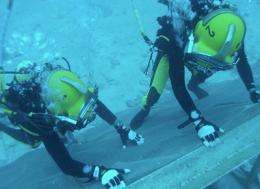
Getting used to the Asteroid Simulation Wall are Cornell's Steve Squyres, left, and Takuya Onishi (JAXA). Here, they are making to the top of the wall.

Cornell professor of astronomy Steven Squyres, the lead scientist for NASA's Rover mission to Mars, has just taken the plunge as a NASA aquanaut.

Cornell's Goldwin Smith Professor of Astronomy is one of six aquanauts who splashed down Oct. 20 for a 13-day undersea training mission off Key Largo as part of the 15th mission of the NASA Mission Operations (NEEMO) program. They will perform "spacewalks" and other exercises to simulate an asteroid mission.

Squyres, the scientific principal investigator for the mission, and the other crew members are living in the Aquarius Undersea Laboratory Base to test techniques, operational methods, tools and communications protocols recently developed for of near-Earth asteroids (NEAs).

The 400-square-foot lab, about the size of a school bus, sits on the ocean floor at a depth of about 62 feet. The crew includes Squyres, who has some research diving experience from an expedition to Antarctica in the 1980s, four NASA crew members and two staff members of the National Undersea Research Center.

"We'll be simulating the process of doing basic field geology tasks on the surface of an asteroid, like deploying instruments and collecting samples," Squyres told the New Scientist. "We will be trying lots of ways to do it, using ropes and small one-person subs to move crew members around."

NASA has a 2025 mission planned to an asteroid that is about two-thirds of a mile in size. Squyres said that the mission will basically be in a .

"Nobody knows how to do field geology in microgravity -- the best way to simulate it is underwater," he said. Considering that he is 55 years of age, 10 years older than the next oldest NEEMO crewmember, he said he didn't think he'd be involved in the 2025 mission: "I think this is going to be the closest to an asteroid I'm ever going to get," he told New Scientist. "I'll be watching the asteroid mission on TV from my rocking chair."

The NEEMO science team will map and explore the coral reef around Aquarius, using operational techniques and protocols that will have a direct bearing on future human space exploration missions.

"We're using the bottom of the ocean which is a great way to simulate the conditions we would encounter at an asteroid," Squyres told keynews.com. "We will use a small sub to simulate a small space module. We will experiment with thruster packs as well."

On Oct. 26 Squyres plans to give a lecture via Skype from the habitat about exploration and NEEMO for the course, The History of Exploration: Land, Sea and Space, that he is co-teaching at Cornell with Mary Beth Norton, the Mary Donlon Professor of American History.

Provided by Cornell University search and more info website


Rank 5 /5 (2 votes)
Relevant PhysicsForums posts
  • Distance of planets from stars and revolution
    created4 hours ago
  • revamping general concept and cosmological principle
    createdMay 25, 2012
  • Transiting Exoplanet Light Curve
    createdMay 25, 2012
  • Math behind Theoretical Physics
    createdMay 24, 2012
  • Do we know whats at the center of galaxies yet?
    createdMay 23, 2012
  • Structure of the Milky Way?
    createdMay 20, 2012
  • More from Physics Forums - General Astronomy

More news stories

Land and sea species differ in climate change response: study

(Phys.org) -- Marine and terrestrial species will likely differ in their responses to climate warming, new research by Simon Fraser University and Australia’s University of Tasmania has found.

Space & Earth / Environment

created 2 hours ago | popularity not rated yet | comments 1 | with audio podcast

Yale study concludes public apathy over climate change unrelated to science literacy

Are members of the public divided about climate change because they don't understand the science behind it? If Americans knew more basic science and were more proficient in technical reasoning, would public consensus match ...

Space & Earth / Environment

created 4 hours ago | popularity 4 / 5 (1) | comments 10 | with audio podcast

10 million years needed to recover from mass extinction

It took some 10 million years for Earth to recover from the greatest mass extinction of all time, latest research has revealed.

Space & Earth / Earth Sciences

created 4 hours ago | popularity not rated yet | comments 1 | with audio podcast

Sophisticated simulations predict future warming

The chances of our planet being hit by a global warming of 3 degrees Celsius by 2050 is as likely as it being hit by an increase of 1.4 degrees, new research shows. Presented in the journal Nature Geoscience, the British study ...

Space & Earth / Earth Sciences

created May 22, 2012 | popularity 4.4 / 5 (9) | comments 51

Aliens don't want to eat us, says former SETI director

Alien life probably isn’t interested in having us for dinner, enslaving us or laying eggs in our bellies, according to a recent statement by former SETI director Jill Tarter.

Space & Earth / Space Exploration

created May 25, 2012 | popularity 4.4 / 5 (14) | comments 40


'Unzipped' carbon nanotubes could help energize fuel cells, batteries

Multi-walled carbon nanotubes riddled with defects and impurities on the outside could replace some of the expensive platinum catalysts used in fuel cells and metal-air batteries, according to scientists at ...

T cells 'hunt' parasites like animal predators seek prey, study shows

By pairing an intimate knowledge of immune-system function with a deep understanding of statistical physics, a cross-disciplinary team at the University of Pennsylvania has arrived at a surprising finding: T cells use a movement ...

Computer model used to pinpoint prime materials for efficient carbon capture

When power plants begin capturing their carbon emissions to reduce greenhouse gases – and to most in the electric power industry, it's a question of when, not if – it will be an expensive undertaking.

Change in developmental timing was crucial in the evolutionary shift from dinosaurs to birds: study

At first glance, it's hard to see how a common house sparrow and a Tyrannosaurus Rex might have anything in common. After all, one is a bird that weighs less than an ounce, and the other is a dinosaur that ...

Nvidia trumpets Tegra 3 phone design wins for 2012

(Phys.org) -- Nvidia’s competitive war paint has a name, Tegra 3. On the heels of Nvidia announcements about lowering costs of its Tegra 3 processors and Nvidia-enabled tablets running Android Ice Cream ...

Scientist: Evolution debate will soon be history

(AP) -- Richard Leakey predicts skepticism over evolution will soon be history. Not that the avowed atheist has any doubts himself.