Asia's biggest tech fair opens in Japan
Oct 04, 2011 by Miwa Suzuki
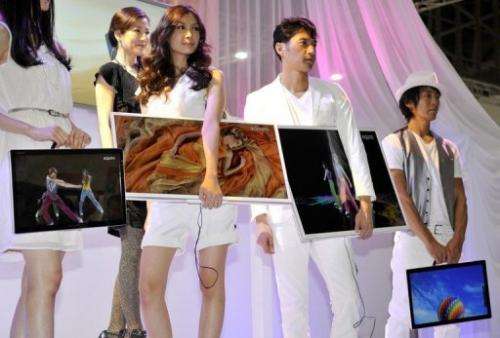
Models display Japanese electronics company Sharp's new LCD television called Aquos, which has a separated wireless tuner unit, at Asia's largest electronics trade show CEATEC (Cutting-Edge IT & Electronics Comprehensive Exhibition) in Chiba City, suburban Tokyo, on October 4.

Smartphones detecting bad breath and radiation, twistable remote controls and a super-thin tablet computer were just some of the gadgets on show at Asia's biggest tech fair in Japan Tuesday.

Around 600 firms unveiled their innovations at the Combined Exhibition of Advanced Technologies (Ceatec) exhibition in Chiba, near Tokyo, expected to draw 200,000 visitors during its five-day run, organisers said.

The impact of Japan's March 11 earthquake, tsunami and nuclear disaster gave added resonance to technologies on display, particularly those aimed at improving urban infrastructure and energy efficiency.

State-of-the-art radiation counters and power-saving technologies are in high demand after Japan's disasters sparked fears over contamination and led to power shortages, requiring cuts to energy consumption this summer.

Japanese telecom giant NTT DoCoMo showed off a smartphone with changeable sensor-embedded shells that can detect bad breath, vital body signs and even be used to measure background radiation levels.

DoCoMo also demonstrated how population data can be obtained from mobile phone base stations, allowing urban planners or disaster relief agencies to map population movements or help identify people in specific areas.
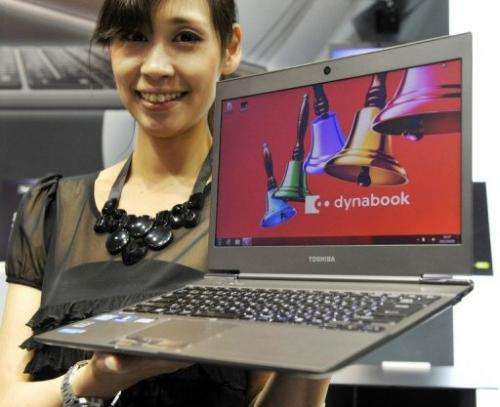
A model displays Japanese electronics company Toshiba's ultra slim notebook PC called the "Dynabook R631," equipped with an Intel's i5 processor and a 13.3-inch LCD display and 15.9mm thick body, weighing 1.12kg, during a preview at Asia's largest electronics trade show CEATEC (Cutting-Edge IT & Electronics Comprehensive Exhibition) in Chiba City, suburban Tokyo, on October 3.

Japan's Nissan showed off its Vehicle to Home system that enables energy stored in an electric vehicle's batteries to be used in houses.

Electronics parts maker Murata Manufacturing unveiled devices using a newly developed transparent organic film that can deliver instructions via twisting motions or pressure.

One of its gadgets, a light-powered plate called the Leaf Grip Remote Controller, has no buttons but is instead operated by the user bending and twisting it.

Another application of the film is as a touch panel which responds to left-right and up-down finger swipes but also senses how strongly it is being pressed, unlike conventional touchscreen glass used on smartphones.

"Currently we give commands two-dimensionally on touch panels in smartphones and tablet computers but this invention would give us another dimension -- how hard they are pressed," Murata spokesman Kazuhisa Mashita said.

"This could enable users to scroll screens slowly by touching the screen lightly and move images faster by pressing it harder," he told AFP ahead of the exhibition.
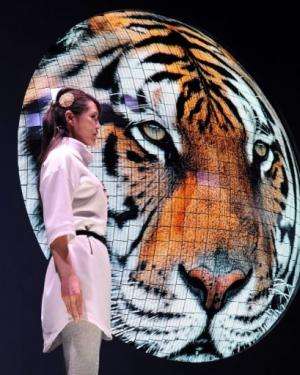
A model displays Mitsubishi Electric's hemisphere Organic Light Emitting Diode (OLED) display, at Asia's largest electronics trade show CEATEC (Cutting-Edge IT & Electronics Comprehensive Exhibition) in Chiba City, suburban Tokyo, on October 4. Some 600 firms unveiled their innovations at the exhibition, which is expected to draw 200,000 visitors during its five-day run.

Consumer electronics were also on show, with firms unveiling advanced gadgets ahead of the year-end shopping season at a time when the global economy is showing signs of a slowdown as the debt crisis in Europe continues.

Sony's new lineup included binoculars capable of high-quality digital recording in 2D and 3D -- particularly useful for animal watchers, storm chasers and sports fans.

Toshiba showcased what it calls "the world's thinnest and lightest" tablet computer, equipped with a 10.1-inch display that is just 7.7 millimetres (0.3 inches) thick and weighs 558 grams (19.5 ounces).

It also gave a Japan debut to its glasses-free Regza 55X3 3D television.

Meanwhile car accessories firm Pioneer displayed an in-car navigation system that projects data directly on to the windscreen instead of relying on a dashboard display.

Microchip maker Rohm showcased what it hails as the world's tiniest resistors -- so small that 500,000 of them can be used in an hourglass instead of sand.

The Japanese firm also revealed efforts to diversify into the healthcare business, with "Technojewel" accessories such as earrings that can take the wearer's pulse.

Explore further: Inventor creates Card Beams with 3D printer

add to favorites email to friend print save as pdf

Related Stories

Japanese Researchers Develop Portable 3D Display System

Sep 29, 2006

NTT DoCoMo, Inc. announced today that it has co-developed a portable, seven-inch 3D display system with Associate Professor Yasuhiro Takagi of Tokyo University of Agriculture and Technology. Both still images and video can ...

Fujitsu unveils 'world's first' glasses-free 3D PC

Jan 12, 2011

Japanese IT services giant Fujitsu on Wednesday unveiled what it calls the world's first desktop computer with a display that enables users to see 3D images without needing special glasses.

Toshiba develops 7.0-inch LTPS TFT LCD panel

Apr 26, 2011

Toshiba Mobile Display has developed a 7.0-inch low-temperature poly-silicon (LTPS) thin-film transistor (TFT) liquid crystal display (LCD) for vehicle-mounted and industrial uses that enables multi-touch ...

Recommended for you

Inventor creates Card Beams with 3D printer

13 hours ago

What are card beams, you may ask? They are the building toy that allows you to build gravity-defying houses of cards with the help of friction, gravity, and two types of beams - the cap and the connector.

With high-tech guns, users could disable remotely

May 21, 2013

A high-tech startup is wading into the gun control debate with a cellphone controller that would allow gun owners to know when their weapon is being moved—and disable it remotely.

Game system castAR debuts at Maker Faire

May 21, 2013

(Phys.org) —Two tech talents, formerly employees at video game publisher Valve, have been working on their own vision in the form of game-ready glasses. Their company, Technical Illusions, will seek to ...

China police billions spell profit opportunity

May 19, 2013

Mannequins in riot gear, armoured cars and drones line a police equipment and "anti-terrorism technology" trade fair in Beijing as vendors seek to profit from China's huge internal security budget.

User comments : 1

Adjust slider to filter visible comments by rank

Display comments: newest first

Vendicar_Decarian
4 / 5 (1) Oct 04, 2011
Meanwhile back in the U.S. The ongoing Bush Depression is keeping the Unemployment rate at 9 percent while American Corporations sit on 6 Trillion in cash.

More news stories

Solar Kettle allows for boiling water off the grid

(Phys.org) —A company called Contemporary Energy has unveiled a new device it calls the Solar Kettle. It looks very much like a normal coffee thermos, but has flaps on one side that open to allow for collecting ...

Spheres can form squares

Everybody who has tried to stack oranges in a box knows that a regular packing of spheres in a flat layer naturally leads to a hexagonal pattern, where each sphere is surrounded by six neighbours in a honeycomb-like ...

Hormone replacement therapy—clarity at last

The British Menopause Society and Women's Health Concern have today released updated guidelines on Hormone Replacement Therapy (HRT) to provide clarity around the role of HRT, the benefits and the risks. The new guidelines ...