Archaeopteryx was first bird after all
Oct 26, 2011
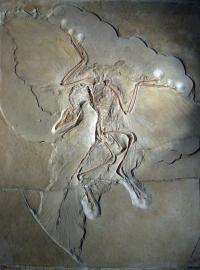
Archaeopteryx fossil (Creative Commons - Wikipedia)

(PhysOrg.com) -- The crown of the famous 150-million-year-old Archaeopteryx fossil as the first bird has been restored by a new evolutionary tree.

In a study published today in the journal Biology Letters, Australian researchers say the feathered fossil is indeed of the first known bird, despite another study earlier this year suggesting otherwise.

had been considered for 150 years to be the first known bird since the first complete specimen was found in Germany in 1861, revealing a combination of reptilian and and bird features.  But Chinese researchers asserted recently that a new and closely related , Xiaotingia zhengi, was a bird-like dinosaur - therefore suggesting that Archaeopteryx was also a dinosaur.

However, the new study, led by Dr Michael Lee, of the South Australian Museum, used a more detailed analyis to show that Archaeopteryx was a bird.

"Archaeopteryx is iconic in palaeontology as the basal bird, however the plethora of discoveries of feathered dinosaurs in China, in particular, has progressively eroded the distinction of just what defines a bird," says one of the authors, Dr Trevor Worthy, a palaeontologist in the UNSW School of Biological, Earth and Environmental Sciences.

"This trend came to a head when Xaiotingia was analysed most recently and in the analysis presented Archaeopteryx was found to jump ship as it were from the birds to the dromaeosaurs.

"This sensational result was presented and attracted much publicity, but the very weak statistical support for this new relationship was not given due consideration. 

"In our work, Mike Lee has shown quite clearly that methodology is highly significant and that before a paradigm is overturned data needs to be rigorously examined.

"Using a different analytical methodology than that usually used by morphologists, but one always used by analysts of molecular data, we found that Archaeopteryx remains the basal bird and does so with strong statistical support.

"This case demonstrates that multiple analysis methods should be used, each with concordant results before a paradigm breaking result is accepted. And it shows that Archaeopteryx remains the key to understanding the origin of ."

Explore further: Shellfish show population growth did not send humans out of Africa

More information: rsbl.royalsocietypublishing.org/content/current

Related Stories

Archaeopteryx and the dinosaur-bird family tree

Sep 15, 2011

The magpie-sized Archaeopteryx had bird and dinosaur features and helped show that birds evolved from dinosaurs. However, recent research in the journal Nature questions its position in the dinosaur-bird family ...

Famed fossil isn't a bird after all, analysis says

Jul 27, 2011

(AP) -- One of the world's most famous fossil creatures, widely considered the earliest known bird, is getting a rude present on the 150th birthday of its discovery: A new analysis suggests it isn't a bird ...

Ancient Birds Flew On All-Fours

Sep 26, 2006

The earliest known ancestor of modern-day birds took to the skies by gliding from trees using primitive feathered wings on their arms and legs, according to new research by a University of Calgary paleontologist. In a paper ...

Inside the First Bird, Surprising Signs of a Dinosaur

Oct 08, 2009

(PhysOrg.com) -- The raptor-like Archaeopteryx has long been viewed as the archetypal first bird, but new research reveals that it was actually a lot less “bird-like” than scientists had believed.

Feathers too weak for early bird flight

May 13, 2010

(PhysOrg.com) -- The evolution of flight took longer than previously thought with the ancestors of modern birds “rubbish” at flying, if they flew at all, according to a Manchester scientist.

Recommended for you

Prehistoric rock art maps cosmological belief

47 minutes ago

It is likely some of the most widespread and oldest art in the United States. Pieces of rock art dot the Appalachian Mountains, and research by University of Tennessee, Knoxville, anthropology professor Jan ...

User comments : 6

Adjust slider to filter visible comments by rank

Display comments: newest first

tadchem
not rated yet Oct 26, 2011
Regarding the evolution of birds, one must ask the question: "Which came first, feathers or flight?"
The answer lies in the facts that - some birds do not fly, and not all animals with feathers fly, but all birds have feathers.
The inference is that the evolution of feathers MUST have preceded the evolution of feathered flight.
kevinrtrs
1 / 5 (10) Oct 26, 2011
I wonder how [the first] eagles learned to fly, given that currently the parent takes the chick up into the air and drops[and catches] it repeatedly until it finally takes to the air by itself....???

Just wondering....
Ojorf
3.7 / 5 (3) Oct 26, 2011
This is the first time I've seen Kevin crack a joke!
Silan
not rated yet Oct 26, 2011
Regarding the evolution of birds, one must ask the question: "Which came first, feathers or flight?"
The answer lies in the facts that - some birds do not fly, and not all animals with feathers fly, but all birds have feathers.

The inference is that the evolution of feathers MUST have preceded the evolution of feathered flight.


The birds that don't fly, came from birds that do fly. Birds came from reptiles who flew without feathers. Flight came before feathers and feathers evolved with flight.
LalaDeLuz
not rated yet Oct 26, 2011
First eagle to fly was probably the result of a prankster or over zealous sibling nudging a smaller one from the nest. Flight School of Hard Knocks.
LivaN
5 / 5 (4) Oct 27, 2011
kevinrtrs
I wonder how [the first] eagles learned to fly, given that currently the parent takes the chick up into the air and drops[and catches] it repeatedly until it finally takes to the air by itself....???

Just wondering....


I can imagine the first "eagles"(evolutionary ancestor?) learned to fly by either falling out of a nest, or taking considerable time to discover the ability. In such a situation any eagle, whose parents facilitated learning to fly in a safer and quicker time frame, would no doubt have a natural advantage over its neighbour. Thus natural selection will select for such genes, and the trait will become more widespread and more precise.

More news stories

Prehistoric rock art maps cosmological belief

It is likely some of the most widespread and oldest art in the United States. Pieces of rock art dot the Appalachian Mountains, and research by University of Tennessee, Knoxville, anthropology professor Jan ...

'Ugly' finding: Unattractive workers suffer more

People who are considered unattractive are more likely to be belittled and bullied in the workplace, according to a first-of-its-kind study led by a Michigan State University business scholar.

The hidden agenda of Obama's opposition

Is the US Tea Party movement a racial backlash against President Obama? A new study by Angie Maxwell from the University of Arkansas, and Wayne Parent from Louisiana State University, assesses whether racial attitudes are ...

Tech companies eye security that goes beyond passwords

In late February, a thief or thieves cracked into Evernote's digital vault filled with log-ins, passwords and email addresses belonging to 50 million users. It was a shocking cyberattack considering the Redwood City, Calif., ...

Validating maps of the brain's resting state

Kick back and shut your eyes. Now stop thinking. You have just put your brain into what neuroscientists call its resting state. What the brain is doing when an individual is not focused on the outside world ...