How algae use a 'sulfate trap' to selectively biomineralize strontium
October 21, 2011

How algae use a 'sulfate trap' to selectively biomineralize strontium

Enlarge

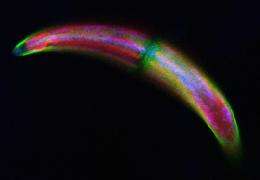
Confocal microscopy of C. moniliferum.

(PhysOrg.com) -- In any kind of nuclear reactor, there is a small amount of the radioactive isotope strontium-90 that is formed as part of the regular fission process. In fact, fission products such as strontium-90 make up approximately 3% of the total mass of spent nuclear fuels. The majority of the fission products are stable isotopes or very short-lived radioisotopes that do not cause much concern. However, there are several radioactive fission products that are present in significant quantities in spent fuels, including strontium-90 and caesium-137 (which together make up 0.3% of the total mass), as well as iodine-129 and technetium-99 (which together make up 0.1% of the total mass).

Strontium-90 has a half-life of approximately 30 years, and emits a beta particle as it decays to yttrium-90 (another ). It is particularly hazardous because in our bodies, strontium is treated the same way as calcium. In fact, the chemistry of strontium is so similar to calcium that it is very difficult to separate the two, even in a lab. If ingested, strontium can become stored in bones, where it is very stable, and may remain there for the rest of one’s life. While some isotopes of strontium are harmless, strontium-90 poses serious health risks such as cancer, and may continue to do so years after the initial exposure.

Over the years, researchers have looked to a small number of organisms, including the desmid green alga Closterium moniliferum, because of their ability to selectively sequester strontium. Somehow, these algae were able to take up and immobilize strontium from samples containing both and strontium, a skill that could potentially be used to reduce the volume of dangerous strontium waste. However, it was not clear how the algae were capable of doing this.

Now, researchers at Northwestern University and Argonne National Laboratory have uncovered the secrets of the algae using x-ray fluorescence microscopy (XFM) at the U.S. Department of Energy Office of Science’s Advanced Photon Source (APS) at Argonne. This work, which was recently featured on the cover of the Journal of Structural Biology, utilized the x-ray fluorescence microprobe at X-ray Science Division (XSD) beamline 2-ID-E, and the sulfur K-edge x-ray absorption near-edge spectroscopy (XANES) capability of the scanning microprobe at XSD beamline 2-ID-B.
How algae use a 'sulfate trap' to selectively biomineralize strontium
Enlarge

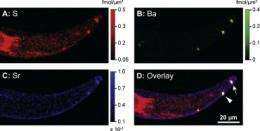
X-ray fluorescence microprobe elemental maps of desmids with (Ba,Sr)SO4 crystals. In sulfur (A), barium (B), and strontium (C) maps of a cell cultured in Ba and Sr-supplemented medium, hotpots of high concentration indicate (Ba,Sr)SO4 crystals and appear white in the overlay (D). Sr incorporation into crystals is evident, although at a low mole fraction (~0.3 mol%). While some crystals appear to be in or near the terminal vacuole (arrow), others are found elsewhere in the cell (arrowhead), possibly in the cytoplasm or in smaller vacuoles. Imaging was performed at 16.7 keV, 1-s dwell time, and 1-µm step size. (Image: M.R. Krejci et al., J. Struct. Biol. 176, 192 (2011). ©2011 Elsevier Inc. All rights reserved.)

Using XFM, the researchers were able to quantitatively measure the amounts of strontium and sulfur at every point in the cell, creating a “map” of these elements in the cell. They were able to correlate this with electron microscopy images, and determine the concentrations of strontium and sulfur in the vacuole, or storage compartment of the algae. They also used sulfur-XANES to determine that the sulfur in the vacuole was inorganic sulfate, rather than part of a protein. By performing measurements both under conditions where the strontium was biomineralized by the cell into crystals, and where it was not, they were able to determine that it was actually the sulfate concentration in the vacuole that was causing selective sequestration of the strontium. Thus, the alga was selectively isolating the into crystals by controlling the amount of sulfate in its vacuole, rather than utilizing any other kind of strontium-specific transport mechanism. This kind of selectivity is called a “sulfate-trap” mechanism.

Now that the mechanism is understood, the researchers postulate that the algae could be used to remediate contaminated environments. Requiring only light and water to carry out their task, these algae would be an energy-efficient solution to a environmental problem, but further work, such as determining the algae’s hardiness to radiation remains to be done before it is clear whether these applications are practical.

More information: Minna R. Krejci, Brian Wasserman, Lydia Finney, Ian McNulty, Daniel Legnini, Stefan Vogt, Derk Joester, “Selectivity in biomineralization of barium and strontium,” J. Struct. Biol. 176, 192 (2011). DOI:10.1016/j.jsb.2011.08.006

Provided by Argonne National Laboratory search and more info website

Filter


Move the slider to adjust rank threshold, so that you can hide some of the comments.


Display comments: newest first

Scottingham
Oct 21, 2011

Rank: not rated yet
Cooool, I could see this algae being used preemptively around nuclear plants in case of any low level leaks.

Since the nuke plants of the future won't have pressurized radioactive materials, the likelihood of these elements being strewn long distances is much lower.
Rank 5 /5 (4 votes)
Relevant PhysicsForums posts
  • Why does light move?
    created56 minutes ago
  • How to calculate the repulsion force between a permanent and an electromagnet?
    created2 hours ago
  • Why does light allow us to see things?
    created2 hours ago
  • Room temperature superconductivity
    created2 hours ago
  • Water flow question
    created5 hours ago
  • 16 year old solves 300 year old problem set by Isaac Newton
    created6 hours ago
  • More from Physics Forums - General Physics

More news stories

Is a classical electrodynamics law incompatible with special relativity?

(Phys.org) -- The laws of classical electromagnetism that were developed in the 19th century are the same laws that scientists use today. They include Maxwell’s four equations along with the Lorentz la ...

Physics / General Physics

created May 24, 2012 | popularity 4.7 / 5 (17) | comments 43 | with audio podcast feature

Landmark calculation clears the way to answering how matter is formed

(Phys.org) -- An international collaboration of scientists, including Thomas Blum, associate professor of physics, is reporting in landmark detail the decay process of a subatomic particle called a kaon – ...

Physics / General Physics

created May 25, 2012 | popularity 4.3 / 5 (22) | comments 51 | with audio podcast

Lying in wait for WIMPs: Researchers seek to dramatically increase sensitivity of Large Underground Xenon detector

Although it's invisible, dark matter accounts for at least 80 percent of the matter in the universe. No one knows what it is, but most scientists would bet on weakly interacting massive particles, or WIMPs.

Physics / General Physics

created May 23, 2012 | popularity 4 / 5 (7) | comments 16 | with audio podcast

Hawaii lab turns laser-powered bubbles into microrobots

(Phys.org) -- A team of scientists from the University of Hawaii are working on microrobots created from bubbles of air in a saline solution. The bubbles take on their title of “robots” as a laser ...

Physics / General Physics

created May 23, 2012 | popularity 5 / 5 (4) | comments 2 | with audio podcast weblog

Sound increases the efficiency of boiling

Scientists at the Georgia Institute of Technology achieved a 17-percent increase in boiling efficiency by using an acoustic field to enhance heat transfer. The acoustic field does this by efficiently removing vapor bubbles ...

Physics / Soft Matter

created May 24, 2012 | popularity 5 / 5 (2) | comments 2


Land and sea species differ in climate change response: study

(Phys.org) -- Marine and terrestrial species will likely differ in their responses to climate warming, new research by Simon Fraser University and Australia’s University of Tasmania has found.

'Unzipped' carbon nanotubes could help energize fuel cells, batteries

Multi-walled carbon nanotubes riddled with defects and impurities on the outside could replace some of the expensive platinum catalysts used in fuel cells and metal-air batteries, according to scientists at ...

T cells 'hunt' parasites like animal predators seek prey, study shows

By pairing an intimate knowledge of immune-system function with a deep understanding of statistical physics, a cross-disciplinary team at the University of Pennsylvania has arrived at a surprising finding: T cells use a movement ...

Computer model used to pinpoint prime materials for efficient carbon capture

When power plants begin capturing their carbon emissions to reduce greenhouse gases – and to most in the electric power industry, it's a question of when, not if – it will be an expensive undertaking.

Change in developmental timing was crucial in the evolutionary shift from dinosaurs to birds: study

At first glance, it's hard to see how a common house sparrow and a Tyrannosaurus Rex might have anything in common. After all, one is a bird that weighs less than an ounce, and the other is a dinosaur that ...

Nvidia trumpets Tegra 3 phone design wins for 2012

(Phys.org) -- Nvidia’s competitive war paint has a name, Tegra 3. On the heels of Nvidia announcements about lowering costs of its Tegra 3 processors and Nvidia-enabled tablets running Android Ice Cream ...