Zebras versus cattle: Not so black and white
Sep 22, 2011
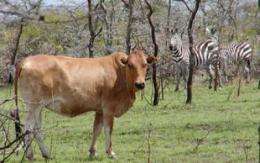
Grazing by wild animals doesn't always harm, and may benefit, livestock like cattle. Credit: Rob Pringle

African ranchers often prefer to keep wild grazers like zebra off the grass that fattens their cattle. But a new study by UC Davis and Kenyan researchers shows that grazing by wild animals doesn't always harm -- and can sometimes benefit -- cattle. The results are published Sept. 23 in the journal Science.

"Although savanna rangelands worldwide are managed on the premise that and wildlife compete for food, there is little scientific information to support this assumption," said Wilfred Odadi, a researcher at the Mpala Research Centre in Kenya.

"Our findings provide further evidence that biodiversity conservation and economic development can be simultaneously achieved in human-occupied savanna ," he said.

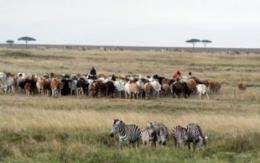
Cattle and wild animals like zebra: not always mutually exclusive on African rangelands. Credit: Ryan Sensenig

Truman Young, a professor of at UC Davis and senior author of the study, said the interaction between cattle and wildlife is more complicated than has been appreciated.

"When we look at the effect of wildlife on cattle, we find that they sometimes do suppress weight gain by cattle, but also sometimes enhance it," Young said.

"Generally the decision has been to exclude wild animals, but we're saying that things are not that simple," he said.

The researchers enclosed 10-acre plots of savanna rangeland inside fences to exclude wild animals (principally zebra). Then they weighed the cattle grazing inside and outside the fences to measure how much weight they put on at different times of the year.

The research team found that during the dry season, cattle that grazed with had reduced – the bottom line for ranchers. But in the wet season, cattle actually put on more weight when they grazed alongside wildlife.
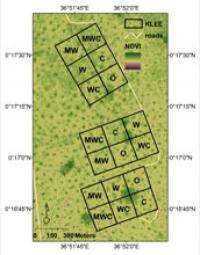
This is a map of the study site in Africa where the research on ungulates and cattle was conducted. Credit: Truman Young et al.

The explanation is that during the wet season, can grow long and become rank, inaccessible and poor in nutritional value.

"When the grass grows very fast and is at risk of becoming rank, having zebras is beneficial," Young said. "They are more than willing to knock back the rank grass."

That means higher-quality, fresher grass for the cattle.

It's not yet clear whether there is a net benefit over a whole year or series of years, Young said, because conditions can vary considerably from year to year. Ranchers are beginning to explore additional ways to control rank grass, such as controlled burns.

Explore further: Drought makes Borneo's trees flower at the same time

Provided by University of California - Davis

5 /5 (1 vote)

Related Stories

ARS scientists study effects of grazing on grouse habitat

Apr 30, 2010

Agricultural Research Service (ARS) scientists at the Eastern Oregon Agricultural Research Center in Burns, Ore., are taking a careful look at how grazing cattle affect sage-grouse habitat on high desert rangelands.

Study shows consumers find grass-fed beef acceptable

Aug 04, 2008

High feed-grain prices and the growing interest in "natural" foods have spurred both consumers and farmers to consider grass-fed beef, and a recent study done by Penn State College of Agricultural Sciences researchers may ...

GPS study shows wolves more reliant on a cattle diet

Mar 28, 2011

Cattle ranchers in southwestern Alberta have suspected it for a long time and now, GPS tracking equipment confirms it: wolf packs in the area are making cow meat a substantial part of their diets.

Canadian border cattle problem explored

Feb 23, 2007

The problem with hundreds of cattle imported from Canada with incomplete documentation involves record-keeping issues, U.S. agriculture officials said.

Recommended for you

Drought makes Borneo's trees flower at the same time

27 minutes ago

Tropical plants flower at supra-annual irregular intervals. In addition, mass flowering is typical for the tropical forests in Borneo and elsewhere, where hundreds of different plant timber species from the ...

Coccoliths thrive despite ocean acidification

2 hours ago

Ocean acidification is damaging some marine species while others thrive, say scientists. An international team studied the effect of ocean acidification on plankton in the North Sea over the past forty years, ...

Australia set to cull 10,000 wild horses

4 hours ago

A controversial cull of up to 10,000 wild horses in Australia's harsh Outback reportedly began Wednesday in a bid to control the feral animals which officials say are destroying the land.

Encouraging signs for bee biodiversity

10 hours ago

Declines in the biodiversity of pollinating insects and wild plants have slowed in recent years, according to a new study. Researchers led by the University of Leeds and the Naturalis Biodiversity Centre in the Netherlands ...

User comments : 0

More news stories

Fast new, one-step genetic engineering technology

A new, streamlined approach to genetic engineering drastically reduces the time and effort needed to insert new genes into bacteria, the workhorses of biotechnology, scientists are reporting. Published in ...

Drought makes Borneo's trees flower at the same time

Tropical plants flower at supra-annual irregular intervals. In addition, mass flowering is typical for the tropical forests in Borneo and elsewhere, where hundreds of different plant timber species from the ...

100K Pathogen Genome Project maps first genomes

(Phys.org) —Striking a blow at foodborne diseases, the 100K Pathogen Genome Project at the University of California, Davis, today announced that it has sequenced the genomes of its first 10 infectious microorganisms, including ...

Strawberry fields forever and fungus-free

(Phys.org) —Strawberries are one of the most economically important berry crops in the world, and a high value export crop for the Australian horticultural industry.For the first time, researchers at The ...

Theorists weigh in on where to hunt dark matter

(Phys.org) —Now that it looks like the hunt for the Higgs boson is over, particles of dark matter are at the top of the physics "Most Wanted" list. Dozens of experiments have been searching for them, but ...

DNA damage: The dark side of respiration

(Phys.org) —Adventitious changes in cellular DNA can endanger the whole organism, as they may lead to life-threatening illnesses like cancer. Researchers at LMU now report how byproducts of respiration cause mispairing ...