Unique Roman gladiator ruins unveiled in Austria
September 5, 2011 By GEORGE JAHN , Associated Press

Unique Roman gladiator ruins unveiled in Austria (AP)

Enlarge

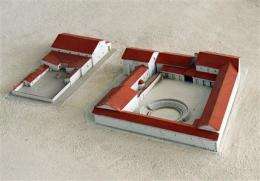
A model of a Roman gladiator school found with a underground radar in Carnuntum, Austria is presented at a press conference by the Ludwig Bolzmann institute for archaeology in Carnuntum, Austria, on Monday, Sept 5, 2011. They lived in cells barely big enough to turn around in for the time allotted them until death; usually four or five battles in the arena. This was the lot of those who trained at what experts described Monday as a world sensation _ the newly found and well preserved remnants of a gladiator school. (AP Photo/Ronald Zak)

They lived in cells barely big enough to turn around in and usually fought until they died. This was the lot of those at a sensational scientific discovery unveiled Monday: The well-preserved ruins of a gladiator school in Austria.

The Carnuntum ruins are part of a city of 50,000 people 28 miles (45 kilometers) east of Vienna that flourished about 1,700 years ago, a major military and trade outpost linking the far-flung Roman empire's Asian boundaries to its central and northern European lands.

Mapped out by radar, the ruins of the gladiator school remain underground. Yet officials say the find rivals the famous Ludus Magnus - the largest of the gladiatorial training schools in Rome - in its structure. And they say the Austrian site is even more detailed than the well-known Roman ruin, down to the remains of a thick wooden post in the middle of the training area, a mock enemy that young, desperate gladiators hacked away at centuries ago.

"(This is) a world sensation, in the true meaning of the word," said Lower Austrian provincial Governor Erwin Proell.

The archaeological park Carnuntum said the ruins were "unique in the world ... in their completeness and dimension."

The gladiator complex is part of a 10-square kilometer (3.9-square mile) site over the former city, an archaeological site now visited by hundreds of thousands of tourists a year. Officials said they had no date yet for the start of excavations of the gladiator school, saying experts needed time to settle on a plan that conserves as much as possible.

"If one has a major injury then you first do a series of CT scans before you let a surgeon do his work," explained Wolfgang Neubauer, director of the Ludwig Bolzman Institute for Archaeological Prospecting and Virtual Archaeology.

Digging at the city site began around 1870, but less than one percent of it has been excavated, due to the enormity of what lies beneath and to the painstaking process of restoring what already has been unearthed.

Neubauer said an unusual and unexplained "white spot" on an aerial photograph led experts to scan the area with state-of-the-art radar that shows a three-dimensional image of what lies underground.

"(It's) a clarity we normally find only in the field of medicine," he said Monday. The same machines have been used at Britain's Stonehenge and other European archaeological sites.

A virtual video presentation of the former Carnuntum gladiator school showed images of the ruins underground shifting into what the complex must have looked like in the third century.

It was definitely a school of hard knocks.

"A gladiator school was a mixture of a barracks and a prison, kind of a high-security facility," said the Roemisch-Germanisches Zentralmuseum, one of the institutes involved in finding and evaluating the discovery. "The fighters were often convicted criminals, prisoners-of-war, and usually slaves."

Still, there were some perks for the men who sweated and bled for what they hoped would at least be a few brief moments of glory before their demise.

At the end of a dusty and bruising day, they could pamper their bodies in baths with hot, cold and lukewarm water. And hearty meals of meat, grains and cereals were plentiful for the men who burned thousands of calories in battle each day for the entertainment of others.

Thick walls surround 11,000 square meters (13,160 sq. yards) of the site, and the school and its adjacent buildings stretch over 2,800 square meters ((3,350 square yards).

Inside, a courtyard was ringed by living quarters and other buildings and contained a round, 19-square meter (23-square yard) training area - a small stadium overlooked by wooden seats and the terrace of the chief trainer.

The complex also contained about 40 tiny sleeping cells for the gladiators; a large bathing area; a training hall with heated floors and assorted administrative buildings. Outside the walls, radar scans show what archeologists believe was a cemetery for those killed during training.

The institute said the training area was where the men's "market value and in end effect their fate" was decided. At the same time, it gave them a small chance for survival, fame, and possibly liberty.

"If they were successful, they had a chance to advance to 'superstar' status - and maybe even achieve freedom," said Carnuntum park head Franz Humer.

©2011 The Associated Press. All rights reserved. This material may not be published, broadcast, rewritten or redistributed.

4.9 /5 (13 votes)  

Filter


Move the slider to adjust rank threshold, so that you can hide some of the comments.


Display comments: newest first

Telekinetic
Sep 05, 2011

Rank: 2 / 5 (1)
The sadism of man knows no bounds.
axemaster
Sep 05, 2011

Rank: 5 / 5 (2)
It would be nice to think mankind has progressed beyond this kind of savagery. Unfortunately, the state of the world suggests this is not the case.
Norezar
Sep 05, 2011

Rank: 3.7 / 5 (3)
I bet it was a hell of a show, though.
FainAvis
Sep 06, 2011

Rank: 2 / 5 (1)
Sqrt(19) is approximately 4.3 meters on a side. Thats a measly little stadium, no room to swing a cat* around, as they say.

*That would be a cat 'o nine tails eh?
thematrix606
Sep 13, 2011

Rank: not rated yet
Sqrt(19) is approximately 4.3 meters on a side. Thats a measly little stadium, no room to swing a cat* around, as they say.

*That would be a cat 'o nine tails eh?


19-square meter (23-square yard) TRAINING area... sounds big enough for a training area.
Rank 4.9 /5 (13 votes)
Relevant PhysicsForums posts

More news stories

Change in developmental timing was crucial in the evolutionary shift from dinosaurs to birds: study

At first glance, it's hard to see how a common house sparrow and a Tyrannosaurus Rex might have anything in common. After all, one is a bird that weighs less than an ounce, and the other is a dinosaur that ...

Other Sciences / Archaeology & Fossils

created 3 hours ago | popularity 5 / 5 (2) | comments 0 | with audio podcast

Social welfare cuts ultimately come with heavy price, researchers say

(Phys.org) -- Slashing government funding for Medicaid, food stamps and other programs that serve the poor – while politically popular with some lawmakers and many conservatives – may do more harm ...

Other Sciences / Social Sciences

created May 24, 2012 | popularity 4.3 / 5 (16) | comments 152

Ancient Bethlehem seal unearthed in Jerusalem

Israeli archaeologists have discovered a 2,700-year-old seal that bears the inscription "Bethlehem," the Israel Antiquities Authority announced Wednesday, in what experts believe to be the oldest artifact ...

Other Sciences / Archaeology & Fossils

created May 23, 2012 | popularity 3.5 / 5 (14) | comments 24

Oldest Jewish archaeological evidence on the Iberian Peninsula

German archaeologists of the Friedrich Schiller University Jena found one of the oldest archaeological evidence so far of Jewish Culture on the Iberian Peninsula at an excavation site in the south of Portugal, ...

Other Sciences / Archaeology & Fossils

created May 25, 2012 | popularity 4.2 / 5 (6) | comments 12

Dollars and sense: Why are some people morally against tax?

As the U.S. presidential election campaigns heat up, the economic debate is dominated by bailouts, austerity and, inevitably, taxation. Now a new study published in Symbolic Interaction asks why tax is such an important issue ...

Other Sciences / Social Sciences

created May 23, 2012 | popularity 3 / 5 (2) | comments 12


Land and sea species differ in climate change response: study

(Phys.org) -- Marine and terrestrial species will likely differ in their responses to climate warming, new research by Simon Fraser University and Australia’s University of Tasmania has found.

'Unzipped' carbon nanotubes could help energize fuel cells, batteries

Multi-walled carbon nanotubes riddled with defects and impurities on the outside could replace some of the expensive platinum catalysts used in fuel cells and metal-air batteries, according to scientists at ...

T cells 'hunt' parasites like animal predators seek prey, study shows

By pairing an intimate knowledge of immune-system function with a deep understanding of statistical physics, a cross-disciplinary team at the University of Pennsylvania has arrived at a surprising finding: T cells use a movement ...

Computer model used to pinpoint prime materials for efficient carbon capture

When power plants begin capturing their carbon emissions to reduce greenhouse gases – and to most in the electric power industry, it's a question of when, not if – it will be an expensive undertaking.

Nvidia trumpets Tegra 3 phone design wins for 2012

(Phys.org) -- Nvidia’s competitive war paint has a name, Tegra 3. On the heels of Nvidia announcements about lowering costs of its Tegra 3 processors and Nvidia-enabled tablets running Android Ice Cream ...

Yale study concludes public apathy over climate change unrelated to science literacy

Are members of the public divided about climate change because they don't understand the science behind it? If Americans knew more basic science and were more proficient in technical reasoning, would public consensus match ...