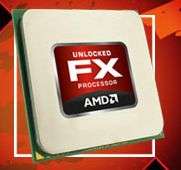
Team AMD FX sets Guiness record
September 14, 2011 by Nancy Owano
(PhysOrg.com) -- AMD has set the world record of fastest CPU with a speed frequency of 8.429 GHz, winning the company a place in the Guiness World Records. AMDs yet-to-ship Bulldozer-based FX chips drew the Guinness ranking for the "Highest Frequency of a Computer Processor." The AMD-FX CPU is set to debut in Q4 2011.
Announced yesterday, the Guiness record news drew kudos and comments from a wide range of sites that closely follow news and events circling rivals AMD and Intel.
Some reports noted the timing of AMD's announcement was made on the opening day of the Intel Developer Forum in San Francisco.The record was actually set at an event in Austin, Texas, on August 31. A special team had been assembled at the Texas event made up of expert overclockers along with AMD technologists and were dubbed Team AMD-FX. Their goal was to attempt record numbers by "overclocking" 8-core AMD FX desktop processors.
This video is not supported by your browser at this time.
They achieved an overclocked frequency of 8.429 GHz on the processors, breaking their former record of 8.308 GHz.Overclocking refers to the process where technical experts get chips to run at higher than normal speeds.
AMD said they found that the company's FX chips could reach over 5 GHz using normal air cooling or water-cooling rigs that cost less than $100.
Commenting on the record-setting feat, the overclocking review site Overclockers Club made note that only two cores were running throughout the overclock. Having the other cores disabled may have helped the frequency boost, it said, along with the temperature of -235 degrees C to keep the CPU chilled. Nonetheless, the site added that a dual core clocked at 8.429GHz is still an AMD triumph.
Similarly, another site, Overclockers, said the record numbers spell only the beginning and that, looking forward, one might wonder what about 9 GHz. "Pre-production chips historically only scratch the surface of what the architecture is capable of. Given time as fabrication processes and yields improve while more people get their hands on more chips, we could hear reports of AMD seriously flirting with 9 GHz soon enough."
The AMD press statement said that, beside setting world records, the AMD FX processor will enable an "unrivaled enthusiast PC experience" for the money, including extreme multi-display gaming and HD content creation.
More information: Press release
© 2011 PhysOrg.com
-
From lemons to lemonade: Reaction uses carbon dioxide to make carbon-based semiconductor,
32 comments
-
Thioridazine kills cancer stem cells in human while avoiding toxic side-effects of conventional cancer treatments,
3 comments
-
SpaceX private rocket blasts off for space station (Update),
42 comments
-
Climate scientists say they have solved riddle of rising sea,
31 comments
-
SpaceX capsule has 'new car' smell, astronauts say (Update),
4 comments
-
Need a rigid insulation material???
20 hours ago
-
magnets or EMF in car bumpers to protect from fender bender
May 26, 2012
-
length of wire in a coil of known dimensions?
May 25, 2012
-
India Engineering Powerhouse
May 25, 2012
-
electromagnet core dereference between hard and soft iron
May 25, 2012
-
Measuring water pressure in an open tank
May 24, 2012
- More from Physics Forums - General Engineering
More news stories
Nvidia trumpets Tegra 3 phone design wins for 2012
(Phys.org) -- Nvidias competitive war paint has a name, Tegra 3. On the heels of Nvidia announcements about lowering costs of its Tegra 3 processors and Nvidia-enabled tablets running Android Ice Cream ...
Dell tablet leak: 10.1-inch display, two-battery choice
(Phys.org) -- Headline after headline talks about vendors tablets in the wings as likely number-one contenders for the iPad. Such claims have justifiably been taken with a grain of salt, considering ...
Nvidia says Kai platform will turn price tide for tablets
(Phys.org) -- In March, Nvidia gave some signs that they were working to lower the cost of their Tegra 3 processors and they suggested consumers might see prices for Android tablets as low as $199. Connect ...
OmniVision tops up sensors for cameras, phones
(Phys.org) -- OmniVision has announced two high-resolution image sensors for the digital still and digital video camera market (DS/DVC) and higher end smartphones. In end-user language, it is a claim for superior ...
MIT researchers devise new means to synchronize a group of robots (w/ Video)
(Phys.org) -- For several years, roboticists have been working out ways to get a group of robots to perform synchronized activities as demonstrated most often in dance routines. Its not just about trying ...
'Unzipped' carbon nanotubes could help energize fuel cells, batteries
Multi-walled carbon nanotubes riddled with defects and impurities on the outside could replace some of the expensive platinum catalysts used in fuel cells and metal-air batteries, according to scientists at ...
T cells 'hunt' parasites like animal predators seek prey, study shows
By pairing an intimate knowledge of immune-system function with a deep understanding of statistical physics, a cross-disciplinary team at the University of Pennsylvania has arrived at a surprising finding: T cells use a movement ...
Computer model used to pinpoint prime materials for efficient carbon capture
When power plants begin capturing their carbon emissions to reduce greenhouse gases and to most in the electric power industry, it's a question of when, not if it will be an expensive undertaking.
Change in developmental timing was crucial in the evolutionary shift from dinosaurs to birds: study
At first glance, it's hard to see how a common house sparrow and a Tyrannosaurus Rex might have anything in common. After all, one is a bird that weighs less than an ounce, and the other is a dinosaur that ...
Land and sea species differ in climate change response: study
(Phys.org) -- Marine and terrestrial species will likely differ in their responses to climate warming, new research by Simon Fraser University and Australia’s University of Tasmania has found.
Scientist: Evolution debate will soon be history
(AP) -- Richard Leakey predicts skepticism over evolution will soon be history. Not that the avowed atheist has any doubts himself.
Sep 14, 2011
Rank: 2 / 5 (12)
Pentium 4 anyone?
Sep 14, 2011
Rank: 5 / 5 (3)
Intel respectively locks their multiplier. Kind of hard to achieve the frequency past the recommended allocations.
Sep 14, 2011
Rank: 2.5 / 5 (8)
Although you won't get any real benefits by increasing the clock speed of the CPU by increasing the multiplier, because the memory lags behind and the caches start to run empty. You can run PiFast extremely quickly, but any real application will choke on it.
Which is why these top overclocks are rather pointless. Increasing the DRAM speed by 5 MHz nets you more actual performance than getting the CPU to run 100 MHz faster, because any heavier computations tend to be memory bound, and this is exactly where computers have been dragging their feet.
Despite the increases in memory BUS speeds, the memory chips themselves are still almost as slow as ever, requiring dual and triple channeling (intel) to get sequential data in and out quickly.
The clock speed of the CPU has been quite irrelevant for the past 10 years.
Sep 14, 2011
Rank: 1.7 / 5 (6)
Sep 14, 2011
Rank: 3 / 5 (2)
Sep 14, 2011
Rank: not rated yet
Sep 14, 2011
Rank: not rated yet
Nothing changes, even doing engineering work on a old Ferrite iron core, transistorized, asynchronous clocked mainframe in the 60's things still had the same bottlenecks as now. GIGO
Sep 14, 2011
Rank: 5 / 5 (1)
Sep 14, 2011
Rank: not rated yet
Sep 14, 2011
Rank: 2 / 5 (3)
I am well aware, and that is why I always chuckle at the singularity idiots who think that just because the numbers get bigger every year, they'll get a free pass to nerd Valhalla in no time.
Feeding eight processing cores running at 8 GHz with today's memory systems is futile. It's like feeding fuel to a big block V8 through a drinking straw. Every time they introduce new improved memories with more megahertz to buy, the latencies increase at the same rate with the clock speed, which means that the random access time remains exactly the same - because the DRAM chips themselves are exactly the same.
It's simply a marketing gimmick.
Sep 14, 2011
Rank: not rated yet
The same stuff that mades AMD processors can be used to make RAM memory. RAM can also be cooled and sped up.
An advance in CPU speed will lead to faster memories eventually.
Sep 14, 2011
Rank: not rated yet
Not necessarily, since they rely on slightly different mechanics. Dynamic RAM relies on small capacitors that are supposed to hold a charge until the next refresh cycle, whereas CPU switching transistors just try to gain and dump their gate charge as fast as possible when the state changes. The CPU transistors are always driven high or low, they have a defined state to be, whereas the DRAM cell's state drifts constantly like a ball thrown up in the air (hence, dynamic RAM), so the faster you make them the more suspectible they become to slight deviations in timing and random errors, and manufacturing tolerances.
Technically, you could replace DRAM with SRAM which is made out of transistor flip-flops, which would make it fast and reliable, but it would also make the cost of a gigabyte of RAM shoot through the roof.
Ironically, the last Intel processor I owned was a 486. I buy value, not top speed.
Sep 14, 2011
Rank: 5 / 5 (1)
Sep 14, 2011
Rank: not rated yet
That was the first thing I noticed too...
I think this record is about as useful as most other records (think land/air speed records). It shows what can be done when you focus all your efforts on a single variable, usually to the detriment of all others. Once proven that it can be done (at all), you then dare others to do it more practically.
Sep 15, 2011
Rank: not rated yet
Well.. my old BMW gets to 40 in first gear... and 120 in third....
Sep 15, 2011
Rank: not rated yet
Sep 15, 2011
Rank: not rated yet
Yes, but what happens when you have a gigabyte of data that you need to churn through? Once your processor becomes quick enough to process the cached information faster than it can be replaced, you hit a brick wall in performance.
It's especially bad if you need data from random locations in memory instead of just streaming a block of data, because modern memory systems use interleaving to put the data in two or three different banks (channels) to get it in and out faster. E.g. you can hop on to writing the next bit to the next bank without waiting the previous one to finish doing its job. The trouble is that it only works properly if you have a continuous bunch of data, instead of bits and bobs from here and there.
So you can imagine how the performance scales when you try to run multiple processes that all require access to different data.
Sep 15, 2011
Rank: not rated yet
How much crap can you fit in the trunk? And don't include the back seats, because that's your L2 cache area.
Sep 15, 2011
Rank: not rated yet
It's a '95 Five series, so quite a lot! My L2 area is a bit cramped for large people, but it does have dual access.
Sep 15, 2011
Rank: 5 / 5 (1)
You can dip your hand in LN briefly without any ill effect. The Leidenfrost effect forms a vapor barrier preventing heat conduction, just like a drop of water skittering over a hot frying pan. I've done it - it only feels a little cool, less so than ice water.
Sep 16, 2011
Rank: 5 / 5 (1)
Thanks. I nominate this for the cool fact of the day. :)