Tacit hand device steers blind to safety (w/ video)
September 15, 2011 by Nancy Owano report

Tacit hand device steers blind to safety

Enlarge

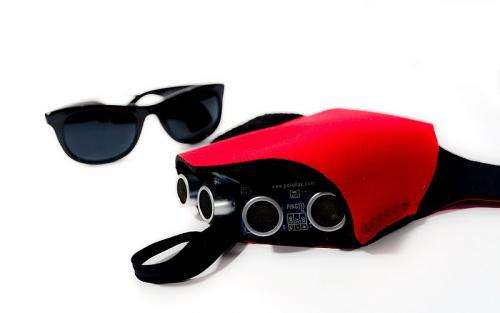
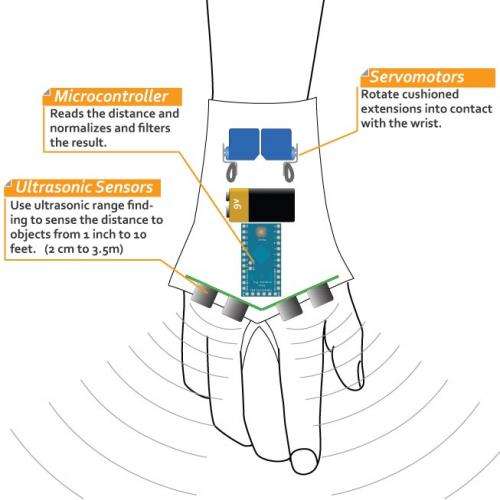
(PhysOrg.com) -- A hand device called the Tacit can help the blind and visually impaired move around safely in complex environments. Wrist-mounted, the device uses ultrasonic sensors mounted above the knuckles that can pick up the distance of objects from one inch to 10 feet away and then translate that distance to pressure on the wrist--the closer the object, the more pressure on the wrist. Pressure is applied on the right or left side of the wrist to help the user determine where the obstacle is located.

The can be strapped on to either hand and one-size-fits-most. The device shows a fast , in fractions of a second. A blind or visually impaired person can sense what is in the immediate area with a sweep of the hand. The , Steve Hoefer, chose the word Tacit to describe the haptic-feedback , he wrote, because "it just seemed like an appropriate name that’s a lot shorter (though less descriptive) than 'Hand-Mounted Haptic Feedback Sonar Obstacle Avoidance Assistance Device'.”

As interesting as the device is, what has attracted much buzz is the fact that the device, more formally called The Tacit Project, is under a Creative Commons License, and the project has been dedicated as a DIY idea for others to build. Hoefer's site, Grathio Labs, has posted source code, a list of parts, and detailed diagrams, with an invitation to make the device. "I am active in the Open Source software and hardware and encourage community innovation and creativity," he says on his site. He is using the Creative Commons BY-NC-SA license, which he explains as a “Don’t be a jerk” license. "In short: Make it, learn from it, teach it, improve it, modify it. Just share what you do, give credit, and don’t sell any without contacting me first."

As such, Hoefer is straightforward about where the device, which is a prototype, is of merit and where it needs improvements. "It's not perfect but it works and it can be better." It could easily be made about half the size, he said; another challenge is the fabric he chose, neoprene. He chose neoprene because it is a solid, durable, shock-absorbent base for electronics, but neoprene is not easy to sew. "It likes to drop stitches like crazy on a sewing machine."
Tacit hand device steers blind to safety
Enlarge


As for device accuracy, Hoefer says that lasers would have provided the most accuracy, but would be too costly, in his opinion. The cost of materials for Hoefer's prototype is $65. "For now ultrasonics work best at this price."

The hand device follows an earlier idea by Hoefer for a headband with ultrasonic sensors and vibration motors around the
circumference of a headband; the motors vibrated faster when close to an obstacle. The headband had two flaws which led Hoefer to try something different. The most dangerous obstacles, such as furniture that the blind person can trip over, are not at head level. Also, said Hoefer, "vibrating motors stuck on your skull will drive you insane quickly."

The Tacit device's learning curve is measured in seconds, according to Hoefer. He said everyone who has worn it figured it out immediately.

© 2011 PhysOrg.com

Filter


Move the slider to adjust rank threshold, so that you can hide some of the comments.


Display comments: newest first

Jotaf
Sep 15, 2011

Rank: not rated yet
Awesome! It's so simple yet it has a lot of potential. The fact that it's DYI/open-source is also inspiring. Someone who thinks his inventions should be for the whole world and not just to make him rich. It also doesn't prevent him from making some profit by selling pre-built devices, even setting up a company or signing a contract with one willing to do it.
braindead
Sep 16, 2011

Rank: not rated yet
Well done - this might also be a cheap and cheerful device for not just the vision impaired but also for first responders navigating in limited visibility conditions - eg smoke-filled air - in which case ultrasonics will work where lasers would not.
Rank 5 /5 (4 votes)
Relevant PhysicsForums posts

More news stories

Browser wars flare in mobile space

The browser wars are heating up again, but this time the fight is for dominance of the mobile Internet.

Technology / Software

created 12 hours ago | popularity 5 / 5 (1) | comments 3

Probability of contamination from severe nuclear reactor accidents is higher than expected: study

Catastrophic nuclear accidents such as the core meltdowns in Chernobyl and Fukushima are more likely to happen than previously assumed. Based on the operating hours of all civil nuclear reactors and the number ...

Technology / Energy & Green Tech

created May 22, 2012 | popularity 3.6 / 5 (22) | comments 56 | with audio podcast

HyperSolar shows dirty water no barrier to power world

(Phys.org) -- The Santa Barbara, California, company, HyperSolar, is set to transparently share the ups and downs of its research experiences toward the company’s ultimate vision, successfully producing ...

Technology / Energy & Green Tech

created May 24, 2012 | popularity 4.8 / 5 (16) | comments 17 | with audio podcast report

SpotterRF debuts Radar Backpack Kit (w/ Video)

(Phys.org) -- SpotterRF has announced a special radar backpack kit designed to enhance situational awareness for soldiers on the ground. The company says its special radar is designed for warfighters as part ...

Technology / Hi Tech & Innovation

created May 26, 2012 | popularity 5 / 5 (5) | comments 13 | with audio podcast report

Tesla to launch electric sedan in US on June 22

Tesla Motors said Tuesday it would begin deliveries of "the world's first premium electric sedan" on June 22, slightly ahead of schedule.

Technology / Energy & Green Tech

created May 22, 2012 | popularity 4.5 / 5 (12) | comments 18


Nvidia trumpets Tegra 3 phone design wins for 2012

(Phys.org) -- Nvidia’s competitive war paint has a name, Tegra 3. On the heels of Nvidia announcements about lowering costs of its Tegra 3 processors and Nvidia-enabled tablets running Android Ice Cream ...

'Unzipped' carbon nanotubes could help energize fuel cells, batteries

Multi-walled carbon nanotubes riddled with defects and impurities on the outside could replace some of the expensive platinum catalysts used in fuel cells and metal-air batteries, according to scientists at ...

T cells 'hunt' parasites like animal predators seek prey, study shows

By pairing an intimate knowledge of immune-system function with a deep understanding of statistical physics, a cross-disciplinary team at the University of Pennsylvania has arrived at a surprising finding: T cells use a movement ...

Computer model used to pinpoint prime materials for efficient carbon capture

When power plants begin capturing their carbon emissions to reduce greenhouse gases – and to most in the electric power industry, it's a question of when, not if – it will be an expensive undertaking.

Change in developmental timing was crucial in the evolutionary shift from dinosaurs to birds: study

At first glance, it's hard to see how a common house sparrow and a Tyrannosaurus Rex might have anything in common. After all, one is a bird that weighs less than an ounce, and the other is a dinosaur that ...

Land and sea species differ in climate change response: study

(Phys.org) -- Marine and terrestrial species will likely differ in their responses to climate warming, new research by Simon Fraser University and Australia’s University of Tasmania has found.