Supplement aids milk production
September 12, 2011

Supplement aids milk production

Enlarge

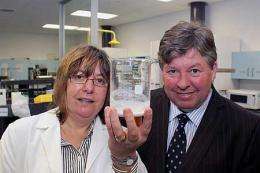
Dr Jean Margerison with Queen of Calves chief executive Stephen Bell-Booth.

(PhysOrg.com) -- Massey University research has led to the development of a calf supplement that can increase milk yield in dairy cows by up to 12 per cent.

Dr Jean Margerison, a senior lecturer in Animal Nutrition and Lactation Physiology at the Institute of Food, Nutrition and Human Health and Major Leader of Animal Science, has been conducting research into the Queen of Calves calf nutrition programme over a number of years.

Dr Margerison has followed the development of groups of from birth through two years of production. She says cows raised on the grew faster and outperformed other animals when it came to milk production.

“It appears that adding plant carbohydrates – a non-fat energy source – to the diet early in life helps,” she says. “It leads to lean growth with minimal fat laid down in the developing mammary, which gets in the way of secretory tissue. It also affects cell signalling – fat cells that develop in the mammary actually inhibit the production of milk from secretory cells.”

After weaning the calves continue to graze and mature better than those not on the nutritional programme. “You want the heifers to mate at 13-15 months to come into the dairy herd nine months later at 22 months of age at 85-90 per cent mature weight so they can compete well with the existing adult animals. Currently most of New Zealand’s 22-month heifers have achieved 78 per cent of their potential mature weight.

“It’s important they reach a good level of mature weight before joining the herd so they’re not trying to grow more than 10-15 per cent of mature weight in their first lactation,” Dr Margerison says. “This often leads to the animal being pushed away from feed and becoming lame and infertile, which is a major problem in New Zealand dairy industry.”

Research has been carried out to perfect the formula, which now contains specific plant carbohydrates and amino acids that provide good lean growth through specific proteins, non-fat energy and minerals making up for some of the natural deficiencies found in milk.

“The raised on this diet at Massey’s number four dairy farm produced 12 per cent more milk than the control group,” Dr Margerison says. “We also have data from industry and those figures show an 18 per cent increase in milk yield.”

Dr Margerison said that the increase in growth rate is beyond what would be expected from the additional energy added, and that rheological studies indicated increased curd strength, which is an important factor in milk digestion, resulted from combining plant carbohydrates, amino acids and milk.

Institute head Professor Richard Archer says the research into Queen of is a good example of how the University can work with industry to improve economic returns very directly. “Working with a company that already has the basis of a product, has manufacturing, distribution and brand already sorted out, provides a university with its most assured route to economic impact for research,” he says.

Dr Margerison presented the latest findings at the Joint American and Dairy Science Association conference in New Orleans in July.

Provided by Massey University search and more info website


Rank not rated yet
Relevant PhysicsForums posts

More news stories

Scientist: Evolution debate will soon be history

(AP) -- Richard Leakey predicts skepticism over evolution will soon be history. Not that the avowed atheist has any doubts himself.

Biology / Evolution

created 23 hours ago | popularity 3.5 / 5 (20) | comments 86

Manufacturing genes to attack flu virus

An international research team has manufactured a new protein that can combat deadly flu epidemics.

Biology / Biotechnology

created 4 hours ago | popularity not rated yet | comments 0 | with audio podcast

More plant species responding to global warming than previously thought

(Phys.org) -- Far more wild plant species may be responding to global warming than previous large-scale estimates have suggested.

Biology / Ecology

created May 22, 2012 | popularity 4.6 / 5 (14) | comments 18 | with audio podcast

For monogamous sparrows, it doesn't pay to stray (but they do it anyway)

It's quite common for a female song sparrow to stray from her breeding partner and mate with the male next door, but a new study shows that sleeping around can be costly.

Biology / Plants & Animals

created May 22, 2012 | popularity 5 / 5 (2) | comments 8 | with audio podcast

Thousands of shellfish found dead in Peru

Thousands of crustaceans were found dead off the coast of Lima following the mystery mass death of dolphins and pelicans, the Peruvian Navy said Friday.

Biology / Ecology

created May 26, 2012 | popularity 4.7 / 5 (6) | comments 7


Nvidia trumpets Tegra 3 phone design wins for 2012

(Phys.org) -- Nvidia’s competitive war paint has a name, Tegra 3. On the heels of Nvidia announcements about lowering costs of its Tegra 3 processors and Nvidia-enabled tablets running Android Ice Cream ...

'Unzipped' carbon nanotubes could help energize fuel cells, batteries

Multi-walled carbon nanotubes riddled with defects and impurities on the outside could replace some of the expensive platinum catalysts used in fuel cells and metal-air batteries, according to scientists at ...

T cells 'hunt' parasites like animal predators seek prey, study shows

By pairing an intimate knowledge of immune-system function with a deep understanding of statistical physics, a cross-disciplinary team at the University of Pennsylvania has arrived at a surprising finding: T cells use a movement ...

Computer model used to pinpoint prime materials for efficient carbon capture

When power plants begin capturing their carbon emissions to reduce greenhouse gases – and to most in the electric power industry, it's a question of when, not if – it will be an expensive undertaking.

Change in developmental timing was crucial in the evolutionary shift from dinosaurs to birds: study

At first glance, it's hard to see how a common house sparrow and a Tyrannosaurus Rex might have anything in common. After all, one is a bird that weighs less than an ounce, and the other is a dinosaur that ...

Land and sea species differ in climate change response: study

(Phys.org) -- Marine and terrestrial species will likely differ in their responses to climate warming, new research by Simon Fraser University and Australia’s University of Tasmania has found.