How the bat got its buzz: Superfast muscles in mammals
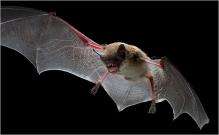
As nocturnal animals, bats rely echolocation to navigate and hunt prey. By bouncing sound waves off objects, including the bugs that are their main diet, bats can produce an accurate representation of their environment in total darkness. Now, researchers at the University of Southern Denmark and the University of Pennsylvania have shown that this amazing ability is enabled by a physical trait never before seen in mammals: so-called "superfast" muscles.
The work was conducted by Coen Elemans, John Ratcliffe and Lasse Jakobsen of Denmark, along with Andrew Mead, a graduate student in the Department of Biology in Penn's School of Arts and Science.
Their findings will appear in the journal Science.
Superfast muscles are capable of contraction about 100 times faster than typical body muscles and as much as 20 times faster than the fastest human muscles, those that control eye movement. Mead, who studies muscle physiology, and Elemans, who studies neuroscience and biomechanics, had previously collaborated in studying how superfast muscles help birds sing.
"Superfast muscles were previously known only from the sound-producing organs of rattlesnakes, birds and several fish," Elemans said. "Now we have discovered them in mammals for the first time, suggesting that these muscles – once thought extraordinary – are more common than previously believed."
With vision, animals receive a more-or-less continuous stream of information about the world. With echolocation, however, bats only get a snapshot of their environment with each call and echo, requiring them to make rapid successions of calls. When hunting a flying insect that can quickly move in any direction, bats need the most rapid updates on their prey's position in the instant before the catch. At this critical point, bats produce what is known as the "terminal buzz," where they make as many as 190 calls per second.
"Bat researchers assumed that the muscles that control this behavior must be pretty fast, but there was no understanding of how they worked," Mead said. "Research on superfast muscles is just a world apart from what they do. This study represents many worlds coming together: the muscle world, that bio-acoustics and echolocation world and the bat behavioral world."
The researchers tested the performance of the bats' vocal muscles by attaching one between a motor and a force sensor and electrically stimulating it to flex. When the motor was stationary, a single electric pulse allowed the researchers to measure the time that bat muscle took to twitch, or to contract and relax.
"The twitch gives us a sense of the time it takes for a muscle cell to go though all the steps, all the chemical reactions, necessary exert force and to relax again," Mead said. "The faster the muscle, the shorter the twitch. These muscles could go through all the motions in less than a hundredth of a second."
To approximate how much work the muscle was doing within the bat, however, the researchers had to change the length of the muscle while it was contracting. When the motor was on, it lengthened and shortened the muscle at a controllable rate. While the muscle was being stretched, the researchers stimulated the muscle to contract, so they could see if the muscle pulled on the motor harder than the motor pulled on the muscle.
The test to see if the muscle was truly of the superfast type involved increasing the speed of the motor to more than a 100 oscillations per second.
"You're always limited to how many twitches you can do in a given period of time," Mead said. "If you keep on increasing the frequency, doing twitch after twitch, you get to the point where the twitches begin to build on top of each other and the muscle doesn't fully turn off. We went to the highest cycling frequency where we still had evidence that the muscle was turning on and off. "
The researchers also did an experiment in which bats hunted insects in a chamber wired with microphones in order to determine the theoretical maximum frequency for a buzz without overlapping echoes, which could confuse the bat.
"We determined the power the muscles can deliver, much like how you measure a car's performance," Denmark's Elemans said. "We were surprised to see that bats have the superfast muscle type and can power movements up to 190 times per second, but also that it is actually the muscles that limit the maximum call rate during the buzz."
"You can think of it like a car engine," Mead said. "It can be tuned to be efficient, or tuned to be powerful depending on what you want it to do. It turns out that bats trade off a lot of force to be able to get these rapid oscillations. In a way it's like an engine that's been tuned for extremely high RPM."
Mead and Elemans plan further study of superfast muscles from a molecular and genetic perspective.
"With more and more genomes being sequenced, including one species of bat, and one from a bird we've studied,' Mead said, "we have some powerful tools to start pick apart whether or not similar genes are involved in various important roles."
Provided by University of Pennsylvania


