Can the United States postal service survive?
September 21, 2011 By Melissa Beattie Moss
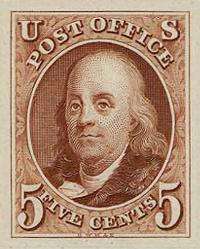
The first U.S. postage stamp Ben Franklin 5 cents U.S. Post Office, 1847. Credit: Wikimedia Commons
Neither snow nor rain nor heat nor gloom of night stays these couriers from swift completion of their appointed rounds, declares the (unofficial) mail carriers creed.
While it may be noble to brave the forces of nature, the more apt question today is whether the United States Postal Service (USPS) can survive the modern realities of email, online bill-paying and stiff competition from private delivery companies.
Is the U.S. Postal Service terminally outdated?
The USPS has faced major changes in the competition for parcel service over the last couple of decades as UPS and FedEx have grown, said Mark Roberts, Penn State professor of economics. It is now facing large declines in the demand for first-class service as substitute delivery methods -- particularly electronic bill paying and Internet streaming of movies -- have developed.
One major challenge, notes Roberts, is the hybrid nature of the USPS as a quasi-governmental agency. Created in Philadelphia by the Continental Congress in 1775 -- with Benjamin Franklin at the helm as the first Postmaster General of the United Colonies -- the service is neither an entirely government-owned corporation (as Amtrak is) nor an entirely independent business. The USPS is defined as a semi-independent federal agency, mandated to be revenue-neutral, meaning just breaking even, without making a profit.
Breaking even it is not.
Recent articles have reported that the USPS will reach a $9.2 billion shortfall when its fiscal year ends at the end of September, 2011 and a $238 billion budget shortfall within 10 years. Our situation is extremely serious, Postmaster General Patrick R. Donahoe is quoted as saying. If Congress doesnt act, we will default.
The enormous shortfall, explains Roberts, is partly the result of a law Congress passed in 2006 that required the USPS to pay $5.5 billion dollars every year for a decade to ensure future health benefits for its career employees -- all 574,000 of them. (The USPS is the second-largest employer in the nation, after Walmart.)
Given the services sharp declines in revenue and its steeper operating costs, its doubtful it can sustain that kind of payment, Roberts notes.
The USPS is saddled with restrictions from Congress that few private businesses would face, he explained. It cannot restructure its network of post offices, change days of delivery, alter prices significantly, restructure labor contracts, modify pension or medical benefits, or eliminate universal coverage without intervention from Congress or labor union pressure.
In the end, noted Roberts emphatically, Congress cannot mandate that the Postal Service make profits while imposing operating rules based on political, not business, reasons. It needs to either free the USPS to operate as a business or provide it with the funds to subsidize the mandated types of service -- but Congress is unwilling to do either one.
On the current trajectory, USPS may eventually be left with managing and delivering only junk mail, believes Roberts. One response, he said, is to downscale and improve efficiency. The Postal Service is, in fact, trying to do both. USPS officials are pushing a plan to eliminate Saturday mail delivery, close up to 3,700 postal locations and lay off 120,000 workers.
Will that be enough to restore the USPS to fiscal health?
Thats an unknown, says Roberts, but the agency needs to have flexibility to lower prices where it faces more competition and substitute products. The United States Postal Service has a large, unique and valuable distribution network, he explained -- one that in its early days helped to unite our nation -- but paying for the cost of operating that network needs to be shifted away from first-class mail and toward the bulk mail classes which account for an increasing share of the mail volume.
Otherwise, it might ultimately be stormy economic weather -- rather than snow, rain, heat or gloom of nightthat stays these couriers from the swift completion of their appointed rounds.
Provided by
Pennsylvania State University
-
From lemons to lemonade: Reaction uses carbon dioxide to make carbon-based semiconductor,
32 comments
-
Thioridazine kills cancer stem cells in human while avoiding toxic side-effects of conventional cancer treatments,
3 comments
-
SpaceX private rocket blasts off for space station (Update),
42 comments
-
Climate scientists say they have solved riddle of rising sea,
31 comments
-
SpaceX capsule has 'new car' smell, astronauts say (Update),
4 comments
-
Consumption rivalry
May 25, 2012
-
Bilateral trade between all countries
May 24, 2012
-
Is the economic foundation of social media in jeopardy?
May 20, 2012
-
Psychology: Rosenthal and Hawthorne Effect
May 15, 2012
-
Is GDP and National Income the Same Thing?
May 13, 2012
-
Difference between hourly wage and real GDP per hour worked?
May 12, 2012
- More from Physics Forums - Social Sciences
More news stories
Change in developmental timing was crucial in the evolutionary shift from dinosaurs to birds: study
At first glance, it's hard to see how a common house sparrow and a Tyrannosaurus Rex might have anything in common. After all, one is a bird that weighs less than an ounce, and the other is a dinosaur that ...
Other Sciences / Archaeology & Fossils
4 hours ago |
5 / 5 (2) |
0
|
Social welfare cuts ultimately come with heavy price, researchers say
(Phys.org) -- Slashing government funding for Medicaid, food stamps and other programs that serve the poor while politically popular with some lawmakers and many conservatives may do more harm ...
Other Sciences / Social Sciences
May 24, 2012 |
4.3 / 5 (16) |
154
Ancient Bethlehem seal unearthed in Jerusalem
Israeli archaeologists have discovered a 2,700-year-old seal that bears the inscription "Bethlehem," the Israel Antiquities Authority announced Wednesday, in what experts believe to be the oldest artifact ...
Other Sciences / Archaeology & Fossils
May 23, 2012 |
3.5 / 5 (14) |
24
Dollars and sense: Why are some people morally against tax?
As the U.S. presidential election campaigns heat up, the economic debate is dominated by bailouts, austerity and, inevitably, taxation. Now a new study published in Symbolic Interaction asks why tax is such an important issue ...
Other Sciences / Social Sciences
May 23, 2012 |
3 / 5 (2) |
15
Oldest Jewish archaeological evidence on the Iberian Peninsula
German archaeologists of the Friedrich Schiller University Jena found one of the oldest archaeological evidence so far of Jewish Culture on the Iberian Peninsula at an excavation site in the south of Portugal, ...
Other Sciences / Archaeology & Fossils
May 25, 2012 |
4.2 / 5 (6) |
12
Nvidia trumpets Tegra 3 phone design wins for 2012
(Phys.org) -- Nvidias competitive war paint has a name, Tegra 3. On the heels of Nvidia announcements about lowering costs of its Tegra 3 processors and Nvidia-enabled tablets running Android Ice Cream ...
'Unzipped' carbon nanotubes could help energize fuel cells, batteries
Multi-walled carbon nanotubes riddled with defects and impurities on the outside could replace some of the expensive platinum catalysts used in fuel cells and metal-air batteries, according to scientists at ...
T cells 'hunt' parasites like animal predators seek prey, study shows
By pairing an intimate knowledge of immune-system function with a deep understanding of statistical physics, a cross-disciplinary team at the University of Pennsylvania has arrived at a surprising finding: T cells use a movement ...
Computer model used to pinpoint prime materials for efficient carbon capture
When power plants begin capturing their carbon emissions to reduce greenhouse gases and to most in the electric power industry, it's a question of when, not if it will be an expensive undertaking.
Land and sea species differ in climate change response: study
(Phys.org) -- Marine and terrestrial species will likely differ in their responses to climate warming, new research by Simon Fraser University and Australia’s University of Tasmania has found.
Scientist: Evolution debate will soon be history
(AP) -- Richard Leakey predicts skepticism over evolution will soon be history. Not that the avowed atheist has any doubts himself.
Sep 21, 2011
Rank: 5 / 5 (6)
Sep 21, 2011
Rank: 5 / 5 (1)
Sep 21, 2011
Rank: 5 / 5 (3)
In the meantime, Congress can stretch out the payment schedule that the PO as on its facilities.
Sep 22, 2011
Rank: 5 / 5 (1)
Sep 22, 2011
Rank: not rated yet
Sep 22, 2011
Rank: 1 / 5 (1)
Sep 22, 2011
Rank: 5 / 5 (1)
Sep 22, 2011
Rank: 5 / 5 (1)
If the PO goes private, some people are going to choke over the 'new' costs of postage.
Sep 24, 2011
Rank: 4.6 / 5 (29)
If there is no one behind the counter making a profit, there is no one who cares to adapt and improve. Typical government can't do anything efficiently.
Sep 24, 2011
Rank: 5 / 5 (1)
Sep 25, 2011
Rank: 4.6 / 5 (28)
Why is it that everytime the governments absurd fiscal irresponsibility is pointed out some lefty plays the military card. I don't have a problem cutting back some,... but gutting it? Not even Obama is stupid enough to do that.
Sep 25, 2011
Rank: 5 / 5 (1)