Spontaneous combustion in nanobubbles
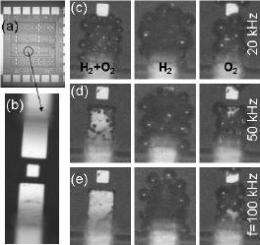
Formation of bubbles at the electrodes during electrolysis (can be seen in a and b). Situations c, d, and e show the formation of both hydrogen and oxygen on the left, hydrogen alone in the middle and oxygen alone on the right. Situation e shows combustion taking place on the left. No bubbles can be seen on the electrodes.
(PhysOrg.com) -- Nanometer-sized bubbles containing the gases hydrogen and oxygen can apparently combust spontaneously, although nothing happens in larger bubbles. For the first time, researchers at the University of Twentes MESA+ Institute for Nanotechnology have demonstrated this spontaneous combustion in a publication in Physical Review E. They intend to use the phenomenon to construct a compact ultrasonic loudspeaker.
The fact that a violent reaction takes place is already evident from the damage incurred by the electrodes with which the reaction is initiated. These electrodes are used to make hydrogen and oxygen by electrolysis, in the usual manner, in an ultra-small reaction chamber. If the plus and minus poles are continually alternated, tiny bubbles containing both gases arise.
The frequency with which the poles are alternated determines the size of the bubbles: the higher the frequency, the smaller the bubbles. Combustion only takes place in bubbles that are smaller than 150 nanometres (a nanometre is a millionth of a millimetre); nothing happens in larger bubbles. Early experiments in microreactors also showed that nothing happened in larger bubbles; the heat can dissipate to the larger internal surface.
Meters per second
Researcher Vitaly Svetovoy was working on the construction of an actuator for rapidly building pressure when he came across this phenomenon. Such actuators are, for example, used in loudspeakers for ultrasonic frequencies undetectable by the human ear in the medical world. None of the mechanical techniques currently available are suitable for making a very compact loudspeaker of this kind and still achieving a 'deflection' of metres per second on this scale. Svetovoy thought, however, that it might be possible by building up pressure with bubbles. The problem was that the bubbles could be made very rapidly but that they did not disappear quickly enough. The combustion reaction that has now been demonstrated might solve this problem. But it causes other problems too, such as the damage to the electrodes. "That is what we now have to look at", Svetovoy said.
This research was carried out by Prof. Miko Elwenspoek's Transducer Science and Technology group of the University of Twente's MESA+ Institute for Nanotechnology.
The article 'Combustion of hydrogen-oxygen mixture in electrochemically generated nanobubbles' by Vitaly Svetovoy, Remko Sanders, Theo Lammerink and Miko Elwenspoek appeared in Physical Review E on 23 September 2011.
Provided by
University of Twente
-
From lemons to lemonade: Reaction uses carbon dioxide to make carbon-based semiconductor,
32 comments
-
Thioridazine kills cancer stem cells in human while avoiding toxic side-effects of conventional cancer treatments,
3 comments
-
SpaceX private rocket blasts off for space station (Update),
42 comments
-
Climate scientists say they have solved riddle of rising sea,
31 comments
-
SpaceX capsule has 'new car' smell, astronauts say (Update),
4 comments
-
Why does light move?
1 hour ago
-
How to calculate the repulsion force between a permanent and an electromagnet?
2 hours ago
-
Why does light allow us to see things?
2 hours ago
-
Room temperature superconductivity
3 hours ago
-
Water flow question
6 hours ago
-
16 year old solves 300 year old problem set by Isaac Newton
7 hours ago
- More from Physics Forums - General Physics
More news stories
'Unzipped' carbon nanotubes could help energize fuel cells, batteries
Multi-walled carbon nanotubes riddled with defects and impurities on the outside could replace some of the expensive platinum catalysts used in fuel cells and metal-air batteries, according to scientists at ...
Nanotechnology / Nanomaterials
4 hours ago |
not rated yet |
0
|
Dopant gives graphene solar cells highest efficiency yet
(Phys.org) -- By taking advantage of graphenes favorable electrical and optical properties, and then adding an organic dopant, researchers have achieved the highest power conversion efficiency yet for ...
In nanorod crystal growth, nanoparticles seen as artificial atoms
In the growth of crystals, do nanoparticles act as "artificial atoms" forming molecular-type building blocks that can assemble into complex structures? This is the contention of a major but controversial theory ...
May 24, 2012 |
4.8 / 5 (6) |
0
|
First direct observation of oriented attachment in nanocrystal growth
Berkeley Lab researchers have reported the first direct observation of nanoparticles undergoing oriented attachment, the critical step in biomineralization and the growth of nanocrystals. A better understanding ...
May 24, 2012 |
4.7 / 5 (3) |
0
|
Synthetic nano-waste does not disappear
(Phys.org) -- Tiny particles of cerium oxide do not burn or change in the heat of a waste incineration plant. They remain intact on combustion residues or in the incineration system, as a new study by Swiss ...
Nanotechnology / Bio & Medicine
May 25, 2012 |
5 / 5 (2) |
1
|
Nvidia trumpets Tegra 3 phone design wins for 2012
(Phys.org) -- Nvidias competitive war paint has a name, Tegra 3. On the heels of Nvidia announcements about lowering costs of its Tegra 3 processors and Nvidia-enabled tablets running Android Ice Cream ...
T cells 'hunt' parasites like animal predators seek prey, study shows
By pairing an intimate knowledge of immune-system function with a deep understanding of statistical physics, a cross-disciplinary team at the University of Pennsylvania has arrived at a surprising finding: T cells use a movement ...
Computer model used to pinpoint prime materials for efficient carbon capture
When power plants begin capturing their carbon emissions to reduce greenhouse gases and to most in the electric power industry, it's a question of when, not if it will be an expensive undertaking.
Change in developmental timing was crucial in the evolutionary shift from dinosaurs to birds: study
At first glance, it's hard to see how a common house sparrow and a Tyrannosaurus Rex might have anything in common. After all, one is a bird that weighs less than an ounce, and the other is a dinosaur that ...
Land and sea species differ in climate change response: study
(Phys.org) -- Marine and terrestrial species will likely differ in their responses to climate warming, new research by Simon Fraser University and Australia’s University of Tasmania has found.
Scientist: Evolution debate will soon be history
(AP) -- Richard Leakey predicts skepticism over evolution will soon be history. Not that the avowed atheist has any doubts himself.