Space telescopes reveal secrets of turbulent black hole
September 29, 2011

Space telescopes reveal secrets of turbulent black hole

Enlarge

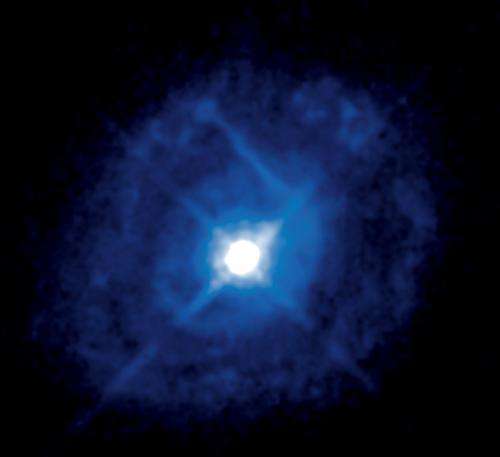
This image of the distant active galaxy Markarian 509 was taken in April 2007 with the Hubble Space Telescope's Wide Field Camera 2. Credit: NASA, ESA, G. Kriss (STScI), and J. de Plaa (SRON Netherlands Institute for Space Research); Acknowledgment: B. Peterson (Ohio State University)

(PhysOrg.com) -- A fleet of spacecraft including NASA's Hubble Space Telescope has uncovered unprecedented details in the surroundings of a supermassive black hole. Observations reveal huge bullets of gas being driven away from the gravitational monster and a corona of very hot gas hovering above the disk of matter that is falling into the black hole.

A team led by Jelle Kaastra of SRON Netherlands Institute for Space Research made use of data from ESA's XMM-Newton and INTEGRAL spacecraft (which study X-rays and , respectively), the (for ultraviolet observations with the COS instrument), and NASA's Chandra (X-ray) Observatory and Swift (gamma-ray) satellites.

The black hole that the team chose to study lies at the heart of the galaxy Markarian 509 (Mrk 509), nearly 500 million light-years away. This black hole is colossal, containing 300 million times the mass of the Sun, and is growing more massive every day as it continues to feed on surrounding matter, which glows brightly as it forms a rotating disk around the black hole. Mrk 509 was chosen because it is known to vary in brightness, which indicates that the flow of matter is turbulent.

The above image of Mrk 509 was taken in April 2007 with Hubble's Wide Field Planetary Camera 2. But using a large number of telescopes that are sensitive to different gave astronomers unprecedented coverage running from the infrared, through the visible, ultraviolet, X-rays, and into the gamma-ray band.
Space telescopes reveal secrets of turbulent black hole
Enlarge

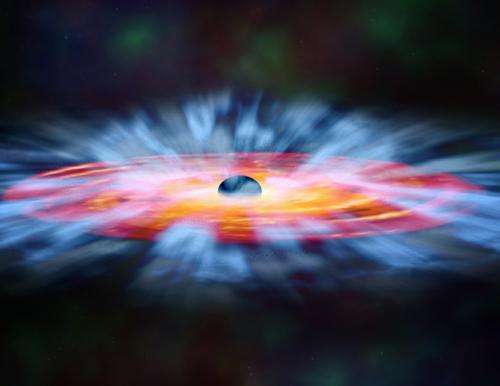
In this artist's illustration, turbulent winds of gas swirl around a black hole. Some of the gas is spiraling inward toward the black hole, but another part is blown away. Artwork Credit: NASA, and M. Weiss (Chandra X -ray Center)

The study is presented in a series of seven papers in the journal , with more expected to be published in coming months.

More information: A full account of the research can be read on the SRON website at http://www.sron.nl

Provided by JPL/NASA search and more info website

4.7 /5 (7 votes)  

Filter


Move the slider to adjust rank threshold, so that you can hide some of the comments.


Display comments: newest first

eachus
Sep 29, 2011

Rank: not rated yet
The artist's conception is wrong. The gas above or below the accretion disk quickly becomes a plasma, blown up or down by the light from the disk. What happens next is unclear. My guess is that the pulses due to the uneven supply of gas result in charge separation in the plasma streaming away, and this creates powerful magnetic fields that further confine the plasma. (The plasma will be rotating in the same direction as the accretion disk, so charge separation will result in magnetic field lines parallel to the jets. The field will flip from time to time, making things suitably chaotic.)
omatumr
Sep 29, 2011

Rank: 1 / 5 (7)
Observations reveal huge bullets of gas being driven away from the gravitational monster


Yes, observations violate models of:

a.) "Black Holes" that are not really black, and
b.) "Dead" nuclear embers of stars are violently energetic!

Why? The most powerful form of nuclear energy [1-3] was overlooked in nuclear rest mass data.

1. "Attraction and repulsion of nucleons: Sources of stellar energy," JFE 19, 93-98 (2001)

www.omatumr.com/a...tnuc.pdf

2. "Neutron repulsion confirmed as energy source", JFE 20, 197-201 (2002)

www.springerlink....6685079/

3."Neutron Repulsion", The APEIRON Journal, in press (2011)

http://arxiv.org/...2.1499v1

With kind regards,
Oliver K. Manuel
http://myprofile....anuelo09

jsdarkdestruction
Sep 30, 2011

Rank: 4 / 5 (4)
HOW DO NEUTRON STARS FORM IF NEUTRON REPULSION PREVENTS BLACK HOLES FROM FORMING?
yyz
Sep 30, 2011

Rank: 5 / 5 (2)
"Yes, observations violate models of:

a.) "Black Holes" that are not really black, and
b.) "Dead" nuclear embers of stars are violently energetic!"

Well, yes, those 803 published peer reviewed papers on Markarian 501, I presume, are in error: http://ned.ipac.c...of=table

I look forward to your published objections to their conclusions regarding Mrk 501 on a point-by-point basis sometime in the future. I guess you're not ready, able or willing to publish at this time. ;-)
jsdarkdestruction
Oct 01, 2011

Rank: 5 / 5 (2)
oliver, remember when you said a neutron star can be any size and a single neutron could be a neutron star?. which actually goes against your nonsense you normally say. how can neutron repulsion be the energy source of a star made of 1 neutron?
yyz
Oct 01, 2011

Rank: 5 / 5 (1)
@eachus,

These observations of Mrk 501 reveal the presence of a very hot UV-emitting corona surrounding the inner regions of this active galaxy which extends beyond 15ly from the center. UV light from the disk energizes and forms outflows of extremely hot, x-ray emitting regions within the 15ly corona surrounding the disk.

It was observations by XMM-Newton that discovered five of these x-ray emitting outflows in the hot corona of Mrk 501. Further work with the COS instrument on the HST revealed cooler UV-emitting gas spiraling inward near the edge of the 15ly-wide corona surrounding the AGN.

These observations may indicate that past merger activity might be responsible for the AGN activity we currently see in this galaxy. The press release has links to several papers that detail this current work on this nearby active galaxy: http://www.sron.n...emid=754


jsdarkdestruction
Oct 01, 2011

Rank: 5 / 5 (1)
well oliver, answer my question.
Rank 4.7 /5 (7 votes)
Relevant PhysicsForums posts
  • Distance of planets from stars and revolution
    created5 hours ago
  • revamping general concept and cosmological principle
    createdMay 25, 2012
  • Transiting Exoplanet Light Curve
    createdMay 25, 2012
  • Math behind Theoretical Physics
    createdMay 24, 2012
  • Do we know whats at the center of galaxies yet?
    createdMay 23, 2012
  • Structure of the Milky Way?
    createdMay 20, 2012
  • More from Physics Forums - General Astronomy

More news stories

Land and sea species differ in climate change response: study

(Phys.org) -- Marine and terrestrial species will likely differ in their responses to climate warming, new research by Simon Fraser University and Australia’s University of Tasmania has found.

Space & Earth / Environment

created 2 hours ago | popularity 5 / 5 (2) | comments 2 | with audio podcast

Yale study concludes public apathy over climate change unrelated to science literacy

Are members of the public divided about climate change because they don't understand the science behind it? If Americans knew more basic science and were more proficient in technical reasoning, would public consensus match ...

Space & Earth / Environment

created 4 hours ago | popularity 4 / 5 (1) | comments 11 | with audio podcast

10 million years needed to recover from mass extinction

It took some 10 million years for Earth to recover from the greatest mass extinction of all time, latest research has revealed.

Space & Earth / Earth Sciences

created 4 hours ago | popularity not rated yet | comments 1 | with audio podcast

Sophisticated simulations predict future warming

The chances of our planet being hit by a global warming of 3 degrees Celsius by 2050 is as likely as it being hit by an increase of 1.4 degrees, new research shows. Presented in the journal Nature Geoscience, the British study ...

Space & Earth / Earth Sciences

created May 22, 2012 | popularity 4.4 / 5 (9) | comments 51

Aliens don't want to eat us, says former SETI director

Alien life probably isn’t interested in having us for dinner, enslaving us or laying eggs in our bellies, according to a recent statement by former SETI director Jill Tarter.

Space & Earth / Space Exploration

created May 25, 2012 | popularity 4.4 / 5 (14) | comments 40


Nvidia trumpets Tegra 3 phone design wins for 2012

(Phys.org) -- Nvidia’s competitive war paint has a name, Tegra 3. On the heels of Nvidia announcements about lowering costs of its Tegra 3 processors and Nvidia-enabled tablets running Android Ice Cream ...

'Unzipped' carbon nanotubes could help energize fuel cells, batteries

Multi-walled carbon nanotubes riddled with defects and impurities on the outside could replace some of the expensive platinum catalysts used in fuel cells and metal-air batteries, according to scientists at ...

T cells 'hunt' parasites like animal predators seek prey, study shows

By pairing an intimate knowledge of immune-system function with a deep understanding of statistical physics, a cross-disciplinary team at the University of Pennsylvania has arrived at a surprising finding: T cells use a movement ...

Computer model used to pinpoint prime materials for efficient carbon capture

When power plants begin capturing their carbon emissions to reduce greenhouse gases – and to most in the electric power industry, it's a question of when, not if – it will be an expensive undertaking.

Change in developmental timing was crucial in the evolutionary shift from dinosaurs to birds: study

At first glance, it's hard to see how a common house sparrow and a Tyrannosaurus Rex might have anything in common. After all, one is a bird that weighs less than an ounce, and the other is a dinosaur that ...

Scientist: Evolution debate will soon be history

(AP) -- Richard Leakey predicts skepticism over evolution will soon be history. Not that the avowed atheist has any doubts himself.