Names, not social networks, bind us to global cultural and ethnic communities
September 8, 2011 By Dave Weston
Links between hundreds of millions of names belonging to people all around the world have been analysed by geographers from UCL and the University of Auckland. The results reveal how our forenames and surnames are connected in distinct global networks of cultural, ethnic and linguistic communities.
The researchers methods could be of use to social scientists and health researchers investigating migration, identity and integration.
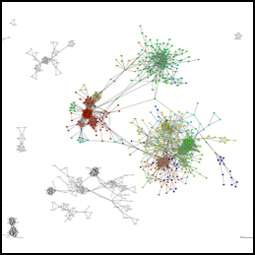
After studying the names of 118 million individuals, from 17 different countries, the team can reveal for the first time the existence of global naming networks of linked forenames and surnames, providing a valuable representation of cultural, ethnic and linguistic population structure around the world.
Previously, in order to try to classify and map populations using peoples names you first needed to compile a comprehensive name dictionary identifying the cultural ethnic and linguistic origins of each name, says author Dr. Pablo Mateos of UCLs Department of Geography. It is difficult to compile the extremely large name dictionaries required to cover complete national populations and there were inevitable inconsistencies in the way individual names were interpreted and categorised.
Rather than use a name dictionary, our approach has been to focus on the links between surnames and forenames. When you combine millions of these links into networks you see clusters emerge. They reveal the cultural baggage involved in the way in which we bestow forenames on babies and pass surnames from one generation to the next, even long after migration to a different cultural setting has occurred, continues Dr. Mateos.
Weve shown how names can be used to automatically classify individuals into cultural ethnic and linguistic communities, covering complete populations. By using repositories of names, such as telephone directories and electoral registers, we are able to identify ethnicity when no other alternative data source exists - something which could be extremely useful for future studies of public health, demography, ethnic segregation and migrant integration.
The article clearly demonstrates that the way in which people choose their childrens names is far from random, instead reflecting cultural and kinship affiliations, geographical factors and social stratification even in todays highly interconnected world. It shows how it is possible to highlight the degree of isolation, integration or overlap between population groups in a rapidly globalising world and has important implications for research in population genetics, public health, and social science.
More information: PLoS ONE article: http://dx.plos.org … pone.0022943
'Zoomable' image (1)
'Zoomable' image (2)
Provided by
University College London
-
From lemons to lemonade: Reaction uses carbon dioxide to make carbon-based semiconductor,
32 comments
-
Thioridazine kills cancer stem cells in human while avoiding toxic side-effects of conventional cancer treatments,
3 comments
-
SpaceX private rocket blasts off for space station (Update),
42 comments
-
Climate scientists say they have solved riddle of rising sea,
31 comments
-
SpaceX capsule has 'new car' smell, astronauts say (Update),
4 comments
-
Justifying Proof by Contradiction
7 hours ago
-
Combining equations help
8 hours ago
-
About the definition of "discrete random variable"
10 hours ago
-
Limits
May 26, 2012
-
Complex numbers: Why is the modulus of z...
May 26, 2012
-
A close approximation for square root of 2.
May 25, 2012
- More from Physics Forums - General Math
More news stories
Change in developmental timing was crucial in the evolutionary shift from dinosaurs to birds: study
At first glance, it's hard to see how a common house sparrow and a Tyrannosaurus Rex might have anything in common. After all, one is a bird that weighs less than an ounce, and the other is a dinosaur that ...
Other Sciences / Archaeology & Fossils
4 hours ago |
5 / 5 (2) |
0
|
Social welfare cuts ultimately come with heavy price, researchers say
(Phys.org) -- Slashing government funding for Medicaid, food stamps and other programs that serve the poor while politically popular with some lawmakers and many conservatives may do more harm ...
Other Sciences / Social Sciences
May 24, 2012 |
4.3 / 5 (16) |
154
Ancient Bethlehem seal unearthed in Jerusalem
Israeli archaeologists have discovered a 2,700-year-old seal that bears the inscription "Bethlehem," the Israel Antiquities Authority announced Wednesday, in what experts believe to be the oldest artifact ...
Other Sciences / Archaeology & Fossils
May 23, 2012 |
3.5 / 5 (14) |
24
Dollars and sense: Why are some people morally against tax?
As the U.S. presidential election campaigns heat up, the economic debate is dominated by bailouts, austerity and, inevitably, taxation. Now a new study published in Symbolic Interaction asks why tax is such an important issue ...
Other Sciences / Social Sciences
May 23, 2012 |
3 / 5 (2) |
15
Oldest Jewish archaeological evidence on the Iberian Peninsula
German archaeologists of the Friedrich Schiller University Jena found one of the oldest archaeological evidence so far of Jewish Culture on the Iberian Peninsula at an excavation site in the south of Portugal, ...
Other Sciences / Archaeology & Fossils
May 25, 2012 |
4.2 / 5 (6) |
12
Nvidia trumpets Tegra 3 phone design wins for 2012
(Phys.org) -- Nvidias competitive war paint has a name, Tegra 3. On the heels of Nvidia announcements about lowering costs of its Tegra 3 processors and Nvidia-enabled tablets running Android Ice Cream ...
'Unzipped' carbon nanotubes could help energize fuel cells, batteries
Multi-walled carbon nanotubes riddled with defects and impurities on the outside could replace some of the expensive platinum catalysts used in fuel cells and metal-air batteries, according to scientists at ...
T cells 'hunt' parasites like animal predators seek prey, study shows
By pairing an intimate knowledge of immune-system function with a deep understanding of statistical physics, a cross-disciplinary team at the University of Pennsylvania has arrived at a surprising finding: T cells use a movement ...
Computer model used to pinpoint prime materials for efficient carbon capture
When power plants begin capturing their carbon emissions to reduce greenhouse gases and to most in the electric power industry, it's a question of when, not if it will be an expensive undertaking.
Land and sea species differ in climate change response: study
(Phys.org) -- Marine and terrestrial species will likely differ in their responses to climate warming, new research by Simon Fraser University and Australia’s University of Tasmania has found.
Scientist: Evolution debate will soon be history
(AP) -- Richard Leakey predicts skepticism over evolution will soon be history. Not that the avowed atheist has any doubts himself.
Oct 29, 2011
Rank: not rated yet
Larry Dale