A smarter way to deliver drugs
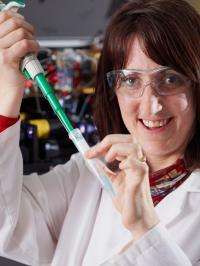
Smart capsules could change the way we deliver drugs.
Today, when we’re treated for cancer, the drug spreads throughout the body indiscriminately. Along the way it causes side-effects such as nausea and hair loss.
To tackle this problem Georgina imagines a miniscule capsule designed like a set of Russian babushka dolls. The capsule sneaks through the blood stream untouched. When it finds its target—a cancer cell—it passes into the cell, sheds a layer, finds the part of the cellular machinery it needs to attack, sheds another layer and releases its cargo of drugs, destroying the cancer cell and only the cancer cell.
Creating such a capsule may take decades, but Georgina and her colleagues at The University of Melbourne have already developed several materials which offer potential to do the job. Now, with the help of a $20,000 L’Oréal Australia For Women in Science Fellowship she plans to go further.
Like father, like daughter
Georgina’s interest in chemistry started early. “My father is an industrial chemist, and we’ve always been very close. I was always intrigued by the way he spoke about what he did. It’s all about problem solving, and being creative at finding new ways of getting results. He made it very exciting. He still works in the industry and still loves it. I think it’s very much like father, like daughter.”
At university the flexibility of plastics and similar polymers attracted her interest. “Polymer chemistry is what I love. It allows you to tailor and design materials to be really intelligent—and to respond to their environment.”
For her PhD, at the University of New South Wales, CSIRO and the Cooperative Research Centre for Polymers in Melbourne, she developed and patented a new set of polymer modified photochromic compounds—of the type used to darken spectacle lenses in sunlight. Her compounds can be engineered to go clearer faster and may reach the market.
But developing an intelligent drug capsule is a much more complex problem. So far, Georgina has combined two different techniques—layer by layer assembly (LbL) and click chemistry—to produce the required type of ‘intelligent’ materials that can deliver cancer drugs only to unhealthy cells within the body..
Using a combination of these techniques she can create her babushka doll capsules with each coating tailored to a particular purpose and then being stripped away to reveal the next layer. Click chemistry is important as it is an efficient bonding technique which allows her to build ‘the smarts’— chemical ingredients with highly specific properties—into the polymer capsule coatings.
For example, she has developed ‘low fouling’ capsules, coated, like a stealth bomber, with materials that allow them to pass undetected through the body’s immune surveillance systems. And her L’Oréal Fellowship will be directed to the problem of how to ensure the drug carried by the smart capsule is most effective once it is taken into a target cell.
Cells can be encouraged to engulf tiny capsules loaded with drugs, but once drawn inside the capsule is enclosed in a membrane-bound sac, known as an endosome, which is an acidic and destructive environment. Georgina wants to ensure the capsule escapes from the endosome and then dissolves, releasing its cargo, possibly multiple drugs, each targeted at a different part of the cell.
She may be able to devise the capsule’s escape by constructing a coating that becomes positively charged, causing salt and water to be pulled into the endosome. This causes an increase in osmotic pressure which bursts the membrane sac. As this is occurring the capsule coating is degraded releasing several smaller packages containing the drugs. Each package would have a smart surface to bind to a particular biochemical target in the cell. And Georgina can control how resistant the coating of the packages will be, which determines how quickly the drug acts.
“I find the biological challenge is a large one. It requires a lot out of polymer chemistry, to actually meet the very sophisticated requirements of the biological system. That makes it really good fun as a materials scientist. You might open one door, and then there are 50 other problems, and then there are another 50. It’s a very challenging field.”
Provided by Science in Public


