Scientists working on technique to use lasers to force rain
September 1, 2011 by Bob Yirka report

Scientists working on technique to use lasers to force rain

Enlarge

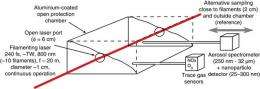
Experimental setup. Image: NPG, doi:10.1038/ncomms1462

(PhysOrg.com) -- As with many of man's most basic ancient desires; to be able to fly, to become invisible etc. making it rain on command (or by prayer) has always been high on the list, and up to now, has proved more elusive than other advances in the sciences. Now however, physicists in Switzerland might have finally made a breakthrough. In their paper published in Nature Communications, they describe a method whereby a laser is used to create nitric acid particles in the air to which moisture will gravitate forming droplets.

To test their theory, the researchers, led by Jérôme Kasparian, physicist at the University of Geneva, hauled their laser, called the Teramobile mobile femtosecond-Terawatt laser system, to a an area near the Rhône river and commenced to firing it into the sky (on a very humid day - over 70%) for 113 hours. To ensure their results were constrained to one area, wind shields were used. They then sampled the aerosols alternatively at 2 cm distances in the areas where they expected to see nitric acid form. In so doing they found that their efforts did indeed result in the creation of nitric acid particles which caused water to form on the order of a few microns in size.

While the water droplets formed were clearly not nearly large or heavy enough to fall as , the results are encouraging because up to now, the best hope for forcing nature’s hand has been to seed clouds with silver nitrate or dry ice, neither of which has so far been proven to actually work.

Unfortunately, despite the initial success of the project, it appears the idea of using lasers to control rain is still largely theoretical due to the uncertainty of whether the same technique can be used to make larger drops, and whether or not it would then be possible to use the technique in a big enough way to create a meaningful amount of rainfall (or whether there is a risk that larger drops might actually fall as rain). Also, would the laser technique be useful in areas that need it most because of droughts, etc? And if so, what would that mean for the environment; if such rainmakers were activated all over the planet for example, would the resultant additional cloud cover serve to reduce global temperatures as they reflect back some of the sun’s heat as suggested by other studies? Would it cause wars over rain rights as is now the case with water rights?

Clearly the development of such technology would create a situation where there would be more at stake than simple matters of physics.

More information: Field measurements suggest the mechanism of laser-assisted water condensation, Nature Communications 2, Article number: 456 doi:10.1038/ncomms1462

Abstract
Because of the potential impact on agriculture and other key human activities, efforts have been dedicated to the local control of precipitation. The most common approach consists of dispersing small particles of dry ice, silver iodide, or other salts in the atmosphere. Here we show, using field experiments conducted under various atmospheric conditions, that laser filaments can induce water condensation and fast droplet growth up to several μm in diameter in the atmosphere as soon as the relative humidity exceeds 70%. We propose that this effect relies mainly on photochemical formation of p.p.m.-range concentrations of hygroscopic HNO3, allowing efficient binary HNO3–H2O condensation in the laser filaments. Thermodynamic, as well as kinetic, numerical modelling based on this scenario semiquantitatively reproduces the experimental results, suggesting that particle stabilization by HNO3 has a substantial role in the laser-induced condensation.

© 2011 PhysOrg.com

4.8 /5 (4 votes)  

Filter


Move the slider to adjust rank threshold, so that you can hide some of the comments.


Display comments: newest first

Temple
Sep 01, 2011

Rank: 5 / 5 (3)
News from the future: Droughtovia is threatening to respond with military action if Lushitania does not immediately cease it's Operation Rainmaker, a laser-based method of taking moisture out of the trade-winds before it reaches Droughtovia airspace, thus 'stealing' their rightful drinking and irrigation water.
c0y0te
Sep 02, 2011

Rank: not rated yet
unknownorgin
Sep 05, 2011

Rank: not rated yet
A high voltage spark will also make nitric acid but the resulting fog will not always result in rain otherwise more rain fall near high voltage power lines would be observed due to corona discharge.
Rank 4.8 /5 (4 votes)
Relevant PhysicsForums posts
  • Why does light move?
    created1 hour ago
  • How to calculate the repulsion force between a permanent and an electromagnet?
    created3 hours ago
  • Why does light allow us to see things?
    created3 hours ago
  • Room temperature superconductivity
    created3 hours ago
  • Water flow question
    created6 hours ago
  • 16 year old solves 300 year old problem set by Isaac Newton
    created7 hours ago
  • More from Physics Forums - General Physics

More news stories

Is a classical electrodynamics law incompatible with special relativity?

(Phys.org) -- The laws of classical electromagnetism that were developed in the 19th century are the same laws that scientists use today. They include Maxwell’s four equations along with the Lorentz la ...

Physics / General Physics

created May 24, 2012 | popularity 4.7 / 5 (17) | comments 43 | with audio podcast feature

Landmark calculation clears the way to answering how matter is formed

(Phys.org) -- An international collaboration of scientists, including Thomas Blum, associate professor of physics, is reporting in landmark detail the decay process of a subatomic particle called a kaon – ...

Physics / General Physics

created May 25, 2012 | popularity 4.3 / 5 (22) | comments 51 | with audio podcast

Lying in wait for WIMPs: Researchers seek to dramatically increase sensitivity of Large Underground Xenon detector

Although it's invisible, dark matter accounts for at least 80 percent of the matter in the universe. No one knows what it is, but most scientists would bet on weakly interacting massive particles, or WIMPs.

Physics / General Physics

created May 23, 2012 | popularity 4 / 5 (7) | comments 16 | with audio podcast

Hawaii lab turns laser-powered bubbles into microrobots

(Phys.org) -- A team of scientists from the University of Hawaii are working on microrobots created from bubbles of air in a saline solution. The bubbles take on their title of “robots” as a laser ...

Physics / General Physics

created May 23, 2012 | popularity 5 / 5 (4) | comments 2 | with audio podcast weblog

Sound increases the efficiency of boiling

Scientists at the Georgia Institute of Technology achieved a 17-percent increase in boiling efficiency by using an acoustic field to enhance heat transfer. The acoustic field does this by efficiently removing vapor bubbles ...

Physics / Soft Matter

created May 24, 2012 | popularity 5 / 5 (2) | comments 2


Nvidia trumpets Tegra 3 phone design wins for 2012

(Phys.org) -- Nvidia’s competitive war paint has a name, Tegra 3. On the heels of Nvidia announcements about lowering costs of its Tegra 3 processors and Nvidia-enabled tablets running Android Ice Cream ...

'Unzipped' carbon nanotubes could help energize fuel cells, batteries

Multi-walled carbon nanotubes riddled with defects and impurities on the outside could replace some of the expensive platinum catalysts used in fuel cells and metal-air batteries, according to scientists at ...

T cells 'hunt' parasites like animal predators seek prey, study shows

By pairing an intimate knowledge of immune-system function with a deep understanding of statistical physics, a cross-disciplinary team at the University of Pennsylvania has arrived at a surprising finding: T cells use a movement ...

Computer model used to pinpoint prime materials for efficient carbon capture

When power plants begin capturing their carbon emissions to reduce greenhouse gases – and to most in the electric power industry, it's a question of when, not if – it will be an expensive undertaking.

Change in developmental timing was crucial in the evolutionary shift from dinosaurs to birds: study

At first glance, it's hard to see how a common house sparrow and a Tyrannosaurus Rex might have anything in common. After all, one is a bird that weighs less than an ounce, and the other is a dinosaur that ...

Land and sea species differ in climate change response: study

(Phys.org) -- Marine and terrestrial species will likely differ in their responses to climate warming, new research by Simon Fraser University and Australia’s University of Tasmania has found.