Scientists discover important step in sperm reprogramming
Sep 22, 2011
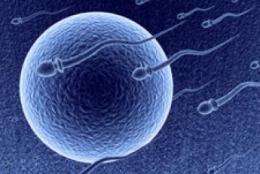
Illustrated here are images of sperm and egg. Credit: NIH

When sperm meets egg, the chemical instructions that tag sperm cells must be erased so that human life can start anew. One way these instructions are erased is through demethylation, the removal of specific chemical tags or methyl groups that dot the underlying DNA of cells. Though scientists have known about this phenomenon for a decade, exactly how such "reprogramming" occurs has proved elusive.

Now, a study from the University of North Carolina at Chapel Hill School of Medicine has illuminated a key step of demethylation, giving stem cell researchers critical information as they try to reprogram to mimic the curative and self-renewing properties of .

Previous research had shown that the methyl tags on DNA are converted to their chemical cousin, hydroxymethyl, before disappearing completely. The current finding, published online in the September 22, 2011, issue of Science Express, suggests that the disappearance of these chemical tags in the later steps of demethylation is not an active process catalyzed by an enzyme but is rather a passive process.

"The of this molecular event is not known yet, we are still trying to figure it out," said senior study author Yi Zhang, Ph.D., Kenan distinguished professor of biochemistry and biophysics at UNC and an investigator of the Howard Hughes Medical Institute. "But we do believe it must be important for development, because it happens before the cells committed to any specific cell types." Zhang is also a member of the UNC Lineberger Comprehensive Cancer Center.

Zhang's postdoctoral fellow and co-author Azusa Inoue, Ph.D., developed a technique that enabled him to visualize chromosomes – the threadlike bodies that contain the cell's DNA – at the earliest stage of life. Through a high resolution staining technique, he was able to compare the levels of methyl tags and hydroxymethyl tags in sperm and egg chromosomes at early developmental stages of life.

Their findings confirmed what they already knew – that the sperm DNA goes through a chemical conversion from methyl to hydroxylmethyl while the egg DNA did not. But it also found something new – that the hydroxymethyl tags disappeared passively over time, being diluted out as the DNA divided and the organism doubled from the one-cell to the two- and four-cell stage.

The clinical implications of the finding are still not clear, Zhang says, because researchers still don't know why male DNA undergoes that initial conversion when female DNA does not. It may have something to do with the differential protein structure (chromatin) that packages the DNA of sperm and egg. This is a notion Zhang and others in the field are actively pursuing.

Explore further: Researcher admits mistakes in stem cell study

Related Stories

Scientists identify seventh and eighth bases of DNA

Jul 21, 2011

For decades, scientists have known that DNA consists of four basic units -- adenine, guanine, thymine and cytosine. Those four bases have been taught in science textbooks and have formed the basis of the growing knowledge ...

Recommended for you

Researcher admits mistakes in stem cell study

1 hour ago

A blockbuster study in which US researchers reported that they had turned human skin cells into embryonic stem cells contained errors, its lead author has acknowledged. ...

Scientists discover how rapamycin slows cell growth

2 hours ago

University of Montreal researchers have discovered a novel molecular mechanism that can potentially slow the progression of some cancers and other diseases of abnormal growth. In the May 23 edition of the prestigious journal ...

Unlocking secrets of cell reproduction

11 hours ago

Research published in Open Biology today identifies, for the first time, nearly all the genes required for reproduction of a cell in a living organism.

What the smallest infectious agents reveal about evolution

23 hours ago

Radically different viruses share genes and are likely to share ancestry, according to research published in BioMed Central's open access journal Virology Journal this week. The comprehensive phylogenomic analysis compar ...

User comments : 1

Adjust slider to filter visible comments by rank

Display comments: newest first

astro_optics
1 / 5 (1) Sep 22, 2011
looks similar to the immune system reprogramming, most likely to prevent male DNA from be rejected.

More news stories

Scientists discover how rapamycin slows cell growth

University of Montreal researchers have discovered a novel molecular mechanism that can potentially slow the progression of some cancers and other diseases of abnormal growth. In the May 23 edition of the prestigious journal ...

Controlling mood through the motions of mitochondria

(Medical Xpress)—Regulating the distribution of power in neurons is done by a system that makes the national electric grid look simple by comparison. Each neuron has several thousand mitochondria confined ...

Google Drive sports new view and scan enhancements

(Phys.org) —Google Drive has a new look and functions. The makeover in Google Drive features scanning and interface enhancements that put the user into "card" mode. The enhancements make it easy for the ...

Future doctors unaware of their obesity bias

Two out of five medical students have an unconscious bias against obese people, according to a new study by researchers at Wake Forest Baptist Medical Center. The study is published online ahead of print in the Journal of ...

WHO: Scientific red tape mars efforts vs. virus

International efforts to combat a new pneumonia-like virus that has now killed 22 people are being slowed by unclear rules and competition for the potentially profitable rights to disease samples, the head ...