Scientists lay out plans for efficient harvesting of solar energy
September 23, 2011

Nature offers key lessons on harvesting solar power, says U of T chemistry professor

Enlarge

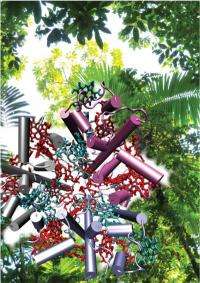
Half the green pigment (chlorophyll) in this Costa Rican rain forest is bound in the light-harvesting complex LHCII (shown in the inset). By studying these natural solar energy antennas, researchers have learnt new physical principles underlying the design of "circuits" that harvest and transport energy from the sun. Credit: Greg Scholes

Solar power could be harvested more efficiently and transported over long distances using tiny molecular circuits, according to research inspired by new insights into natural photosynthesis.

Incorporating the latest research into how plants, algae and some bacteria use to optimise energy production via photosynthesis, scientists have set out how to design molecular "circuitry" that is 10 times smaller than the thinnest electrical wire in computer processors. Published in Nature Chemistry, the report discusses how tiny molecular energy grids could capture, direct, regulate and amplify raw solar energy.

Professor Gregory Scholes, lead author from the University of Toronto said: "Solar often starts with the energy from light being absorbed by an assembly of molecules. The energy is stored fleetingly as vibrating electrons and then transferred to a suitable reactor.

"It is the same in biological systems. In , for example, antenna complexes comprised of chlorophyll capture sunlight and direct the energy to special proteins that help make oxygen and sugars. It is like plugging those proteins (called reaction centres) into a solar power socket."

In natural systems energy from sunlight is captured by 'coloured' molecules called dyes or pigments, but is only stored for a billionth of a second. This leaves little time to route the energy from pigments to the that produces fuel or electricity.

The key to transferring and very quickly is to harness the collective of antennae, which are made up of just a few tens of pigments.

Dr Alexadra Olaya-Castro, co-author of the paper from UCL's department of Physics and Astronomy said: "On a bright sunny day, more than 100 million billion red and blue "coloured" photons strike a leaf each second.

"Under these conditions plants need to be able to both use the energy that is required for growth but also to get rid of that can be harmful. Transferring energy quickly and in a regulated manner are the two key features of natural light-harvesting systems.

"By assuring that all relevant energy scales involved in the process of energy transfer are more or less similar, natural antennae manage to combine quantum and classical phenomena to guarantee efficient and regulated capture, distribution and storage of the sun's energy."

Summary of lessons from nature about concentrating and distributing solar power with nanoscopic antennae:

1. The basic components of the antenna are efficient light absorbing molecules. These photo-energy absorbers should be appropriately distributed to guarantee that there is an even probability of converting sun energy into vibrating electrons across the whole antennae.

2. Take advantage of the collective properties of light-absorbing molecules by grouping them close together. This will make them exploit quantum mechanical principles so that the antenna can: i) absorb different colours ii) create energy gradients to favour unidirectional transfer and iii) possibly exploit quantum coherence for energy distribution -several energy transfer pathways can be exploited at once.

3. Make sure that the relevant energy scales involved in the energy transfer process are more or less resonant. This will guarantee that both classical and quantum transfer mechanisms are combined to create regulated and efficient distribution of energy across short and long-range distances when many antennae are connected.

4. An antenna should transfer energy not as fast as possible but as fast as necessary. This means that regulatory mechanisms need to be integrated in the antenna. For instance, if necessary, combine light-absorbing molecules with a few local "sinks" that dissipate excess of damaging energy.

More information: 'Lessons from nature about solar light harvesting' is published online in the Nature Chemistry today.

Provided by University College London search and more info website

Filter


Move the slider to adjust rank threshold, so that you can hide some of the comments.


Display comments: newest first

Doug_Huffman
Sep 23, 2011

Rank: 1 / 5 (1)
Perfect efficiency is less than 1350 Watts meter^-2
Rank 5 /5 (2 votes)
Relevant PhysicsForums posts
  • Calculating partial pressures Pa and Pw
    created1 hour ago
  • Gibbs Free Energy Change/Entropy
    created11 hours ago
  • What's the rule to covalent character
    created12 hours ago
  • Schwartz reagent-- NMR/MS/IR
    createdMay 26, 2012
  • High school chemistry EEI
    createdMay 25, 2012
  • oxidation of I- by KMnO4
    createdMay 25, 2012
  • More from Physics Forums - Chemistry

More news stories

Computer model used to pinpoint prime materials for efficient carbon capture

When power plants begin capturing their carbon emissions to reduce greenhouse gases – and to most in the electric power industry, it's a question of when, not if – it will be an expensive undertaking.

Chemistry / Materials Science

created 4 hours ago | popularity not rated yet | comments 0 | with audio podcast

Scientists develop ultra-sensitive test that detects diseases in their earliest stages

Scientists have developed an ultra-sensitive test that should enable them to detect signs of a disease in its earliest stages, in research published today in the journal Nature Materials.

Chemistry / Analytical Chemistry

created 4 hours ago | popularity not rated yet | comments 0 | with audio podcast

New CO2-removing catalyst can take the heat

(Phys.org) -- The current method of removing the greenhouse gas carbon dioxide (CO2) from the flues of coal-fired power plants uses so much energy that no one bothers to use it. So says Roger Aines, principal ...

Chemistry / Materials Science

created May 24, 2012 | popularity 5 / 5 (9) | comments 10 | with audio podcast

High-speed method to aid search for solar energy storage catalysts

Eons ago, nature solved the problem of converting solar energy to fuels by inventing the process of photosynthesis.

Chemistry / Materials Science

created May 25, 2012 | popularity 5 / 5 (3) | comments 4 | with audio podcast

Researchers demonstrate possible primitive mechanism of chemical info self-replication

(Phys.org) -- When scientists think about the replication of information in chemistry, they usually have in mind something akin to what happens in living organisms when DNA gets copied: a double-stranded molecule ...

Chemistry / Materials Science

created May 25, 2012 | popularity 5 / 5 (4) | comments 2 | with audio podcast


Land and sea species differ in climate change response: study

(Phys.org) -- Marine and terrestrial species will likely differ in their responses to climate warming, new research by Simon Fraser University and Australia’s University of Tasmania has found.

'Unzipped' carbon nanotubes could help energize fuel cells, batteries

Multi-walled carbon nanotubes riddled with defects and impurities on the outside could replace some of the expensive platinum catalysts used in fuel cells and metal-air batteries, according to scientists at ...

T cells 'hunt' parasites like animal predators seek prey, study shows

By pairing an intimate knowledge of immune-system function with a deep understanding of statistical physics, a cross-disciplinary team at the University of Pennsylvania has arrived at a surprising finding: T cells use a movement ...

Change in developmental timing was crucial in the evolutionary shift from dinosaurs to birds: study

At first glance, it's hard to see how a common house sparrow and a Tyrannosaurus Rex might have anything in common. After all, one is a bird that weighs less than an ounce, and the other is a dinosaur that ...

Nvidia trumpets Tegra 3 phone design wins for 2012

(Phys.org) -- Nvidia’s competitive war paint has a name, Tegra 3. On the heels of Nvidia announcements about lowering costs of its Tegra 3 processors and Nvidia-enabled tablets running Android Ice Cream ...

Yale study concludes public apathy over climate change unrelated to science literacy

Are members of the public divided about climate change because they don't understand the science behind it? If Americans knew more basic science and were more proficient in technical reasoning, would public consensus match ...