Many US schools adding iPads, trimming textbooks
September 4, 2011 By STEPHANIE REITZ , Associated Press
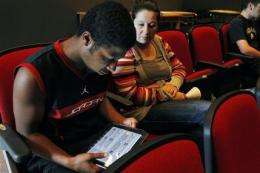
In this Aug. 23, 2011 photo, sophomore Lenny Thelusma, 16, checks out his new iPad as his mother, Tara Killion, looks on at Burlington High School in Burlington, Mass. Burlington is giving iPads this year to every one of its 1,000-plus high school students. Some classes will still have textbooks, but the majority of work and lessons will be on the iPads. (AP Photo/Elise Amendola)
(AP) -- For incoming freshmen at western Connecticut's suburban Brookfield High School, hefting a backpack weighed down with textbooks is about to give way to tapping out notes and flipping electronic pages on a glossy iPad tablet computer.
A few hours away, every student at Burlington High School near Boston will also start the year with new school-issued iPads, each loaded with electronic textbooks and other online resources in place of traditional bulky texts.
While iPads have rocketed to popularity on many college campuses since Apple Inc. introduced the device in spring 2010, many public secondary schools this fall will move away from textbooks in favor of the lightweight tablet computers.
Apple officials say they know of more than 600 districts that have launched what are called "one-to-one" programs, in which at least one classroom of students is getting iPads for each student to use throughout the school day.
Nearly two-thirds of them have begun since July, according to Apple.
New programs are being announced on a regular basis, too. As recently as Wednesday, Kentucky's education commissioner and the superintendent of schools in Woodford County, Ky., said that Woodford County High will become the state's first public high school to give each of its 1,250 students an iPad.
At Burlington High in suburban Boston, principal Patrick Larkin calls the $500 iPads a better long-term investment than textbooks, though he said the school will still use traditional texts in some courses if suitable electronic programs aren't yet available.
"I don't want to generalize because I don't want to insult people who are working hard to make those resources," Larkin said of textbooks, "but they're pretty much outdated the minute they're printed and certainly by the time they're delivered. The bottom line is that the iPads will give our kids a chance to use much more relevant materials."
The trend has not been limited to wealthy suburban districts. New York City, Chicago and many other urban districts also are buying large numbers of iPads.
The iPads generally cost districts between $500 and $600, depending on what accessories and service plans are purchased.
By comparison, Brookfield High in Connecticut estimates it spends at least that much yearly on every student's textbooks, not including graphing calculators, dictionaries and other accessories they can get on the iPads.
Educators say the sleek, flat tablet computers offer a variety of benefits.
They include interactive programs to demonstrate problem-solving in math, scratchpad features for note-taking and bookmarking, the ability to immediately send quizzes and homework to teachers, and the chance to view videos or tutorials on everything from important historical events to learning foreign languages.
They're especially popular in special education services, for children with autism spectrum disorders and learning disabilities, and for those who learn best when something is explained with visual images, not just through talking.
Some advocates also say the interactive nature of learning on an iPad comes naturally to many of today's students, who've grown up with electronic devices as part of their everyday world.
But for all of the excitement surrounding the growth of iPads in public secondary schools, some experts watching the trend warn that the districts need to ensure they can support the wireless infrastructure, repairs and other costs that accompany a switch to such a tech-heavy approach.
And even with the most modern device in hand, students still need the basics of a solid curriculum and skilled teachers.
"There's a saying that the music is not in the piano and, in the same way, the learning is not in the device," said Mark Warschauer, an education and informatics professor at the University of California-Irvine whose specialties include research on the intersection of technology and education.
"I don't want to oversell these things or present the idea that these devices are miraculous, but they have some benefits and that's why so many people outside of schools are using them so much," he said.
One such iPad devotee is 15-year-old Christian Woods, who starts his sophomore year at Burlington, Mass., High School on a special student support team to help about 1,000 other teens adjust to their new tablets.
"I think people will like it. I really don't know anybody in high school that wouldn't want to get an iPad," he said. "We're always using technology at home, then when you're at school it's textbooks, so it's a good way to put all of that together."
Districts are varied in their policies on how they police students' use.
Many have filtering programs to keep students off websites that have not been pre-approved, and some require the students to turn in the iPads during vacation breaks and at the end of the school year. Others hold the reins a little more loosely.
"If we truly consider this a learning device, we don't want to take it away and say, `Leaning stops in the summertime.' " said Larkin, the Burlington principal.
And the nation's domestic textbook publishing industry, accounting for $5.5 billion in yearly sales to secondary schools, is taking notice of the trend with its own shift in a competitive race toward developing curriculum specifically for iPads.
At Boston-based Houghton Mifflin Harcourt, for instance, programmers scrambled to create an iPad-specific secondary school program starting almost as soon as Apple unveiled the tablet in spring 2010.
The publisher's HMH Fuse algebra program, which became available at the start of the 2010 school year, was among the first and is a top seller to districts. Another algebra program and a geometry offering are coming out now.
The HMH Fuse online app is free and gives users an idea of how it works, and the content can be downloaded for $60. By comparison, the publisher's 950-page algebra text on which it was based is almost $73 per copy, and doesn't include the graphing calculators, interactive videos and other features.
For a school that would buy 300 of the textbooks for its freshman class, for instance, the savings from using the online version would be almost $4,000.
Jay Diskey, executive director of the Association of American Publishers' schools division, said all of the major textbook publishers are moving toward electronic offerings, but at least in the short term, traditional bound textbooks are here to stay.
"I think one of the real key questions that will be answered over the next several years is what sort of things work best in print for students and what sort of things work best digitally," Diskey said. "I think we're on the cusp of a whole new area of research and comprehension about what digital learning means."
©2011 The Associated Press. All rights reserved. This material may not be published, broadcast, rewritten or redistributed.
-
From lemons to lemonade: Reaction uses carbon dioxide to make carbon-based semiconductor,
32 comments
-
Thioridazine kills cancer stem cells in human while avoiding toxic side-effects of conventional cancer treatments,
3 comments
-
SpaceX private rocket blasts off for space station (Update),
42 comments
-
Climate scientists say they have solved riddle of rising sea,
31 comments
-
SpaceX capsule has 'new car' smell, astronauts say (Update),
4 comments
-
Need a rigid insulation material???
19 hours ago
-
magnets or EMF in car bumpers to protect from fender bender
May 26, 2012
-
length of wire in a coil of known dimensions?
May 25, 2012
-
India Engineering Powerhouse
May 25, 2012
-
electromagnet core dereference between hard and soft iron
May 25, 2012
-
Measuring water pressure in an open tank
May 24, 2012
- More from Physics Forums - General Engineering
More news stories
Nvidia trumpets Tegra 3 phone design wins for 2012
(Phys.org) -- Nvidias competitive war paint has a name, Tegra 3. On the heels of Nvidia announcements about lowering costs of its Tegra 3 processors and Nvidia-enabled tablets running Android Ice Cream ...
Dell tablet leak: 10.1-inch display, two-battery choice
(Phys.org) -- Headline after headline talks about vendors tablets in the wings as likely number-one contenders for the iPad. Such claims have justifiably been taken with a grain of salt, considering ...
Nvidia says Kai platform will turn price tide for tablets
(Phys.org) -- In March, Nvidia gave some signs that they were working to lower the cost of their Tegra 3 processors and they suggested consumers might see prices for Android tablets as low as $199. Connect ...
OmniVision tops up sensors for cameras, phones
(Phys.org) -- OmniVision has announced two high-resolution image sensors for the digital still and digital video camera market (DS/DVC) and higher end smartphones. In end-user language, it is a claim for superior ...
MIT researchers devise new means to synchronize a group of robots (w/ Video)
(Phys.org) -- For several years, roboticists have been working out ways to get a group of robots to perform synchronized activities as demonstrated most often in dance routines. Its not just about trying ...
Land and sea species differ in climate change response: study
(Phys.org) -- Marine and terrestrial species will likely differ in their responses to climate warming, new research by Simon Fraser University and Australia’s University of Tasmania has found.
'Unzipped' carbon nanotubes could help energize fuel cells, batteries
Multi-walled carbon nanotubes riddled with defects and impurities on the outside could replace some of the expensive platinum catalysts used in fuel cells and metal-air batteries, according to scientists at ...
T cells 'hunt' parasites like animal predators seek prey, study shows
By pairing an intimate knowledge of immune-system function with a deep understanding of statistical physics, a cross-disciplinary team at the University of Pennsylvania has arrived at a surprising finding: T cells use a movement ...
Computer model used to pinpoint prime materials for efficient carbon capture
When power plants begin capturing their carbon emissions to reduce greenhouse gases and to most in the electric power industry, it's a question of when, not if it will be an expensive undertaking.
Change in developmental timing was crucial in the evolutionary shift from dinosaurs to birds: study
At first glance, it's hard to see how a common house sparrow and a Tyrannosaurus Rex might have anything in common. After all, one is a bird that weighs less than an ounce, and the other is a dinosaur that ...
Yale study concludes public apathy over climate change unrelated to science literacy
Are members of the public divided about climate change because they don't understand the science behind it? If Americans knew more basic science and were more proficient in technical reasoning, would public consensus match ...
Sep 04, 2011
Rank: 1.8 / 5 (5)
Kindle or something similar = good idea
You don't want an IPAD toy on every students desk. But an electronic book is not unreasonable.
Sep 04, 2011
Rank: 4.8 / 5 (27)
Sep 04, 2011
Rank: 2.3 / 5 (6)
Fool.
Sep 04, 2011
Rank: 4.8 / 5 (26)
Sep 04, 2011
Rank: 5 / 5 (2)
Wurd up. Da village raises de chile.I dont know. Kids need to learn how to resist temptation and focus on their work. Cant you restrict what goes on school ipads anyway? Sure you can.
Sep 04, 2011
Rank: 1.6 / 5 (7)
"That would be the future" - NumenTard
Conservative stupidity knows no bounds apparently.
Based on his inadequate mental development I conclude that NumenTard must be self home schooled.
Sep 04, 2011
Rank: 1.8 / 5 (5)
Then you don't have the benefits of an Ipad, and a kindle type book reader would be better suited.
Children have difficulty breaking books. That won't be the case for overpriced electronic toys from Apple.
Sep 04, 2011
Rank: 4.9 / 5 (27)
Perhaps, but, I never implied we should get rid of social discourse for kids. These things are readily available through community sports, activities, etc. Public schools don't have a monopoly on social interactions, so getting rid of them as old fashioned has no baring on social development.
Further, the opposite could occur, where social stigmas and bullying could cause the counter effect and stunt a kids development. This must have happened to Vendicar because he appears not to have left his mothers basement for two decades.
Sep 04, 2011
Rank: 4.7 / 5 (27)
I have to agree (may never happen again). An iPad is just another distraction. Ultimately the most important lesson is for Kids to learn how to learn themselves. The teachers unions want free ones probably for themselves, and want a device to do their job for them. Corruption.
If they're not going to go all the way with utilizing computers and the internet, then stick with texts made out of a tree. It's the twenty first century,.. full interactive curriculum's should already be online, period.
Sep 04, 2011
Rank: 5 / 5 (1)
Group learning has been the norm in tribal settings. Most people spend their lives working in groups. A group dynamic where kids are all asking questions, offering answers, making mistakes, and helping one another can be beneficial in ways which arent available when learning in isolation.
Discussion and cooperation in groups is a very human way of interacting. This can be experienced to a degree online, as it is here. Has this experience made us better people? Perhaps we would be better able to exercise responsibility for what we say in person, or at least in Second Life or some similar setting.
Sep 04, 2011
Rank: 4 / 5 (1)
How many times have you changed cell phone carriers, and found that even though the new carrier sold the exact same model of cell phone you were using you can't use it with them? The only difference is either in the removable chipset under the battery, or embedded chipset which has a jtag port in the battery compartment to read/write it.
Now they are extended this into the field of computers via the tablet computers. That is beyond stupid. It cost a lot of money to make the things, it cost a lost of money to distribute them, it cost a lot of money to (properly) dispose of them, and this just makes it cost more money on the consumer that is already strapped for cash in a failing economy. All this cost for schools is going to be reflected in taxation to keep up with it.
Take it back to the drawing board, don't come back until we have a reusable tablet that is on part with a desktop PC in terms of reuse.
Sep 04, 2011
Rank: 2.6 / 5 (5)
I see, so you think that after a hard day at home, teaching themselves, children are going to bus themselves to a local community center and play a little basketball or baseball to round out their education.
Is that how School works on your home planet Libertaria?
Sep 04, 2011
Rank: 2 / 5 (4)
Oh, come on man... That is Libertarian free market freedom.
"it cost a lot of money to (properly) dispose of them, and this just makes it cost more money on the consumer that is already strapped for cash in a failing economy." - Default
Ya, but as long as it destroys public education, Conservatives are all for it.
"Take it back to the drawing board, don't come back until we have a reusable tablet that is on part with a desktop PC in terms of reuse." - Default
Kids will break almost everything you give them. Giving them a tablet with an exposed screen screaming to be scratched, and cracked is a sure path to the road of expensive failure.
Sep 05, 2011
Rank: not rated yet
omf, that is SO TRUE!