Salmon and other fish predators rely on 'no guts, no glory' survival tactic
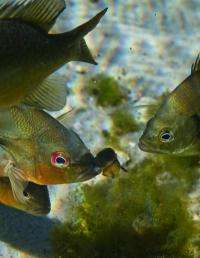
Bluegill forage on snails in Florida. Credit: Jonathan Armstrong
The phrase "no guts, no glory" doesn't just apply to athletes who are striving to excel.
Salmon and other fish predators take the adage literally, by having up to three times the "gut" capacity they need on a daily basis just so they can "glory" when prey is abundant, University of Washington researchers have discovered.
It's a previously unrecognized survival tactic that might apply to other top predators, such as wolves, lions and bears, according to Jonathan Armstrong, a UW doctoral student in aquatic and fishery sciences and lead author of a letter published recently in the journal Nature.
"The predatory fish we examined have the guts to consume two- to three-times the amount of food that they regularly encounter. This much excess capacity suggests predator-prey encounters are far patchier or random than assumed in biology and that binge-feeding enables predators to survive despite regular periods of famine," Armstrong said. Co-author on the paper is Daniel Schindler, UW professor of aquatic and fishery sciences.
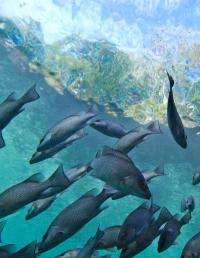
This is a gray snapper school in Florida waters. Credit: Jonathan Armstrong
"Guts are really expensive organs in terms of metabolism," Armstrong said. For instance, maintaining a gut can require 30 to 40 percent of the blood pumped by an animal's heart.Some animals have some capacity to grow or shrink their guts in response to changing conditions. For example, the digestive organs of birds that are about to migrate expand so they can eat more and fatten up. This is followed by a period when their guts atrophy and then, freed of the baggage of heavy guts, the birds take off.
That and results from lab studies led some scientists to assume that predators eliminate excess digestive capacity to save energy in times of famine. But the UW findings show that many fish species maintain a huge gut, which enables them to capitalize on unpredictable pulses of food.
"For predator fish, the world is a slot machine sometimes they stumble upon small meals and other times they hit the jackpot. It's just not as predictable as some have thought," Armstrong said.
"Unlike some other animals, fish can't just hoard their food behind a rock in the stream and eat it later. They need to binge during the good times so that they can grow and build energy reserves to survive the bad times."
Armstrong and Schindler hope that their results can help with ecological models used in conservation and management.
"Ecosystem models typically assume relatively constant interactions between predator and prey but our results suggest such interactions are extremely patchy. We're excited to see if including this ecological realism might improve the predictions of these models."
More information: Nature: http://www.nature. … re10240.html
Provided by
University of Washington
-
From lemons to lemonade: Reaction uses carbon dioxide to make carbon-based semiconductor,
32 comments
-
Thioridazine kills cancer stem cells in human while avoiding toxic side-effects of conventional cancer treatments,
3 comments
-
SpaceX private rocket blasts off for space station (Update),
42 comments
-
Climate scientists say they have solved riddle of rising sea,
31 comments
-
SpaceX capsule has 'new car' smell, astronauts say (Update),
4 comments
-
What would stain as translucent on light-coloured fabric?
21 hours ago
-
How do I identify different bacteria on culture plates?
May 26, 2012
-
Why Do Dogs do Strange things...
May 25, 2012
-
What does exophillic and endophillic mean in terms of mosquito and their control?
May 24, 2012
-
Semen stains glows under black lights (uv light)?
May 23, 2012
-
Question on Human Chromosome 2
May 23, 2012
- More from Physics Forums - Biology
More news stories
Manufacturing genes to attack flu virus
An international research team has manufactured a new protein that can combat deadly flu epidemics.
2 hours ago |
not rated yet |
0
|
Scientist: Evolution debate will soon be history
(AP) -- Richard Leakey predicts skepticism over evolution will soon be history. Not that the avowed atheist has any doubts himself.
20 hours ago |
3.4 / 5 (19) |
78
More plant species responding to global warming than previously thought
(Phys.org) -- Far more wild plant species may be responding to global warming than previous large-scale estimates have suggested.
May 22, 2012 |
4.6 / 5 (14) |
18
|
Thousands of shellfish found dead in Peru
Thousands of crustaceans were found dead off the coast of Lima following the mystery mass death of dolphins and pelicans, the Peruvian Navy said Friday.
May 26, 2012 |
4.8 / 5 (5) |
7
For monogamous sparrows, it doesn't pay to stray (but they do it anyway)
It's quite common for a female song sparrow to stray from her breeding partner and mate with the male next door, but a new study shows that sleeping around can be costly.
May 22, 2012 |
5 / 5 (2) |
8
|
Land and sea species differ in climate change response: study
(Phys.org) -- Marine and terrestrial species will likely differ in their responses to climate warming, new research by Simon Fraser University and Australia’s University of Tasmania has found.
Almost half of new vets seek disability
(AP) -- America's newest veterans are filing for disability benefits at a historic rate, claiming to be the most medically and mentally troubled generation of former troops the nation has ever seen.
'Unzipped' carbon nanotubes could help energize fuel cells, batteries
Multi-walled carbon nanotubes riddled with defects and impurities on the outside could replace some of the expensive platinum catalysts used in fuel cells and metal-air batteries, according to scientists at ...
T cells 'hunt' parasites like animal predators seek prey, study shows
By pairing an intimate knowledge of immune-system function with a deep understanding of statistical physics, a cross-disciplinary team at the University of Pennsylvania has arrived at a surprising finding: T cells use a movement ...
Computer model used to pinpoint prime materials for efficient carbon capture
When power plants begin capturing their carbon emissions to reduce greenhouse gases and to most in the electric power industry, it's a question of when, not if it will be an expensive undertaking.
Change in developmental timing was crucial in the evolutionary shift from dinosaurs to birds: study
At first glance, it's hard to see how a common house sparrow and a Tyrannosaurus Rex might have anything in common. After all, one is a bird that weighs less than an ounce, and the other is a dinosaur that ...
