RIT conducts flood mapping of New York's hard hit Schoharie County
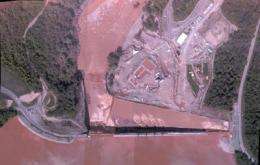
RIT captured high-resolution color imagery of water overflowing the Gilboa Dam on Aug. 30. Several images were stitched together and provided to New York State Office of Emergency Management within four hours. Credit: RIT Digital Imaging and Remote Sensing Laboratory
The New York State Office of Emergency Management is using imagery of the widespread flooding in Schoharie County captured by Rochester Institute of Technology and Kucera International Inc.
On Tuesday, a crew from RIT and Kucera International remotely imaged the destruction in eastern New York caused by downpours from Tropical Storm Irene. The downgraded hurricane caused devastation along the Schoharie Creek and the Mohawk River west of Schenectady.
RIT engineer and sensor operator Jason Faulring and Kucera pilots Rebecca Heller and James Bowers flew a twin engine Piper Navajo over the entire flood zone. They covered 28 square miles, capturing 1,400 images during the 3.5-hour flight.
State emergency managers are accessing images of the entire flood zone, including high-resolution imagery of the towns of Middleburg, Schoharie and Prattsville, as well as the Gilboa Dam for damage assessment.
"One of the sensors is a shortwave infrared camera that is good for flood mapping," says Don McKeown, project manager and distinguished research scientist in the Digital Imaging and Remote Sensing Group in RIT's Chester F. Carlson Center for Imaging Science. "The state office of emergency management will use the imagery for recovery planning and damage assessment."
The National Geospatial-Intelligence Agency and the Federal Emergency Management Agency also have requested access to the data. Researchers at State University of New York at Buffalo are also planning to use the imagery to assist in the development of improved watershed models for future events.
Mapping the flooded region in New York is the second disaster-imaging mission for RIT and Kucera International. The Schoharie County images were captured using the same sensors employed in Haiti following the 2010 earthquake. Faulring operated the sensor system RIT developed for the U.S. Forest Servicethe four-camera system combines high-resolution color with infrared imaging; Bowers operated Kucera's LIDAR sensor, the optical analogue to RADAR that uses laser pulses to make precision elevation measurements.
The report, "Disaster Relief 2.0: The Future of Information Sharing in Humanitarian Emergencies," attributed RIT and industry partner ImageCat for transforming the work of the Haiti response effort by capturing and releasing to public domain aerial imagery of the earthquake's aftermath. The report was issued in the spring and prepared by the United Nation Foundation, UN Office for the Coordination of Humanitarian Affairs, Harvard Humanitarian Initiative and Vodaphone Foundation Emergencies.
As a result of Haiti, we learned a lot of lessons about processing and how to do it and we came up with an automated processing flow," McKeown says. "Jason [Faulring] did a whole day's processing in an hour and a half. We're light years ahead of where we were during Haiti."
RIT and Kucera International are partners through the National Science Foundation-funded Information Products Laboratory for Emergency Response, a collaborative effort between RIT and UB to match remote sensing technology with the needs of emergency responders.
"The thing that highlights the function that we're performing with IPLER is that not all the problems are technical," McKeown says. "Realizing the state and federal funding constraints, and the critical need to assess the impact of the damage to help those citizens most immediately affected, we felt that imagery‑based information could be very useful, so we stood up to the plate. Kucera donated flight time and LIDAR sensor data for the operation. We were able to use funding from our U.S. Department of Homeland Security grant to cover RIT's efforts, as this kind of mission is exactly what this research program is designed to address. As a result, we were able to provide this information at no cost to the New York state taxpayer."
Provided by
Rochester Institute of Technology
-
From lemons to lemonade: Reaction uses carbon dioxide to make carbon-based semiconductor,
32 comments
-
Thioridazine kills cancer stem cells in human while avoiding toxic side-effects of conventional cancer treatments,
3 comments
-
SpaceX private rocket blasts off for space station (Update),
42 comments
-
Climate scientists say they have solved riddle of rising sea,
31 comments
-
SpaceX capsule has 'new car' smell, astronauts say (Update),
4 comments
-
Hypothetical desert earth
17 hours ago
-
More human population = greater mass?
May 25, 2012
-
Conversion from aircraft bearing to normal degrees
May 23, 2012
-
Interpretation/Analysis of the Lab results(HEPA filter)
May 22, 2012
-
Has anyone here attended the The Urbino Summer School in Paleoclimatology?
May 22, 2012
-
Earthquakes: Mag 6 N. Italy and Mag 5.6 W. Bulgaria
May 21, 2012
- More from Physics Forums - Earth
More news stories
Land and sea species differ in climate change response: study
(Phys.org) -- Marine and terrestrial species will likely differ in their responses to climate warming, new research by Simon Fraser University and Australia’s University of Tasmania has found.
25 minutes ago |
not rated yet |
1
|
Yale study concludes public apathy over climate change unrelated to science literacy
Are members of the public divided about climate change because they don't understand the science behind it? If Americans knew more basic science and were more proficient in technical reasoning, would public consensus match ...
2 hours ago |
not rated yet |
10
|
10 million years needed to recover from mass extinction
It took some 10 million years for Earth to recover from the greatest mass extinction of all time, latest research has revealed.
Space & Earth / Earth Sciences
2 hours ago |
not rated yet |
1
|
Sophisticated simulations predict future warming
The chances of our planet being hit by a global warming of 3 degrees Celsius by 2050 is as likely as it being hit by an increase of 1.4 degrees, new research shows. Presented in the journal Nature Geoscience, the British study ...
Space & Earth / Earth Sciences
May 22, 2012 |
4.4 / 5 (9) |
51
Aliens don't want to eat us, says former SETI director
Alien life probably isnt interested in having us for dinner, enslaving us or laying eggs in our bellies, according to a recent statement by former SETI director Jill Tarter.
Space & Earth / Space Exploration
May 25, 2012 |
4.4 / 5 (14) |
39
Almost half of new vets seek disability
(AP) -- America's newest veterans are filing for disability benefits at a historic rate, claiming to be the most medically and mentally troubled generation of former troops the nation has ever seen.
'Unzipped' carbon nanotubes could help energize fuel cells, batteries
Multi-walled carbon nanotubes riddled with defects and impurities on the outside could replace some of the expensive platinum catalysts used in fuel cells and metal-air batteries, according to scientists at ...
T cells 'hunt' parasites like animal predators seek prey, study shows
By pairing an intimate knowledge of immune-system function with a deep understanding of statistical physics, a cross-disciplinary team at the University of Pennsylvania has arrived at a surprising finding: T cells use a movement ...
Computer model used to pinpoint prime materials for efficient carbon capture
When power plants begin capturing their carbon emissions to reduce greenhouse gases and to most in the electric power industry, it's a question of when, not if it will be an expensive undertaking.
Change in developmental timing was crucial in the evolutionary shift from dinosaurs to birds: study
At first glance, it's hard to see how a common house sparrow and a Tyrannosaurus Rex might have anything in common. After all, one is a bird that weighs less than an ounce, and the other is a dinosaur that ...
Same gene that stunts infants' growth also makes them grow too big: research
UCLA geneticists have identified the mutation responsible for IMAGe* syndrome, a rare disorder that stunts infants' growth. The twist? The mutation occurs on the same gene that causes Beckwith-Wiedemann syndrome, which makes ...