Recycling fat might help worms live longer
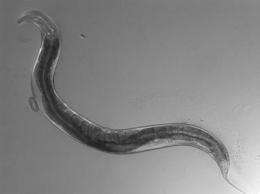
Aging is generally accepted as a universal fact of life, but how do humans and other organisms age at the molecular level? At Sanford-Burnham Medical Research Institute (Sanford-Burnham), a team led by Malene Hansen, Ph.D., uses a type of worm called Caenorhabditis elegans to work out the molecular underpinnings of the aging process. In a study appearing online September 8 in Current Biology, they found that two cellular processes—lipid metabolism and autophagy -- work together to influence worms' lifespan. Autophagy, a major mechanism cells use to digest and recycle their own contents, has become the subject of intense scientific scrutiny over the past few years, particularly since the process (or its malfunction) has been implicated in many human diseases, including cancer and Alzheimer's disease. This study provides a more detailed understanding of the roles autophagy and lipid metabolism play in aging.
"The particular worm model we used in this study is known to live longer than normal worms, but we didn't completely understand why," said Dr. Hansen, assistant professor in Sanford-Burnham's Del E. Webb Neuroscience, Aging and Stem Cell Research Center and senior author of the study. "Our results suggest that increased autophagy has an anti-aging effect, possibly by promoting the activity of a fat-digesting enzyme. In other words, it seems that recycling fat is a good thing—at least for worms."
C. elegans is a common laboratory model because it can be grown in bulk, is convenient for genetic analysis, and has a short lifespan that makes it ideal for longevity studies. Over the past 50 years, this humble organism has given scientists valuable insight not only into aging, but also many other biological systems and processes that occur in higher species, such as neural development and RNA interference. The worms used in this particular study were germline-less. It's been known for awhile that germline-less worms live longer than normal worms, and this study helps explain why.
Although they can't reproduce, germline-less worms still have gonads (albeit empty ones). They still produce all the fat that would normally go into making eggs, but don't actually produce them. This study shows that—perhaps as a result of all this extra fat that needs to go somewhere or be recycled—autophagy kicks into high gear in germline-less worms.
LIPL-4, an enzyme that helps break down fats, was also previously shown to be hyperactive in these worms, where it helps extend lifespan. Yet it was unknown how the enzyme modulates longevity. Here the researchers found that these two events were interdependent—autophagy was required to maintain high LIPL-4 activity and, reciprocally, LIPL-4 was required for the initiation of autophagy. Ultimately, they tied both of these events to a master regulator that is reduced in germline-less worms—a nutrient sensor called TOR, which influences metabolism and aging in many species.
Hyperactive autophagy and LIPL-4 added up to longer lives for these germline-less worms. On average, they survived 25 percent longer than their normal counterparts.
"It's basically a supply and demand problem," explained Louis Lapierre, Ph.D., postdoctoral researcher and first author of the study. "When worms have more fat in supply than they have demand for, it has to be stored. In these long-lived worms however, there's activation of a seemingly futile cycle of breaking down fat and re-synthesizing it. Only we found that breaking down fat is actually beneficial and perhaps not so futile after all."
Dr. Hansen's group is interested in many aspects of aging, and they were excited to discover this new angle linking autophagy and lipid metabolism. In addition to answering questions about aging, this research is likely to advance the molecular understanding of age-related disorders such as diabetes, cancer, and neurodegenerative diseases.
In their next experiments, the team will further delineate the relationship between autophagy and LIPL-4, and their exact effects on lipid metabolism. They are also interested in determining if the longevity function of these pathways is conserved in other animals.
Provided by Sanford-Burnham Medical Research Institute


