September 27, 2011 feature
The quantum world writ large: Using short optical pulses to study macroscopic quantum behavior
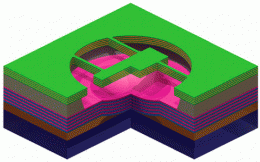
(PhysOrg.com) -- Einstein infamously dismissed quantum entanglement as spooky action at a distance and quantum uncertainty with his quip that God does not play dice with the universe. Aside from revealing his conceptual prejudices, Einstein’s rejection of these now-established hallmarks of quantum mechanics point to the field’s elusive nature: Coherent quantum mechanical phenomena, such as entanglement and superposition, are not apparent at macroscopic levels of scale. In fact, a common view is that on these scales quantum behavior is masked by decoherence, or even that quantum mechanics itself needs revision. Encouragingly, however, researchers at the Vienna Center for Quantum Science and Technology (VCQ), University of Vienna, have recently proposed an experimental design that would use a macroscopic mechanical resonator, short optical pulses and optical microcavities to realize quantum state tomography, squeezing, and state purification that could shed light on this elusive boundary between the quantum and classical worlds.
Led by Michael R. Vanner in Prof. Markus Aspelmeyer’s Aspelmeyer Group for Quantum Foundation and Quantum Information at the Nano- and Microscale, the team – which also included I. Pikovski, G. D. Cole, M. S. Kim, Č. Brukner, K. Hammerer, and G. J. Milburn – faced a number of challenges in devising their optomechanical scheme to fully reconstruct quantum states of mechanical motion. One of the most fundamental is the attempt to observe quantum mechanical behavior of a macroscopic mechanical object, since any potential quantum features would exhibit themselves only on truly miniscule scales. “For the mechanical structures that we consider,” Vanner explains, “one needs to resolve position displacements of about a femtometer,” or one-trillionth of a millimeter. “This is a mind‐bogglingly small distance that is, in fact, smaller than even the diameter of a hydrogen nucleus.”
This then leads to additional challenges: In the attempt to measure an object’s position, the object moves and causes positional smearing by injecting uncertainty into the resulting position information, which is referred to as the Standard Quantum Limit (SQL). “The first challenge that we had to overcome was to find a method which circumvents the SQL,” Vanner continues. “The second was that making measurements of the position alone is insufficient to reconstruct a quantum state. This is because the quantum state contains all that is, at least in principle, knowable about the object. And so, one needs to also measure all the complementary properties of the state, such as its momentum, and to do so also in an equally precise manner.”
Since no existing microscopy technology is capable of resolving quantum-scale features, the team addressed these challenges with optical interferometry. “Perhaps where we benefited most,” Vanner reflects, “was from the work of V. B. Braginsky, who made several seminal contributions to the field of quantum measurement1. In particular he introduced a scheme using short pulses of light that can overcome the SQL.” A short pulsed interaction can achieve this because the mechanical object has very little time to move during the interaction, and thus smearing can be dramatically reduced. “Braginsky developed this technique to make sensitive force detectors with the goal of detecting gravitational waves,” notes Vanner. “We’ve utilized this technique to allow for very sensitive position measurements. What we introduce in our proposal is a protocol using these pulsed measurements to perform quantum state reconstruction, which was our primary interest, and also a protocol to prepare low entropy squeezed states.”
The state reconstruction scheme works in much the same way as many modern medical imaging techniques – that is, by taking images from many angles, as in X‐ray computed tomography, it is possible to determine the three-dimensional internal structure within the body. “Applying this analogy to our case,” Vanner continues, “the internal structure is the quantum state and the angles are its various properties: position, momentum, and their combinations. Our state reconstruction protocol uses appropriately timed pulses of light to access all these properties, thus providing a means to determine all the information in the quantum state.” An important point is that the team has analyzed the experimental feasibility and demonstrated that the scheme is realizable with current state‐of‐the‐art technology.
Vanner is optimistic about the development of additional innovations and extensions in pulse sequences and measurements based on their pulsed design. “As an example,” Vanner notes, “we’re currently trying to compliment our work reported in PNAS by developing pulsed approaches to quantum state preparation. Combining such results with our state reconstruction results provides a complete experimental framework.”
In terms of how their findings might enhance the future exploration of quantum mechanical phenomena on a macroscopic scale, Vanner points out that one important quantum mechanical phenomenon that is little explored in the laboratory is decoherence – the term given to the processes by which the environment surrounding a quantum object gains information about its state, often leading to the undesirable consequence of loss of quantum coherence between superposition components. “Decoherence is often regarded as one of the primary hindrances in efforts to construct a quantum computer. The quantum state tomography scheme that we have introduced can be used to observe and characterize decoherence, thus providing vital experimental data for the development of quantum mechanics based technology.”
Moreover, adds Vanner, “It is a fascinating prospect that quantum information can be encoded into the motion of a mechanical object. This may lead to a number of interesting possibilities, such as transduction between flying qubits – i.e., photons – and qubits in a solid state device or superconductor. A pulsed approach may indeed be a feasible route to achieving this goal.”
In addition to decoherence as discussed above, adds Vanner, “An attractive feature of the quantum state reconstruction scheme is that it can reconstruct and analyze any quantum state of motion. Thus, a large number of state‐dependent quantum effects can be studied. For example, one could utilize the fragility of a quantum superposition state as an extremely sensitive detector.”
For Vanner, one of the key prospects is to see their design actually realized. “We’re currently building an experiment to implement our quantum state reconstruction protocol,” he concludes. “I’m finding it very exciting to be able to physically implement our ideas and begin to experimentally see behavior that is predicted in our theoretical model.”
More information: Pulsed quantum optomechanics, PNAS, Published online before print September 7, 2011, doi: 10.1073/pnas.1105098108
1Related: Quantum nondemolition measurements: the route from toys to tools, V. B. Braginsky and F. Ya. Khalili, Reviews of Modern Physics 68, 1–11 (1996), doi: 10.1103/RevModPhys.68.1
Copyright 2011 PhysOrg.com.
All rights reserved. This material may not be published, broadcast, rewritten or redistributed in whole or part without the express written permission of PhysOrg.com.


