Princeton bans academics from handing all copyright to journal publishers
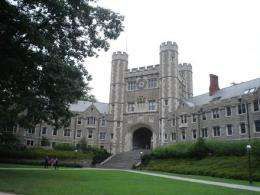
Prestigious US academic institution Princeton University has banned researchers from giving the copyright of scholarly articles to journal publishers, except in certain cases where a waiver may be granted.
The new rule is part of an Open Access policy aimed at broadening the reach of their scholarly work and encouraging publishers to adjust standard contracts that commonly require exclusive copyright as a condition of publication.
Universities pay millions of dollars a year for academic journal subscriptions. People without subscriptions, which can cost up to $25,000 a year for some journals or hundreds of dollars for a single issue, are often prevented from reading taxpayer funded research. Individual articles are also commonly locked behind pay walls.
Researchers and peer reviewers are not paid for their work but academic publishers have said such a business model is required to maintain quality.
At a September 19 meeting, Princeton’s Faculty Advisory Committee on Policy adopted a new open access policy that gives the university the “nonexclusive right to make available copies of scholarly articles written by its faculty, unless a professor specifically requests a waiver for particular articles.”
“The University authorizes professors to post copies of their articles on their own web sites or on University web sites, or in other not-for-a-fee venues,” the policy said.
“The main effect of this new policy is to prevent them from giving away all their rights when they publish in a journal.”
Under the policy, academic staff will grant to The Trustees of Princeton University “a nonexclusive, irrevocable, worldwide license to exercise any and all copyrights in his or her scholarly articles published in any medium, whether now known or later invented, provided the articles are not sold by the University for a profit, and to authorize others to do the same.”
In cases where the journal refuses to publish their article without the academic handing all copyright to the publisher, the academic can seek a waiver from the open access policy from the University.
The policy authors acknowledged that this may make the rule toothless in practice but said open access policies can be used “to lean on the journals to adjust their standard contracts so that waivers are not required, or with a limited waiver that simply delays open access for a few months.”
Academics will also be encouraged to place their work in open access data stores such as Arxiv or campus-run data repositories.
A step forward
Having prestigious universities such as Princeton and Harvard fly the open access flag represented a step forward, said open access advocate Professor Simon Marginson from the University of Melbourne’s Centre for the Study of Higher Education.
“The achievement of free knowledge flows, and installation of open access publishing on the web as the primary form of publishing rather than oligopolistic journal publishing subject to price barriers, now depends on whether this movement spreads further among the peak research and scholarly institutions,” he said.
“Essentially, this approach – if it becomes general – normalises an open access regime and offers authors the option of opting out of that regime. This is a large improvement on the present position whereby copyright restrictions and price barriers are normal and authors have to attempt to opt in to open access publishing, or risk prosecution by posting their work in breach of copyright.”
“The only interests that lose out under the Princeton proposal are the big journal publishers. Everyone else gains.”
Professor Tom Cochrane, Deputy Vice-Chancellor Technology, Information and Learning Support at the Queensland University of Technology, who has also led an Open Access policy mandate at QUT welcomed Princeton’s new rule but warned that the waiver must not be used too regularly, lest the policy be undermined.
If all universities and research institutions globally had policies similar to Princeton’s, the ultimate owner of published academic work would be universities and their research communities collectively, Professor Cochrane said.
“They are the source of all the content that publishers absolutely require to run their business model,” he said.
Dr. Danny Kingsley, an open access expert and Manager of Scholarly Communication and ePublishing at Australian National University said the move was a positive step and that the push for open access should come from the academic community.
In practice, however, the new policy requires staff have a good understanding of the copyright arrangements they currently have with journal publishers in their field.
They will need to ensure future publisher’s agreements accommodate the new position and if not, obtain a waiver from the University.
“This sounds easy but in reality might be a challenge for some academics. There is considerable evidence to show that academics often have very little understanding of the copyright situation of their published work,” she said.
“What will be most telling will be the publishers' response over the next year or so. If they start providing amended agreements to Princeton academics then the door will be open for other universities to follow this lead. I suspect however they will not, as generally the trend seems for publishers to make the open access path a complex and difficult one.”
This story is published courtesy of the The Conversation (under Creative Commons-Attribution/No derivatives).
Source: The Conversation


