September 6, 2011 feature
Patterned media technique achieves Terabit data recording densities
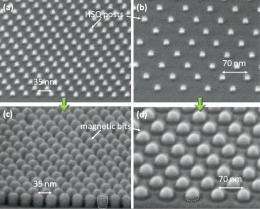
(PhysOrg.com) -- In an effort to increase the recording densities of hard disk drives, patterned media has become one of the most promising strategies for achieving recording densities beyond 1 Tbit/in2. In patterned media, data is stored in a uniform array of magnetic cells that each contain one bit, rather than in groups of randomly arranged magnetic nanograins in a thin-film magnetic alloy, as in today’s hard disk drives. In a new study, researchers have developed a simplified patterned media method by reducing the number of steps in the process, and have demonstrated high densities from 1.9 Tbit/in2 to 3.3 Tbit/in2, although the latter density still needs to be characterized by higher resolution magnetic force microscopes than were available for the study.
The researchers, Joel K. W. Yang, et al., from the Institute of Materials Research and Engineering and the Data Storage Institute at A*STAR (the Agency for Science, Technology and Research) in Singapore, as well as the National University of Singapore, have published their study in a recent issue of Nanotechnology. As Yang explained, the new method pushes the boundaries of hard disk drive recording densities.
“Yes, 3.3 Tbit/in2 is one of the highest demonstrations to date,” Yang told PhysOrg.com. “Though there are other non-magnetic patterns that have higher densities, we believe we've fabricated and tested magnetic bits that are the most densely packed.”
Today’s hard disk drives have recording densities of up to 0.5 Tbit/in2, but improving this density beyond 1-1.5 Tbit/in2 may not be possible using the same granular method. The difficulty stems from two limits. The first is a limit on the minimum number of grains per bit (each bit requires at least a few tens of grains), which is due to the need for a sufficient signal-to-noise ratio. The second limit is the superparamagnetic limit, which limits the minimum grain size. If the grain size is too small, the magnetization state becomes thermally unstable and the grains can no longer store data.
In contrast with the conventional method, patterned media (or bit-patterned media) doesn’t face the same limits. Because the magnetic cells are lithographically patterned in ordered arrays, the signal-to-noise ratio is significantly improved, and each individual magnetic cell can serve as a bit. And since the magnetic cells are larger than the grains, they don’t run into the superparamagnetic limit.
By overcoming the limitations of granular media, patterned media has the potential for achieving recording densities well beyond 1 Tbit/in2. Some patterned media techniques have even demonstrated original pattern resolutions of up to 10 Tdot/in2 (before the dots become functional bits), but these fabrication techniques rely on pattern-transfer methods such as etching or liftoff that degrade the resolution of the original pattern, and reduce the final density.
To address the pattern-transfer problem, the researchers from Singapore have developed a patterned media process that doesn’t require any kind of pattern transfer. Their technique consists of just two steps: (1) using electron beam lithography to pattern arrays of dots (or tiny pillars) as small as 10 nm in diameter on a resist material, and (2) using sputtering techniques to deposit 21-nm-thick magnetic films on top of the entire resist material. The magnetic material that lands on top of the nanoposts serves as magnetically isolated bits. By avoiding etching and liftoff processes, the resolution of the final patterns are basically identical to the resolution of the original lithographic pattern.
“The etching step could be avoided as the e-beam pattern resist itself, while being an excellent imaging medium for the electron beam, doubles up as a robust material that can be used in hard-disk platters,” Yang explained.
Using the new method, the researchers fabricated samples with a patterning density of up to 3.3 Tdot/in2, and scanning-electron microscope images showed that the final magnetic bits maintain the same densities, up to 3.3 Tbit/in2. Because the magnetic bits are physically connected to their neighbors by tiny magnetic links, the researchers had to confirm that the individual bits were still magnetically isolated and that these links did not interfere with each bit’s ability to store data. To do this, they observed the samples under a magnetic force microscope while applying magnetic fields of different strengths to switch individual bits. For samples with densities up to 1.9 Tbit/in2, the microscope showed that individual bits can be switched independently of their neighbors; beyond that, the microscope could not resolve individual bits due to its own resolution limit.
“The biggest advantage of this technique is that the final density/resolution of the fabricated bits were kept as close as possible to that of the lithographic step,” Yang said. “If we had introduced pattern-transfer steps such as etching, the maximum achievable resolution would be significantly lower due to pattern degradation during etching. As a bonus, reducing steps also reduces cost and increases throughput, especially when combined with high-throughput processes such as nanoimprint lithography and guided self-assembly.”
The researchers predict that higher resolution magnetic force microscope techniques will verify the individual switchability of the bits at 3.3 Tbit/in2. They also predict that the new patterned media technique can enable the fabrication of memories at the highest possible densities (in the range of 10 Tbit/in2). If the electron beam lithography step can be combined with, or replaced by, other scalable patterning methods such as templated self-assembly, the new technique could be used for the large-scale manufacturing of future ultrahigh-density hard disk drives.
More information: Joel K W Yang, et al. “Fabrication and characterization of bit-patterned media beyond 1.5 Tbit/in2.” Nanotechnology 22 (2011) 385301 (6pp). DOI:10.1088/0957-4484/22/38/385301
Copyright 2011 PhysOrg.com.
All rights reserved. This material may not be published, broadcast, rewritten or redistributed in whole or part without the express written permission of PhysOrg.com.


