Patented method transforms digital cameras for aerial color infrared photography
September 26, 2011 By Don Comis

Patented method transforms digital cameras for aerial color infrared photography

ARS physical scientist Raymond Hunt and colleagues have patented a way to transform commercial digital cameras to produce color infrared aerial photos that can measure the extent of vegetative cover. Credit: Raymond Hunt, ARS.

The U.S. Department of Agriculture (USDA) and David Linden, a technical consultant currently serving as a chief scientist at Science Applications International Corporation (SAIC) in McLean, Va., have jointly patented technology that transforms commercial digital cameras to color infrared cameras for aerial photography.

Raymond Hunt, a physical scientist at the Agricultural Research Service (ARS) Hydrology and Remote Sensing Laboratory in Beltsville, Md., and Linden did this by choosing a 12-megapixel camera sold without an internal filter that blocks near-infrared (NIR) light. They then added a custom-made lens filter to block red light and transmit NIR. ARS is USDA's principal intramural scientific research agency.

The patented method allows photographing with light in the NIR, green and blue bands, which are used to measure the "greenness" of vegetation and extent of crop canopy cover. There is no need for further processing, so the images are available immediately upon landing. The cameras are also lighter and more compact than the traditional larger format cameras used for aerial infrared photography.

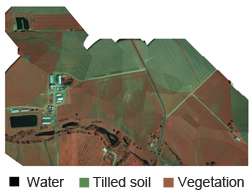
Hunt and Dean Hively, a U.S. Geological Survey scientist stationed at Beltsville, have found the photographs useful for detecting the extent of farmland in the Chesapeake Bay Watershed that is protected from by and other winter .

Hunt and Hively are seeking to increase the spatial resolution to identify plant species and to measure the amount of chlorophyll in a single leaf of a crop. The scientists use their cameras aboard both airplanes and small (UAVs). UAVs can fly as low as a few hundred feet. Currently, UAVs cannot be flown for commercial use. The U.S. is developing rules and regulations on UAVs for safe applications.

Chlorophyll in leaves may indicate the amount of nutrients in the soil, so aerial imagery may be a way to help farmers save money by applying fertilizers more efficiently, which also helps protect the Chesapeake Bay.

Read more about this research in the September 2011 issue of Agricultural Research magazine.

Hunt, Hively, Linden, and colleagues have published papers on this research in the Agronomy Journal and Remote Sensing.

Provided by USDA Agricultural Research Service

Filter


Move the slider to adjust rank threshold, so that you can hide some of the comments.


Display comments: newest first

Henrik44
Sep 27, 2011

Rank: 5 / 5 (1)
Patented technique?

Amateur-astronomer originally invented the stacking-technique for high resolution photography, which was adopted by professional astronomers as "Lucky Imaging"

Amateurs have been modifiyng DSLR cameras for half a decade now, and several telescope suppliers offers filters for this purpose.
The NIR2blue filter has also been used in professional areal photography for years.

What is there to patent? :o)

/Best regards
Henrik
Rank not rated yet
Relevant PhysicsForums posts

More news stories

Land and sea species differ in climate change response: study

(Phys.org) -- Marine and terrestrial species will likely differ in their responses to climate warming, new research by Simon Fraser University and Australia’s University of Tasmania has found.

Space & Earth / Environment

created 25 minutes ago | popularity not rated yet | comments 1 | with audio podcast

Yale study concludes public apathy over climate change unrelated to science literacy

Are members of the public divided about climate change because they don't understand the science behind it? If Americans knew more basic science and were more proficient in technical reasoning, would public consensus match ...

Space & Earth / Environment

created 2 hours ago | popularity not rated yet | comments 10 | with audio podcast

10 million years needed to recover from mass extinction

It took some 10 million years for Earth to recover from the greatest mass extinction of all time, latest research has revealed.

Space & Earth / Earth Sciences

created 2 hours ago | popularity not rated yet | comments 1 | with audio podcast

Sophisticated simulations predict future warming

The chances of our planet being hit by a global warming of 3 degrees Celsius by 2050 is as likely as it being hit by an increase of 1.4 degrees, new research shows. Presented in the journal Nature Geoscience, the British study ...

Space & Earth / Earth Sciences

created May 22, 2012 | popularity 4.4 / 5 (9) | comments 51

Aliens don't want to eat us, says former SETI director

Alien life probably isn’t interested in having us for dinner, enslaving us or laying eggs in our bellies, according to a recent statement by former SETI director Jill Tarter.

Space & Earth / Space Exploration

created May 25, 2012 | popularity 4.4 / 5 (14) | comments 39


Almost half of new vets seek disability

(AP) -- America's newest veterans are filing for disability benefits at a historic rate, claiming to be the most medically and mentally troubled generation of former troops the nation has ever seen.

'Unzipped' carbon nanotubes could help energize fuel cells, batteries

Multi-walled carbon nanotubes riddled with defects and impurities on the outside could replace some of the expensive platinum catalysts used in fuel cells and metal-air batteries, according to scientists at ...

T cells 'hunt' parasites like animal predators seek prey, study shows

By pairing an intimate knowledge of immune-system function with a deep understanding of statistical physics, a cross-disciplinary team at the University of Pennsylvania has arrived at a surprising finding: T cells use a movement ...

Computer model used to pinpoint prime materials for efficient carbon capture

When power plants begin capturing their carbon emissions to reduce greenhouse gases – and to most in the electric power industry, it's a question of when, not if – it will be an expensive undertaking.

Change in developmental timing was crucial in the evolutionary shift from dinosaurs to birds: study

At first glance, it's hard to see how a common house sparrow and a Tyrannosaurus Rex might have anything in common. After all, one is a bird that weighs less than an ounce, and the other is a dinosaur that ...

Same gene that stunts infants' growth also makes them grow too big: research

UCLA geneticists have identified the mutation responsible for IMAGe* syndrome, a rare disorder that stunts infants' growth. The twist? The mutation occurs on the same gene that causes Beckwith-Wiedemann syndrome, which makes ...