Panasonic enters mini robots in Hawaii triathlon (w/ video)
September 16, 2011

A trio of small Japanese robots will be working together in the Ironman triathlon race in Hawaii next month

Enlarge

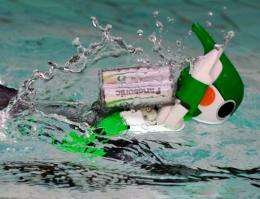
The Panasonic Evolta robot, created by Tomotaka Takahashi, powers along in a pool during a press preview in Tokyo, on September 15.

A trio of small Japanese robots will be working together in the Ironman triathlon race in Hawaii next month in a show of their inner strength -- rechargeable batteries.

Consumer electronics maker Panasonic will use one set of three for the whole 2.4-mile (3.8-kilometre) swim, 112-mile bike ride and 26.2-mile run to power the "Evolta" robots made by creator Tomotaka Takahashi.

Panasonic hopes to reach the finish line in one week, or 168 hours, by recharging the set of batteries shared by the three robots as many times as necessary during the race.

The Hawaii triathlon will be the latest in a series of similar endurance campaigns to show off the strength of the Evolta line of batteries.

This video is not supported by your browser at this time.

In the past, the company sent different Evolta robots to scale the , to ride a tiny in the Le Mans 24 hour race, and to walk 500 kilometres from Tokyo to the ancient city of Kyoto in western Japan.

The Ironman cycling and running robots are 23 and 25 centimetres (10 inches) high while the swimming one is 51 centimetres long.

This video is not supported by your browser at this time.


(c) 2011 AFP

3.4 /5 (5 votes)  

Filter


Move the slider to adjust rank threshold, so that you can hide some of the comments.


Display comments: newest first

GreyLensman
Sep 16, 2011

Rank: 5 / 5 (1)
At first I thought that the same set of battereis were going to power the bots for the entire race. That would've been quite astonishing. However, I see now that the batteries are going to be recharged "as many times as necessary". While it speaks well enough for their charge/recharge cycle, it's hardly newsworthy (and very hard to spot any sleight of hand). It's just an advertizing stunt.
krundoloss
Sep 16, 2011

Rank: not rated yet
Aww, they are cute. Seriously, how long is it gonna take to make humanoid robots? It doesnt seem that hard with today's technology, with the power source being the biggest hurdle. All you need is to give the robot an ability to balance itself like a segway does, then just model them after us. I guess there is no real motivation to create autonomous humanoid robots right now.
Jotaf
Sep 16, 2011

Rank: 5 / 5 (1)
krundoloss: Just try it! Buy an off-the-shelf humanoid and code some control loops for it to balance itself. It sounds easy in theory ("if it's falling this way, just move that way or something"). But you'll see that imagining something and making it real are quite different things! I know people who work on this and it's really, really hard. "Today's technology" is not an abstract problem-solver, but actually the brains of today's scientists. Either wait patiently for them to solve that problem for you, or join them :)
Rank 3.4 /5 (5 votes)
Relevant PhysicsForums posts

More news stories

Nvidia trumpets Tegra 3 phone design wins for 2012

(Phys.org) -- Nvidia’s competitive war paint has a name, Tegra 3. On the heels of Nvidia announcements about lowering costs of its Tegra 3 processors and Nvidia-enabled tablets running Android Ice Cream ...

Electronics / Hardware

created 9 hours ago | popularity 5 / 5 (2) | comments 1 | with audio podcast report

Dell tablet leak: 10.1-inch display, two-battery choice

(Phys.org) -- Headline after headline talks about vendors’ tablets in the wings as likely number-one contenders for the iPad. Such claims have justifiably been taken with a grain of salt, considering ...

Electronics / Consumer & Gadgets

created 21 hours ago | popularity 5 / 5 (3) | comments 9 | with audio podcast report

Nvidia says Kai platform will turn price tide for tablets

(Phys.org) -- In March, Nvidia gave some signs that they were working to lower the cost of their Tegra 3 processors and they suggested consumers might see prices for Android tablets as low as $199. Connect ...

Electronics / Hardware

created May 24, 2012 | popularity 4.3 / 5 (4) | comments 3 | with audio podcast report

OmniVision tops up sensors for cameras, phones

(Phys.org) -- OmniVision has announced two high-resolution image sensors for the digital still and digital video camera market (DS/DVC) and higher end smartphones. In end-user language, it is a claim for superior ...

Electronics / Hardware

created May 25, 2012 | popularity 5 / 5 (6) | comments 3 | with audio podcast report

MIT researchers devise new means to synchronize a group of robots (w/ Video)

(Phys.org) -- For several years, roboticists have been working out ways to get a group of robots to perform synchronized activities as demonstrated most often in dance routines. It’s not just about trying ...

Electronics / Robotics

created May 25, 2012 | popularity 5 / 5 (1) | comments 1 | with audio podcast report


Land and sea species differ in climate change response: study

(Phys.org) -- Marine and terrestrial species will likely differ in their responses to climate warming, new research by Simon Fraser University and Australia’s University of Tasmania has found.

Almost half of new vets seek disability

(AP) -- America's newest veterans are filing for disability benefits at a historic rate, claiming to be the most medically and mentally troubled generation of former troops the nation has ever seen.

'Unzipped' carbon nanotubes could help energize fuel cells, batteries

Multi-walled carbon nanotubes riddled with defects and impurities on the outside could replace some of the expensive platinum catalysts used in fuel cells and metal-air batteries, according to scientists at ...

T cells 'hunt' parasites like animal predators seek prey, study shows

By pairing an intimate knowledge of immune-system function with a deep understanding of statistical physics, a cross-disciplinary team at the University of Pennsylvania has arrived at a surprising finding: T cells use a movement ...

Computer model used to pinpoint prime materials for efficient carbon capture

When power plants begin capturing their carbon emissions to reduce greenhouse gases – and to most in the electric power industry, it's a question of when, not if – it will be an expensive undertaking.

Change in developmental timing was crucial in the evolutionary shift from dinosaurs to birds: study

At first glance, it's hard to see how a common house sparrow and a Tyrannosaurus Rex might have anything in common. After all, one is a bird that weighs less than an ounce, and the other is a dinosaur that ...