NASA sees Katia become second Atlantic Hurricane
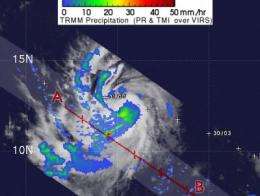
TRMM captured a rainfall image of Tropical Storm Katia on August, 31, 2011 2:29 p.m. EDT. Yellow and green indicate rainfall between 20 and 40 millimeters (.78 to 1.57 inches) per hour. Dark red areas are considered heavy rainfall, as much as 50 mm (2 inches) of rain per hour. Credit: Credit: SSAI/NASA, Hal Pierce
The second Atlantic Ocean Hurricane was born today, Sept. 1 as Katia strengthened from a tropical storm in the central Atlantic. NASA's TRMM satellite noticed towering thunderstorms within Katia yesterday which clued forecasters that she would become a hurricane today. NASA's Aqua satellite showed strong thunderstorms around Katia's center today as the hurricane continues to strengthen.
The Tropical Rainfall Measuring Mission (TRMM) satellite can measure rainfall from its orbit high above the earth and provide heights of towering thunderstorms within a tropical cyclone. Yesterday, August 31, 2011 at 2:29 p.m. EDT (18:29 UTC) TRMM revealed several towering thunderstorms even in Katia's outer bands- that were about 6 miles (10 kilometers) high.
On September 1, the Atmospheric Infrared Sounder (AIRS) instrument on NASA's Aqua satellite showed large areas of strong convection surrounding center. Convection is rapidly rising air that forms the thunderstorms that make up a tropical cyclone. The cloud top temperatures around Katia's center were colder than -63F (-52C) revealing that there's powerful uplift in the atmosphere to create high, cold clouds. AIRS also showed that the sea surface temperatures in the region are over the 80F (26.6C) threshold needed to maintain a tropical cyclone, so that the energy source for Katia remains plentiful and will enable her to strengthen over the weekend.
Katia is a now a Category one hurricane and is expected to bend north-northwest and miss the Leeward Islands. Maximum sustained winds are near 75 mph (120 kmh) with higher gusts, and some strengthening is forecast over the weekend. Katia is still a small storm about 250 miles wide, with hurricane force winds out to 25 miles from the center (35 km) and tropical storm force winds out to 125 miles (205 km).
The National Hurricane Center noted that Katia could become a major hurricane (Category three) over the weekend.
At 11 a.m. EDT on Sept. 1, Katia's center was still far from land. It was about 1050 miles (1,685 km) east of the Leeward Islands, near 15.5 North and 47.5 West. It was moving to the west-northwest near 18 mph (30 kmh) and is expected to slow down.
The National Hurricane Center said Katia is forecast to become a major hurricane on Sunday with winds over 111 mph. It will be between Puerto Rico and Bermuda so NASA will be watching it for the next week.
Provided by
NASA's Goddard Space Flight Center
-
From lemons to lemonade: Reaction uses carbon dioxide to make carbon-based semiconductor,
32 comments
-
Thioridazine kills cancer stem cells in human while avoiding toxic side-effects of conventional cancer treatments,
3 comments
-
SpaceX private rocket blasts off for space station (Update),
42 comments
-
Climate scientists say they have solved riddle of rising sea,
31 comments
-
SpaceX capsule has 'new car' smell, astronauts say (Update),
4 comments
-
Hypothetical desert earth
18 hours ago
-
More human population = greater mass?
May 25, 2012
-
Conversion from aircraft bearing to normal degrees
May 23, 2012
-
Interpretation/Analysis of the Lab results(HEPA filter)
May 22, 2012
-
Has anyone here attended the The Urbino Summer School in Paleoclimatology?
May 22, 2012
-
Earthquakes: Mag 6 N. Italy and Mag 5.6 W. Bulgaria
May 21, 2012
- More from Physics Forums - Earth
More news stories
Land and sea species differ in climate change response: study
(Phys.org) -- Marine and terrestrial species will likely differ in their responses to climate warming, new research by Simon Fraser University and Australia’s University of Tasmania has found.
1 hour ago |
not rated yet |
1
|
Yale study concludes public apathy over climate change unrelated to science literacy
Are members of the public divided about climate change because they don't understand the science behind it? If Americans knew more basic science and were more proficient in technical reasoning, would public consensus match ...
3 hours ago |
4 / 5 (1) |
10
|
10 million years needed to recover from mass extinction
It took some 10 million years for Earth to recover from the greatest mass extinction of all time, latest research has revealed.
Space & Earth / Earth Sciences
3 hours ago |
not rated yet |
1
|
Sophisticated simulations predict future warming
The chances of our planet being hit by a global warming of 3 degrees Celsius by 2050 is as likely as it being hit by an increase of 1.4 degrees, new research shows. Presented in the journal Nature Geoscience, the British study ...
Space & Earth / Earth Sciences
May 22, 2012 |
4.4 / 5 (9) |
51
Aliens don't want to eat us, says former SETI director
Alien life probably isnt interested in having us for dinner, enslaving us or laying eggs in our bellies, according to a recent statement by former SETI director Jill Tarter.
Space & Earth / Space Exploration
May 25, 2012 |
4.4 / 5 (14) |
39
'Unzipped' carbon nanotubes could help energize fuel cells, batteries
Multi-walled carbon nanotubes riddled with defects and impurities on the outside could replace some of the expensive platinum catalysts used in fuel cells and metal-air batteries, according to scientists at ...
T cells 'hunt' parasites like animal predators seek prey, study shows
By pairing an intimate knowledge of immune-system function with a deep understanding of statistical physics, a cross-disciplinary team at the University of Pennsylvania has arrived at a surprising finding: T cells use a movement ...
Computer model used to pinpoint prime materials for efficient carbon capture
When power plants begin capturing their carbon emissions to reduce greenhouse gases and to most in the electric power industry, it's a question of when, not if it will be an expensive undertaking.
Change in developmental timing was crucial in the evolutionary shift from dinosaurs to birds: study
At first glance, it's hard to see how a common house sparrow and a Tyrannosaurus Rex might have anything in common. After all, one is a bird that weighs less than an ounce, and the other is a dinosaur that ...
Nvidia trumpets Tegra 3 phone design wins for 2012
(Phys.org) -- Nvidias competitive war paint has a name, Tegra 3. On the heels of Nvidia announcements about lowering costs of its Tegra 3 processors and Nvidia-enabled tablets running Android Ice Cream ...
Almost half of new vets seek disability
(AP) -- America's newest veterans are filing for disability benefits at a historic rate, claiming to be the most medically and mentally troubled generation of former troops the nation has ever seen.