Innovative nanoparticle purification system uses magnetic fields
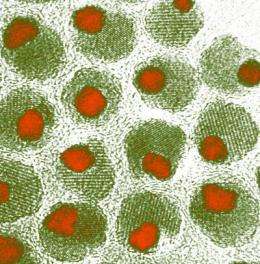
A team of Penn State University scientists has invented a new system that uses magnetism to purify hybrid nanoparticles -- structures that are composed of two or more kinds of materials in an extremely small particle that is visible only with an electron microscope. Team leaders Mary Beth Williams, an associate professor of chemistry, and Raymond Schaak, a professor of chemistry, explained that the never-before-tried method will not only help scientists to remove impurities from such particles, it also will help researchers to distinguish between hybrid nanoparticles that appear to be identical when viewed under an electron microscope, but that have different magnetism -- a great challenge in recent nanoparticle research. The system holds the promise of helping to improve drug-delivery systems, drug-targeting technologies, medical-imaging technologies, and electronic information-storage devices. The paper will be published in the journal Agewandte Chemie and is available on the journal's early-online website.
Schaak explained that purifying hybrid nanoparticles presents an enormous challenge, especially when nanoparticles are designed for human use -- for example, for drug delivery or as a contrast-dye alternative for patients undergoing MRI studies. "The problem is that although molecules are synthesized and purified using well-known methods, there have not been analogous methods for purifying nanoparticles," Schaak said. "Hybrid particles are especially challenging because the methods that are used to make them often leave impurities that are not easily detected or removed. Impurities can change the properties of a sample, for example, by making them toxic, so it is a major challenge to find ways to remove such impurities."
The team combined forces to figure out a way to purify hybrid nanoparticles. "We had to find a way to separate impurities from the target nanoparticles, even when these particles are similar in size and shape, because of the potentially very big consequences of impurities on the ultimate use of nanoparticles," Schaak said. The team's new system does just that. The innovative technique uses the magnetic components of nanoparticles to tell them apart and to separate impurities from the target nanoparticle structures.
"Our method uses magnetic fields to slow the flow of particles through tiny glass tubes called capillaries," Williams explained. "We use a magnet to pull magnetic particles against the wall of the tube and, when the magnetic field is reduced, the particles flow out of the capillary. Magnetism increases as particle volume increases, so small and gradual changes in the magnetic field let us slowly separate and distinguish between nanoparticles based on even minute magnetic and structural differences."
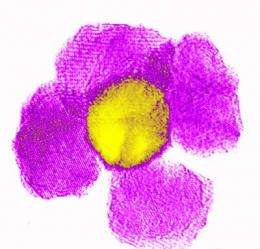
The team's paper shows how magnetic fields can be used to separate and distinguish between hybrid nanoparticles in a mixture of slightly different structures and shapes. In one example, the researchers separated "nano-flowers," so named because of their petal-like arrangement around a solid core, from spherically shaped particles. Williams explained that the magnetism of the particles depends on their shape, so particles of a different shape adhere to the capillary wall when different magnetic fields are applied, thus allowing the researchers to distinguish between the different particles.
In another example in the paper, the researchers showed how the magnetic-field method can be used with a class of nanoparticle dubbed the "nano-olive," which is a spherical particle comprised of two different materials joined in a shape reminiscent of an olive. The nano-olives, which are composed of iron, platinum, and oxygen, may look alike, but they may have slightly different internal compositions that are impossible to detect under a microscope. "For example, some may have more iron content," Schaak explained. "This is a property we can use for purification with our method because these nanoparticles are a bit more magnetic. They stick along the walls of the capillary tubes more easily, while more magnetically weak particles flow out."
The new purification and separation method has many applications, especially within the fields of medicine and diagnostics. For example, nanoparticles could be used in lieu of contrast dye when patients undergo MRI imaging studies. Such particles could be used to track where a drug is traveling in the human body. "Some patients are allergic to traditional contrast dyes, so nanoparticles offer a promising alternative," Williams said.
Williams also explained that one of the very futuristic dreams of nanoparticle research is that it one day may be used to improve cancer-fighting drugs. "Unfortunately, chemotherapy drugs don't discriminate: They attack healthy tissue, as well as cancerous tissue," Williams said. "If we could use nanoparticle technology to manipulate exactly where the drugs are going, which tissue they attack, and which they leave alone, we could greatly reduce some of the bad side effects of chemotherapy, such as hair loss and nausea. But to do this we need to be able to separate out nanoparticle impurities to make them safe for medical use. That's where this new technology comes in."
In addition to Williams and Schaak, other members of the research team include Jacob S. Beveridge, Matthew R. Buck, and James F. Bondi of the Department of Chemistry at Penn State; and Rajiv Misra and Peter Schiffer of the Department of Physics and the Materials Research Institute at Penn State.
More information: The research described here will be published in the journal Agewandte Chemie. An early online edition was posted by the journal today at onlinelibrary.wiley.com/journal/10.1002/%28ISSN%291521-3773/earlyview
Provided by Pennsylvania State University


