MUTE -- Efficient city car, showcase for electromobility research
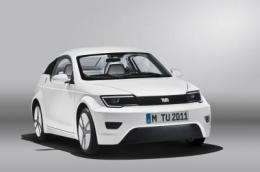
At the International Motor Show in Frankfurt, the Technische Universitaet Muenchen is rolling out the first publicly visible result of its research program TUM.Energy: a purely electric, energy-efficient city car that embodies and integrates research from 20 different university departments. Credit: Project MUTE / Copyright TU Muenchen
With its electric vehicle MUTE, the Technische Universitaet Muenchen (TUM, Germany) presents the first publicly visible result of its research program TUM.Energy. MUTE will showcase the TUM's answer to future challenges in personal mobility at the International Motor Show (IAA) in Frankfurt. MUTE is a purely electric, energy-efficient vehicle that meets all requirements of a full-fledged car. With MUTE, the 20 involved departments present a strategy for manufacturing a mass-production vehicle at an overall cost on par with that of comparable combustion engine vehicles.
With MUTE, researchers from the TU Muenchen have created an agile, sporty two-seater for regional road traffic. It has space sufficient for two persons plus luggage. The L7E certified electric motor, which is electronically limited to 15 kW, accelerates the light vehicle to 120 km/h. The lithium-ion battery is designed to guarantee a range of at least 100 kilometers. When needed, a zinc-air battery serves as a range extender a "reserve" battery, as it were. Its sporty suspension and the active torque vectoring differential drive ensure good cornering stability and excellent driving performance.
The MUTE design conveys a snazzy, self-confident appearance. The built-in features fulfill all essential requirements of a modern road vehicle. A safety package, including an electronic stability program (ESP) system, a robust passenger compartment and crash elements made of carbon fiber reinforced plastic, imparts a high level of safety to the vehicle. Regarding ergonomics and comfort, here too, the MUTE concept leapfrogs other developments to date in the L7E class.
Decisive for the great efficiency of the MUTE is its low weight. A stable vehicle frame made of aluminum and a chassis made of carbon fiber reinforced plastic reduces the curb weight, including batteries, to a mere 500 kilograms. "Low weight is essential for an electric vehicle," says the TUM vehicle engineer Prof. Markus Lienkamp. "Greater weight requires more battery performance for the same range, which results in higher costs. Greater weight also results in reduced dynamics for a given power output. But we want a car that is affordable and fun to drive."
A further contribution to efficiency comes from the torque vectoring differential: A small electrical motor in the differential that functions both as a motor and as a generator serves to ideally distribute the forces between the two back tires. Especially when braking in curves, twice as much energy can be recovered as without the torque vectoring technology. At the same time, the advantageous distribution of drive and braking forces makes the car much more agile and also safer.
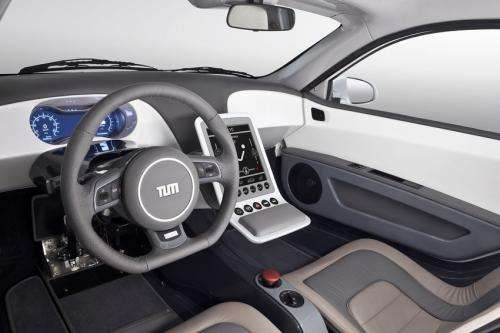
MUTE has been newly developed from scratch. Every part has been optimized for three main factors: efficiency, low overall cost and safety. Extensive preliminary studies were carried out to ascertain what mobility of the future will look like, what customer requirements will be decisive in purchasing decisions and how these might be fulfilled in a cost-effective and weight-saving manner. This led, among other things, to all tertiary user interface elements (e.g., for navigation and infotainment) being collected into a central touchpad. In addition, the touchpad computer can be used as a mobile interface for server-based, value-added services. This will allow the owner to check the current charging status using a smartphone. While underway, the most energy-efficient route (not only the shortest or fastest) can be determined based on the current traffic situation.
Over 200 staff members of 20 departments of TU Muenchen's Science Center for Electromobility joined forces to develop the MUTE concept. The research network belongs to the cross-faculty research initiative TUM.Energy, which bundles the extensive, long-term research activities of more than 100 departments in eight faculties on the topic of energy to a competence center with international prominence. The Science Center for Electromobility provides testing infrastructure, central test beds and the possibility for building shared prototypes. At the same time it is a docking station for national and international cooperation with research departments in industry and academia. The MUTE prototype was built with funding from the university budget and the Bavarian Research Foundation (BFS); project partners were C-CON, Gerg RPT and IAV. R&R KFZ did the vehicle construction. The TUM holds the intellectual property rights for overall concept. Over 30 partners from industry support the project as a whole.
More information: http://www.mute-automobile.de/
Provided by Technische Universitaet Muenchen
-
From lemons to lemonade: Reaction uses carbon dioxide to make carbon-based semiconductor,
32 comments
-
Thioridazine kills cancer stem cells in human while avoiding toxic side-effects of conventional cancer treatments,
3 comments
-
SpaceX private rocket blasts off for space station (Update),
42 comments
-
Climate scientists say they have solved riddle of rising sea,
31 comments
-
SpaceX capsule has 'new car' smell, astronauts say (Update),
4 comments
-
Need a rigid insulation material???
18 hours ago
-
magnets or EMF in car bumpers to protect from fender bender
May 26, 2012
-
length of wire in a coil of known dimensions?
May 25, 2012
-
India Engineering Powerhouse
May 25, 2012
-
electromagnet core dereference between hard and soft iron
May 25, 2012
-
Measuring water pressure in an open tank
May 24, 2012
- More from Physics Forums - General Engineering
More news stories
Browser wars flare in mobile space
The browser wars are heating up again, but this time the fight is for dominance of the mobile Internet.
11 hours ago |
5 / 5 (1) |
3
Probability of contamination from severe nuclear reactor accidents is higher than expected: study
Catastrophic nuclear accidents such as the core meltdowns in Chernobyl and Fukushima are more likely to happen than previously assumed. Based on the operating hours of all civil nuclear reactors and the number ...
Technology / Energy & Green Tech
May 22, 2012 |
3.6 / 5 (22) |
56
|
HyperSolar shows dirty water no barrier to power world
(Phys.org) -- The Santa Barbara, California, company, HyperSolar, is set to transparently share the ups and downs of its research experiences toward the companys ultimate vision, successfully producing ...
SpotterRF debuts Radar Backpack Kit (w/ Video)
(Phys.org) -- SpotterRF has announced a special radar backpack kit designed to enhance situational awareness for soldiers on the ground. The company says its special radar is designed for warfighters as part ...
Tesla to launch electric sedan in US on June 22
Tesla Motors said Tuesday it would begin deliveries of "the world's first premium electric sedan" on June 22, slightly ahead of schedule.
Technology / Energy & Green Tech
May 22, 2012 |
4.5 / 5 (12) |
18
Land and sea species differ in climate change response: study
(Phys.org) -- Marine and terrestrial species will likely differ in their responses to climate warming, new research by Simon Fraser University and Australia’s University of Tasmania has found.
'Unzipped' carbon nanotubes could help energize fuel cells, batteries
Multi-walled carbon nanotubes riddled with defects and impurities on the outside could replace some of the expensive platinum catalysts used in fuel cells and metal-air batteries, according to scientists at ...
T cells 'hunt' parasites like animal predators seek prey, study shows
By pairing an intimate knowledge of immune-system function with a deep understanding of statistical physics, a cross-disciplinary team at the University of Pennsylvania has arrived at a surprising finding: T cells use a movement ...
Computer model used to pinpoint prime materials for efficient carbon capture
When power plants begin capturing their carbon emissions to reduce greenhouse gases and to most in the electric power industry, it's a question of when, not if it will be an expensive undertaking.
Change in developmental timing was crucial in the evolutionary shift from dinosaurs to birds: study
At first glance, it's hard to see how a common house sparrow and a Tyrannosaurus Rex might have anything in common. After all, one is a bird that weighs less than an ounce, and the other is a dinosaur that ...
Nvidia trumpets Tegra 3 phone design wins for 2012
(Phys.org) -- Nvidias competitive war paint has a name, Tegra 3. On the heels of Nvidia announcements about lowering costs of its Tegra 3 processors and Nvidia-enabled tablets running Android Ice Cream ...

Sep 13, 2011
Rank: not rated yet
With 15 kW (20½HP) it's not a sports monster anyways, so why bother having a rear wheel drive?
Sep 13, 2011
Rank: not rated yet
I do drive an extremely light RWD car (Smart Roadster, 800kg). and I have to say this is the easiest car to drive in a snowstorm I have ever been in. I can go (safely and at speed) where many others have to stop or have already slipped off the road. Since the motor is right above he rear wheel axle the weight distribution is perfect for difficult road conditions.
In the case of the MUTE either the electric motor or the battery pack would be in that place - so I expect it handles similarly (or better).
Sep 14, 2011
Rank: not rated yet
No doubt about that, but my complaint was about handling in tight places like in the city, when it rains on cobblestone, or it's snowy and there's ice on the road, because RWD cars do tend to push when the front wheels are turned sideways. The car has to move forward before it will start turning, which can be problematic when parking etc.
FWD cars pull where you want it to go, so it's less problematic. Especially on hill starts, if you lack traction you can go zig-zag up the hill with ease where the RWD car would just spin wheels or slide backwards.
Sep 15, 2011
Rank: not rated yet
Actually I find them more problematic because FWD cars have to put the forces for steering AND acceleration on the forward wheels.
The maximum force you can impart on the road is determined by:
- road condition
- acceleration forces (in line with your axis of travel)
- steering forces (transversal to your axis of travel)
The latter two are at right angles to another. If you want to represent them graphically you can show that the maximum allowable force vector has to remain inside a circle with the x-Axis denoting transversal steering forces, the y-Axis acceleration forces and the radius of the circle determined by road conditions
This means that if you steer more then you can put less acceleration force on the same patch of road before slipping
This also goes for RWD - but not as much as for FWD cars where all forces are concentrated on half the area.
Theres a reason why all race cars have RWD.