Microwave ovens a key to energy production from wasted heat
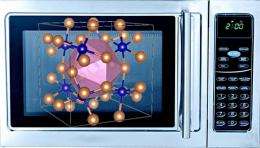
More than 60 percent of the energy produced by cars, machines, and industry around the world is lost as waste heat – an age-old problem - but researchers have found a new way to make "thermoelectric" materials for use in technology that could potentially save vast amounts of energy.
And it's based on a device found everywhere from kitchens to dorm rooms: a microwave oven.
Chemists at Oregon State University have discovered that simple microwave energy can be used to make a very promising group of compounds called "skutterudites," and lead to greatly improved methods of capturing wasted heat and turning it into useful electricity.
A tedious, complex and costly process to produce these materials that used to take three or four days can now be done in two minutes.
Most people are aware you're not supposed to put metal foil into a microwave, because it will spark. But powdered metals are different, and OSU scientists are tapping into that basic phenomenon to heat materials to 1,800 degrees in just a few minutes – on purpose, and with hugely useful results.
These findings, published in Materials Research Bulletin, should speed research and ultimately provide a more commercially-useful, low-cost path to a future of thermoelectric energy.
"This is really quite fascinating," said Mas Subramanian, the Milton Harris Professor of Materials Science at OSU. "It's the first time we've ever used microwave technology to produce this class of materials."
Thermoelectric power generation, researchers say, is a way to produce electricity from waste heat – something as basic as the hot exhaust from an automobile, or the wasted heat given off by a whirring machine. It's been known of for decades but never really used other than in niche applications, because it's too inefficient, costly and sometimes the materials needed are toxic. NASA has used some expensive and high-tech thermoelectric generators to produce electricity in outer space.
The problem of wasted energy is huge. A car, for instance, wastes about two-thirds of the energy it produces. Factories, machines and power plants discard enormous amounts of energy.
But the potential is also huge. A hybrid automobile that has both gasoline and electric engines, for instance, would be ideal to take advantage of thermoelectric generation to increase its efficiency. Heat that is now being wasted in the exhaust or vented by the radiator could instead be used to help power the car. Factories could become much more energy efficient, electric utilities could recapture energy from heat that's now going up a smokestack. Minor applications might even include a wrist watch operated by body heat.
"To address this, we need materials that are low cost, non-toxic and stable, and highly efficient at converting low-grade waste heat into electricity," Subramanian said. "In material science, that's almost like being a glass and a metal at the same time. It just isn't easy. Because of these obstacles almost nothing has been done commercially in large scale thermoelectric power generation."
Skutterudites have some of the needed properties, researchers say, but historically have been slow and difficult to make. The new findings cut that production time from days to minutes, and should not only speed research on these compounds but ultimately provide a more affordable way to produce them on a mass commercial scale.
OSU researchers have created skutterudites with microwave technology with an indium cobalt antimonite compound, and believe others are possible. They are continuing research, and believe that ultimately a range of different compounds may be needed for different applications of thermoelectric generation.
Collaborators on this study included Krishnendu Biswas, a post-doctoral researcher, and Sean Muir, a doctoral candidate, both in the OSU Department of Chemistry. The work has been supported by both the National Science Foundation and U.S. Department of Energy.
"We were surprised this worked so well," Subramanian said. "Right now large-scale thermoelectric generation of electricity is just a good idea that we couldn't make work. In the future it could be huge."
More information: Rapid Microwave Synthesis of Indium Filled Skutterudites: An energy efficient route to high performance thermoelectric materials, ir.library.oregonstate.edu/xmlui/handle/1957/23330
Provided by Oregon State University


