Flying microrobot takes steps toward full autonomy (w/ video)
September 20, 2011 by Lisa Zyga
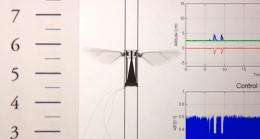
This screenshot from the video below shows the flying microrobot performing vertical flight with closed-loop control. Image credit: Néstor O. Pérez-Arancibia, et al. ©2011 IOP Publishing Ltd
(PhysOrg.com) -- With the goal of designing an insect-inspired flying microrobot capable of sustained autonomous flight, researchers have demonstrated for the first time a microrobot that achieves vertical flight using closed-loop control. The researchers predict that the approach they use for controlling flight on this one axis could also be used for controlling flight on all three axes.
The team of researchers, Dr. Néstor Pérez-Arancibia, Kevin Ma, Dr. Kevin Galloway, Jack Greenberg, and Prof. Robert Wood from the Harvard Microrobotics Lab at Harvard University, has published their study on the first controlled vertical flight of a biologically inspired microrobot in a recent issue of Bioinspiration & Biomimetics. The methods they used could provide a key step toward developing completely autonomous flying microrobots.
Basically, a fully autonomous flying microrobot would do similar things to what natural bees and flies can do: take off, land, and navigate through difficult environments, Pérez-Arancibia told PhysOrg.com. In the long term, I can also envision microrobots that can adapt to their environments, coordinate with other robots to accomplish difficult tasks, and interact with natural insects (this would be very cool, I think).
As the researchers explained in their study, designing a microrobot with total autonomy is a complex problem for which aerodynamics, sensing, actuators, and other factors must be considered simultaneously. To tackle the problem, the researchers focused on just one degree of freedom: altitude.
This video is not supported by your browser at this time.
The hovering microrobot can reject disturbances such as compressed air jets from a small hose. The ruler shown in the video is a rough visual reference; precise altitude is measured with the laser displacement sensor. Video credit: Néstor O. Pérez-Arancibia, et al.
After designing and fabricating a 56-mg flapping-wing microrobot, the researchers attached the microrobot to a double-cantilever beam that could move only in the vertical direction. When the robot flapped its wings, the flapping induced inertial and aerodynamic forces that caused the wings to passively rotate. In turn, the passive rotation created a non-zero angle of attack during the wing stroke, which produced lift. In general, the faster the wings flapped (i.e., the higher the frequency and/or the amplitude of their stroke angle), the greater the lift force.As Pérez-Arancibia explained, to design the controller the set of rules used to generate input to the system the researchers used two separate experimental setups. In the first experimental setup, the researchers gathered relevant information about the robots dynamics by performing static experiments (i.e., the robot flaps, but it does not move). Two sensors measured the actuator output and the force produced by the flapping wings. With this information, the researchers could determine the controllers general structure. In order to fine-tune this structure, the researchers then computed additional parameters by performing experiments in which the robot moves up and down, as shown in the video. This controller resulted in the first demonstration of the closed-loop control of an insect-scale robot.
The term closed-loop implies that feedback is used to generate the input to the robotic system, Pérez-Arancibia explained. In this particular case, the robotʼs altitude is measured using an external laser position sensor and then this information is used by the controller (a set of rules) to generate the control signal, which is the voltage input to the system that makes the wings flap. Note that altitude is the variable that we control (we make it follow the trajectory we desire, using a feedback controller).
Using this controller design process, the researchers demonstrated that the microrobot could perform tasks such as hovering in one place and following a trajectory. Also, when the researchers caused a disturbance by blowing air from a hose at the microrobot, the microrobot was able to withstand the disturbance. In addition, the 56-mg microrobot is capable of generating lift forces of up to 3.6 times its own weight, meaning it could carry a payload including steering components, sensors, and power sources. These characteristics could make the flying microrobots appealing for a variety of applications.
It is reasonable to assume that they will be cheap if manufactured at a large scale, Pérez-Arancibia said. Therefore, they will be excellent for going into, exploring, and sending information out from areas inaccessible or too dangerous to humans. I am thinking of buildings on fire, contaminated areas (by dangerous chemicals, radiation, or even pathogens), collapsed structures, etc. They will be excellent to do field biological research. Imagine the use of 1000 or 2000 of these robots for exploring a tree in the middle of the Amazonian forest, for example. Imagine a group of microrobots flying alongside Monarch butterflies on their migration route from Canada to Mexico, etc. Another application often mentioned is artificial pollination.
As Pérez-Arancibia added, the researchers are making swift progress toward the ultimate goal of fully autonomous flying microrobots.
At the Harvard Microrobotics Lab, as a group, we are and will be working on bringing you autonomous flying microrobots ASAP, he said. Papers coming soon will present experiments on altitude control using optical flow, on pitch control, on new robotic designs that include steering and control actuators, etc. Stay tuned!
More information: Néstor O. Pérez-Arancibia, et al. First controlled vertical flight of a biologically inspired microrobot. Bioinsp. Biomim. 6 (2011) 036009 (11pp). DOI:10.1088/1748-3182/6/3/036009
Copyright 2011 PhysOrg.com.
All rights reserved. This material may not be published, broadcast, rewritten or redistributed in whole or part without the express written permission of PhysOrg.com.
-
From lemons to lemonade: Reaction uses carbon dioxide to make carbon-based semiconductor,
32 comments
-
Thioridazine kills cancer stem cells in human while avoiding toxic side-effects of conventional cancer treatments,
3 comments
-
SpaceX private rocket blasts off for space station (Update),
42 comments
-
Climate scientists say they have solved riddle of rising sea,
31 comments
-
SpaceX capsule has 'new car' smell, astronauts say (Update),
4 comments
-
Need a rigid insulation material???
18 hours ago
-
magnets or EMF in car bumpers to protect from fender bender
May 26, 2012
-
length of wire in a coil of known dimensions?
May 25, 2012
-
India Engineering Powerhouse
May 25, 2012
-
electromagnet core dereference between hard and soft iron
May 25, 2012
-
Measuring water pressure in an open tank
May 24, 2012
- More from Physics Forums - General Engineering
More news stories
Browser wars flare in mobile space
The browser wars are heating up again, but this time the fight is for dominance of the mobile Internet.
10 hours ago |
5 / 5 (1) |
3
Probability of contamination from severe nuclear reactor accidents is higher than expected: study
Catastrophic nuclear accidents such as the core meltdowns in Chernobyl and Fukushima are more likely to happen than previously assumed. Based on the operating hours of all civil nuclear reactors and the number ...
Technology / Energy & Green Tech
May 22, 2012 |
3.6 / 5 (22) |
56
|
HyperSolar shows dirty water no barrier to power world
(Phys.org) -- The Santa Barbara, California, company, HyperSolar, is set to transparently share the ups and downs of its research experiences toward the companys ultimate vision, successfully producing ...
SpotterRF debuts Radar Backpack Kit (w/ Video)
(Phys.org) -- SpotterRF has announced a special radar backpack kit designed to enhance situational awareness for soldiers on the ground. The company says its special radar is designed for warfighters as part ...
Tesla to launch electric sedan in US on June 22
Tesla Motors said Tuesday it would begin deliveries of "the world's first premium electric sedan" on June 22, slightly ahead of schedule.
Technology / Energy & Green Tech
May 22, 2012 |
4.5 / 5 (12) |
18
Land and sea species differ in climate change response: study
(Phys.org) -- Marine and terrestrial species will likely differ in their responses to climate warming, new research by Simon Fraser University and Australia’s University of Tasmania has found.
'Unzipped' carbon nanotubes could help energize fuel cells, batteries
Multi-walled carbon nanotubes riddled with defects and impurities on the outside could replace some of the expensive platinum catalysts used in fuel cells and metal-air batteries, according to scientists at ...
T cells 'hunt' parasites like animal predators seek prey, study shows
By pairing an intimate knowledge of immune-system function with a deep understanding of statistical physics, a cross-disciplinary team at the University of Pennsylvania has arrived at a surprising finding: T cells use a movement ...
Computer model used to pinpoint prime materials for efficient carbon capture
When power plants begin capturing their carbon emissions to reduce greenhouse gases and to most in the electric power industry, it's a question of when, not if it will be an expensive undertaking.
Change in developmental timing was crucial in the evolutionary shift from dinosaurs to birds: study
At first glance, it's hard to see how a common house sparrow and a Tyrannosaurus Rex might have anything in common. After all, one is a bird that weighs less than an ounce, and the other is a dinosaur that ...
Almost half of new vets seek disability
(AP) -- America's newest veterans are filing for disability benefits at a historic rate, claiming to be the most medically and mentally troubled generation of former troops the nation has ever seen.
Sep 20, 2011
Rank: 5 / 5 (3)
Sep 20, 2011
Rank: 4 / 5 (1)
so that hardware is going to one day be useful and mounteable on the actual hoverdrone?
i don't think so.
i would have rather seen this guy focuss designing a micro-mounted position awareness system on the drone that demonstrates a capability for the drone to know roughly where it is , based on where it was and where it's going. ....and then design a feedback loop that perfects this system .
all you have now is a motion capability (distrubance rejection) based on off-drone hardware that stands a poor chance of being adapted for placement on the ultralight drone.
i just have a hard time , from a program level where one hypothetically directs the development of the entire drone , seeing why it is useful to develop motion capabilities, when the position knowledge capability is not there; the former is useless without the latter.
this is piecemeal devlepment
Sep 20, 2011
Rank: not rated yet
Sep 20, 2011
Rank: not rated yet
They did not know the transfer function of the system in regard to lift and now they have one accurate enough to control the altitude of the unit in the presence of external noise inputs. More than likely their next step will be to understand how to incorporate backward/forward motion and lift together along with attitude control. Then they will likely incorporate side to side motion and rotation. At that point they will have a functional flight control system that can accept vectors and distances as command inputs.
Once you have that, a higher level path control system that gets feedback from position sensors will calculate the positional error from the desired path in the form of an error vector that it will use to command the flight control system. This will give path control capability.
A higher level path planning system can then provide flight path data to the path control system to execute missions and/or incorporate positional/situational awareness/adaptation.
Sep 20, 2011
Rank: 1 / 5 (1)
"Resistance is futile. You will be assimilated." LOL
Sep 21, 2011
Rank: 5 / 5 (1)
Already done.
Sep 26, 2011
Rank: not rated yet
Sep 30, 2011
Rank: not rated yet
The controller plays a key role in this application. Did the author give UCLA credit?
J Peters