Building better memories with supramolecular structures that act as tiny magnets
September 16, 2011

Building towards better memories

Enlarge

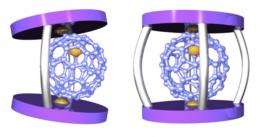
The spherical metallofullerene forms a ferromagnetic host-guest complex (left), but when the host structure is converted to a locked cage, the ferromagnetism is lost (right). Credit: Ref. 1 © 2011 American Chemical Society

In a step towards realizing ultrahigh-density storage devices based on individual molecules behaving as magnets, researchers in Japan have developed a candidate building block -- a supramolecular ferromagnet, which is a caged molecule with magnetic properties. The Japanese research team was led by Takuzo Aida at the RIKEN Advanced Science Institute, Wako, and Kentaro Tashiro at the National Institute for Materials Science, Tsukuba.

The researchers’ supramolecular magnet is based on a metallofullerene dubbed La@C82 -- a lanthanum ion trapped within an 82-carbon spherical cage. La@C82 has well-known paramagnetic properties: it becomes magnetized in the presence of an external field. However, like all paramagnets, La@C82 loses its magnetization once the external field is removed, rendering it useless for data storage.

Endeavoring to overcome this loss of magnetization, Aida and his colleagues designed a molecular component that combines with La@C82 to form the supramolecular . They built a copper-containing structure, itself paramagnetic, to house La@C82 within an internal cavity. When mixed together, the two components self-assembled into a host–guest complex. To lock the La@C82 in place, the researchers clipped together extra arms on the host structure, converting it into a cage.

Assessing the of the locked and unlocked complexes, however, revealed a surprise, says Aida. Thanks to the interaction of the paramagnetic character of the two components, the unlocked caged complex did behave as a ferromagnet. However, when the researchers locked the supramolecular cage, that ferromagnetism was lost. 

“It is difficult to predict the magnetic behavior of host–guest complexes,” says Aida. “We envisaged that the caged structure would give rise to a ferromagnetic property, but this was not the case.”

According to calculations run by the team, the switch in ferromagnetic behavior is all down to geometry. The La@C82 guest is a tight fit within the cavity of its host, and the unlocked cage forms an asymmetric, twisted structure. When the arms of the cage are closed, the structure is forced into a symmetrical shape for which the ferromagnetic state is no longer energetically favorable (Fig. 1).

The researchers are continuing to work with the unlocked supramolecular ferromagnet, building up arrays of the structure on a solid support—an essential step towards developing a practical memory device, says Aida. The most important point is that the cage must be properly oriented such that the resultant material retains its ferromagnetism, he says.

More information: Hajjaj, F., et al. Ferromagnetic spin coupling between endohedral metallofullerene La@C82 and a cyclodimeric copper porphyrin upon inclusion. Journal of the American Chemical Society 133, 9290–9292 (2011). 

Provided by RIKEN search and more info website


Rank 5 /5 (3 votes)
Relevant PhysicsForums posts
  • Calculating partial pressures Pa and Pw
    created25 minutes ago
  • Gibbs Free Energy Change/Entropy
    created10 hours ago
  • What's the rule to covalent character
    created11 hours ago
  • Schwartz reagent-- NMR/MS/IR
    createdMay 26, 2012
  • High school chemistry EEI
    createdMay 25, 2012
  • oxidation of I- by KMnO4
    createdMay 25, 2012
  • More from Physics Forums - Chemistry

More news stories

Computer model used to pinpoint prime materials for efficient carbon capture

When power plants begin capturing their carbon emissions to reduce greenhouse gases – and to most in the electric power industry, it's a question of when, not if – it will be an expensive undertaking.

Chemistry / Materials Science

created 3 hours ago | popularity not rated yet | comments 0 | with audio podcast

Scientists develop ultra-sensitive test that detects diseases in their earliest stages

Scientists have developed an ultra-sensitive test that should enable them to detect signs of a disease in its earliest stages, in research published today in the journal Nature Materials.

Chemistry / Analytical Chemistry

created 3 hours ago | popularity not rated yet | comments 0 | with audio podcast

New CO2-removing catalyst can take the heat

(Phys.org) -- The current method of removing the greenhouse gas carbon dioxide (CO2) from the flues of coal-fired power plants uses so much energy that no one bothers to use it. So says Roger Aines, principal ...

Chemistry / Materials Science

created May 24, 2012 | popularity 5 / 5 (9) | comments 10 | with audio podcast

High-speed method to aid search for solar energy storage catalysts

Eons ago, nature solved the problem of converting solar energy to fuels by inventing the process of photosynthesis.

Chemistry / Materials Science

created May 25, 2012 | popularity 5 / 5 (3) | comments 4 | with audio podcast

Researchers demonstrate possible primitive mechanism of chemical info self-replication

(Phys.org) -- When scientists think about the replication of information in chemistry, they usually have in mind something akin to what happens in living organisms when DNA gets copied: a double-stranded molecule ...

Chemistry / Materials Science

created May 25, 2012 | popularity 5 / 5 (4) | comments 2 | with audio podcast


Land and sea species differ in climate change response: study

(Phys.org) -- Marine and terrestrial species will likely differ in their responses to climate warming, new research by Simon Fraser University and Australia’s University of Tasmania has found.

'Unzipped' carbon nanotubes could help energize fuel cells, batteries

Multi-walled carbon nanotubes riddled with defects and impurities on the outside could replace some of the expensive platinum catalysts used in fuel cells and metal-air batteries, according to scientists at ...

T cells 'hunt' parasites like animal predators seek prey, study shows

By pairing an intimate knowledge of immune-system function with a deep understanding of statistical physics, a cross-disciplinary team at the University of Pennsylvania has arrived at a surprising finding: T cells use a movement ...

Change in developmental timing was crucial in the evolutionary shift from dinosaurs to birds: study

At first glance, it's hard to see how a common house sparrow and a Tyrannosaurus Rex might have anything in common. After all, one is a bird that weighs less than an ounce, and the other is a dinosaur that ...

Almost half of new vets seek disability

(AP) -- America's newest veterans are filing for disability benefits at a historic rate, claiming to be the most medically and mentally troubled generation of former troops the nation has ever seen.

Nvidia trumpets Tegra 3 phone design wins for 2012

(Phys.org) -- Nvidia’s competitive war paint has a name, Tegra 3. On the heels of Nvidia announcements about lowering costs of its Tegra 3 processors and Nvidia-enabled tablets running Android Ice Cream ...