Local government, homeowners paying price for non-native forest insects
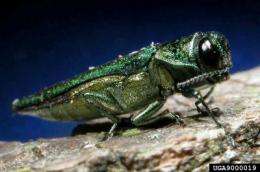
Non-native, wood-boring insects such as the emerald ash borer and the Asian longhorned beetle are costing an estimated $1.7 billion in local government expenditures and approximately $830 million in lost residential property values every year, according to study by a research team that included scientists with the U.S. Forest Service, Northern Research Station.
The research effort was funded by The Nature Conservancy and supported by the University of California / Santa Barbara's National Center for Ecological Analysis and Synthesis (NCEAS). The team included scientists from the U.S. Forest Service and U.S. and Canadian academic institutions. The research findings were published in the on-line journal PLoS ONE on Sept. 9.
This study provides the most comprehensive estimates of the costs of non-native forest insects that are currently available for the United States. While invasive species are widely recognized as being among the greatest threats to biodiversity and ecosystem stability worldwide, there has been little research into their economic impact.
"Solving the problems posed by non-native forest insects demands that we have useful tools and the motivation to use them, and this study provides both," according to Michael T. Rains, Director of the Northern Research Station. "This is a great example of how Forest Service scientists collaborate with others to produce relevant and effective tools."
According to the study, more than 450 non-native insects are established in the United States. "This study underscores the fact that we all have a stake in environmental issues," according to Bob Haight, research forester with the U.S. Forest Service, Northern Research Station. "The economic data shows that cities and homeowners have a strong interest in preventing the inadvertent import of non-native invasive species."
For each of the three main feeding guilds, which are based on the insects' feeding habits, researchers identified one high impact "poster pest" that was the most damaging species of its guild to date. Poster pests identified for the study were the emerald ash borer in the borer guild, hemlock woolly adelgid in the sap feeder guild, and gypsy moth in the foliage feeder guild.
For each poster pest, researchers analyzed five cost categories: (1) federal governmental expenditures (e.g. survey, research, regulation, and outreach), (2) local governmental expenditures (tree removal, replacement, and treatment), (3) household expenditures (tree removal, replacement, and treatment), (4) residential property value losses and (5) timber value losses to forest landowners.
For all of the guilds studied, homeowners and local governments are bearing the greatest share of costs associated with non-native forest insects. The wood- and phloem-boring insects, including the emerald ash borer and Asian longhorned beetle, are the species that create the greatest economic damage to urban trees. Of the three guilds, borers were represented by the fewest species, but a high proportion of them – 20 percent – are damaging, according to the study.
Of the three guilds, efforts to control or manage sap feeders received the fewest federal dollars ($14 million annually), although they caused substantial losses in real estate values – approximately $260 million per year. Costs associated with foliage feeders were substantially lower than costs associated with borers for all categories except annual federal expenditures, which were slightly greater ($110 million for foliage feeders and $92 million for borers). Foliage feeders were estimated to cause approximately $410 million per year in lost property value.
"In the forest insect research community we've known for many years that invading species are a huge problem but now that we were finally able to calculate their economic impact, even I am a little bit shocked by the level of damage," according to Andrew Liebhold, a research entomologist with the Northern Research Station.
The team calculated a 32 percent risk that a new borer that is as damaging or more costly than the emerald ash borer will invade in the next 10 years. That calculation may be reduced if recent international standards targeting pathways of introduction such as wood packaging materials are effectively implemented.
Development of the study's analytical framework is as much an end product of the study as its findings. The framework can be used to estimate the economic impacts of natural resource disturbances at scales ranging from municipalities to nations in any country where data are available. It can be easily adapted for estimating costs of a variety of natural resource disturbances in addition to invasive species, including fire, disease, and water pollution.
Provided by USDA Forest Service


