Lasers could be used to detect roadside bombs
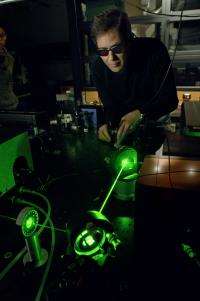
Marcos Dantus, chemistry department
A research team at Michigan State University has developed a laser that could detect roadside bombs the deadliest enemy weapon encountered in Iraq and Afghanistan.
The laser, which has comparable output to a simple presentation pointer, potentially has the sensitivity and selectivity to canvas large areas and detect improvised explosive devices weapons that account for around 60 percent of coalition soldiers' deaths. Marcos Dantus, chemistry professor and founder of BioPhotonic Solutions, led the team and has published the results in the current issue of Applied Physics Letters.
The detection of IEDs in the field is extremely important and challenging because the environment introduces a large number of chemical compounds that mask the select few molecules that one is trying to detect, Dantus said.
"Having molecular structure sensitivity is critical for identifying explosives and avoiding unnecessary evacuation of buildings and closing roads due to false alarms," he said
Since IEDs can be found in populated areas, the methods to detect these weapons must be nondestructive. They also must be able to distinguish explosives from vast arrays of similar compounds that can be found in urban environments. Dantus' latest laser can make these distinctions even for quantities as small as a fraction of a billionth of a gram.
The laser beam combines short pulses that kick the molecules and make them vibrate, as well as long pulses that are used to "listen" and identify the different "chords." The chords include different vibrational frequencies that uniquely identify every molecule, much like a fingerprint. The high-sensitivity laser can work in tandem with cameras and allows users to scan questionable areas from a safe distance.
"The laser and the method we've developed were originally intended for microscopes, but we were able to adapt and broaden its use to demonstrate its effectiveness for standoff detection of explosives," said Dantus, who hopes to net additional funding to take this laser from the lab and into the field.
This research is funded in part by the Department of Homeland Security. BioPhotonic Solutions is a high-tech company Dantus launched in 2003 to commercialize technology invented in a spinoff from his research group at MSU.
Provided by
Michigan State University
-
From lemons to lemonade: Reaction uses carbon dioxide to make carbon-based semiconductor,
32 comments
-
Thioridazine kills cancer stem cells in human while avoiding toxic side-effects of conventional cancer treatments,
3 comments
-
SpaceX private rocket blasts off for space station (Update),
42 comments
-
Climate scientists say they have solved riddle of rising sea,
31 comments
-
SpaceX capsule has 'new car' smell, astronauts say (Update),
4 comments
-
Why does light move?
26 minutes ago
-
How to calculate the repulsion force between a permanent and an electromagnet?
1 hour ago
-
Why does light allow us to see things?
1 hour ago
-
Room temperature superconductivity
1 hour ago
-
Water flow question
5 hours ago
-
16 year old solves 300 year old problem set by Isaac Newton
6 hours ago
- More from Physics Forums - General Physics
More news stories
Is a classical electrodynamics law incompatible with special relativity?
(Phys.org) -- The laws of classical electromagnetism that were developed in the 19th century are the same laws that scientists use today. They include Maxwell’s four equations along with the Lorentz la ...
Landmark calculation clears the way to answering how matter is formed
(Phys.org) -- An international collaboration of scientists, including Thomas Blum, associate professor of physics, is reporting in landmark detail the decay process of a subatomic particle called a kaon ...
May 25, 2012 |
4.3 / 5 (22) |
51
|
Lying in wait for WIMPs: Researchers seek to dramatically increase sensitivity of Large Underground Xenon detector
Although it's invisible, dark matter accounts for at least 80 percent of the matter in the universe. No one knows what it is, but most scientists would bet on weakly interacting massive particles, or WIMPs.
May 23, 2012 |
4 / 5 (7) |
16
|
Hawaii lab turns laser-powered bubbles into microrobots
(Phys.org) -- A team of scientists from the University of Hawaii are working on microrobots created from bubbles of air in a saline solution. The bubbles take on their title of robots as a laser ...
Sound increases the efficiency of boiling
Scientists at the Georgia Institute of Technology achieved a 17-percent increase in boiling efficiency by using an acoustic field to enhance heat transfer. The acoustic field does this by efficiently removing vapor bubbles ...
May 24, 2012 |
5 / 5 (2) |
2
Land and sea species differ in climate change response: study
(Phys.org) -- Marine and terrestrial species will likely differ in their responses to climate warming, new research by Simon Fraser University and Australia’s University of Tasmania has found.
'Unzipped' carbon nanotubes could help energize fuel cells, batteries
Multi-walled carbon nanotubes riddled with defects and impurities on the outside could replace some of the expensive platinum catalysts used in fuel cells and metal-air batteries, according to scientists at ...
T cells 'hunt' parasites like animal predators seek prey, study shows
By pairing an intimate knowledge of immune-system function with a deep understanding of statistical physics, a cross-disciplinary team at the University of Pennsylvania has arrived at a surprising finding: T cells use a movement ...
Computer model used to pinpoint prime materials for efficient carbon capture
When power plants begin capturing their carbon emissions to reduce greenhouse gases and to most in the electric power industry, it's a question of when, not if it will be an expensive undertaking.
Change in developmental timing was crucial in the evolutionary shift from dinosaurs to birds: study
At first glance, it's hard to see how a common house sparrow and a Tyrannosaurus Rex might have anything in common. After all, one is a bird that weighs less than an ounce, and the other is a dinosaur that ...
Almost half of new vets seek disability
(AP) -- America's newest veterans are filing for disability benefits at a historic rate, claiming to be the most medically and mentally troubled generation of former troops the nation has ever seen.
Sep 16, 2011
Rank: 3 / 5 (2)
Watch out DARPA, They're looking for money.
Sep 17, 2011
Rank: 5 / 5 (1)
Sep 17, 2011
Rank: 5 / 5 (1)
You spend $13 billion to equip all vehicles with laser explosive detectors.
Bad guys come along and gives kid $5 to spread explosive pieces, fragments and dust down the road for miles. Repeat until laser detectors go off constantly.
Nothing like continuous false positives to make our guys relax and feel like they're one up on the competition.
Meanwhile, Marcos Dantus of BioPhotonic Solutions will be getting fat on war profiteering. To hell with microscopes. The big money is in war.
Sep 17, 2011
Rank: not rated yet
Sep 18, 2011
Rank: not rated yet