La Nina may dampen fall leaf colors
(PhysOrg.com) -- The weather in Pennsylvania this year won't soon be forgotten -- one of the wettest springs ever, followed by a record-breaking dry heat wave in July, followed by the remnants of a hurricane and tropical storm in August and September that caused historic flooding.
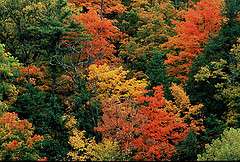
But it turns out the extreme weather conditions may not cause a less brilliant foliage display this autumn, according to a forest expert in Penn State's College of Agricultural Sciences. Ironically, the climate extremes may not be so much to blame as what is happening now, explained Marc Abrams, professor of forest ecology and physiology.
"It's true 2011 has been an extraordinary year for climate -- going from one extreme to another," he said. "Some counties in the eastern part of the state are now 1 to 2 feet above their average precipitation. And eastern Pennsylvania also suffered the impacts of strong winds from Hurricane Irene.
"But despite all these extremes, I am still somewhat optimistic about a good display of fall leaf colors this year, because most trees are in good physiological condition going into October, due to late-summer rains."
The one foliage factor that worries Abrams this year is the continuation of warm and wet weather extending into the middle of October. That stems from the La Nina phenomenon that was detected in August.
La Niña -- which means "The Little Girl" -- is characterized by unusually cold ocean temperatures in the eastern equatorial Pacific. The phenomenon, which has happened 15 other times since 1900, has a huge impact on global weather patterns. It generally results in warmer- and wetter-than-normal conditions in the mid-Atlantic region of the United States.
"The prediction is for wet and mostly warm weather to continue well into October," Abrams said. "From past experience, most trees will keep their green leaf color as long as temperatures stay relatively high. We really need nighttime temps to start getting into the low 40s and 30s to bring out peak colors."
He noted that peak colors normally arrive to central Pennsylvania around mid-October, but not if it stays warm and wet.
"Still, Pennsylvania's forests are amazingly resilient, so there will be some colorful foliage in mid-October," he said. "There remains the possibility for decent fall color despite the difficult climate. But clearly this won't be one of our better years."
For more than two decades, Abrams has studied how seasonal precipitation and temperature influence timing and intensity of fall colors in central Pennsylvania. "We believe that clear, bright days, low but not freezing temperatures, and dry but not drought conditions promote the best fall colors," he said.
Cooler temperatures signal deciduous trees to stop producing chlorophyll, the green pigment responsible for photosynthesis, he explained. The chlorophyll breaks down and disappears, unmasking other leaf pigments. It's these other pigments -- called xanthophylls and carotenes -- that create the yellows and oranges seen in the leaves of yellow poplar, hickory, sycamore, honey locust, birch, beech and certain maples.
After chlorophyll production stops, trees also produce another pigment in their leaves called anthocyanin, according to Abrams. The anthocyanins create the brilliant reds and purples seen in maple, sassafras, sumac, black gum and purple oak.
The amount of anthocyanin produced each year is related to starch levels in the tree. Trees often produce less starch during droughts.
"One thing that I have been impressed with in my 20 years of gauging foliage is the resiliency of the display," Abrams said. "Year after year, despite the conditions, there are places where the trees show good color, but perhaps not great color.
"People should go out and search for those pockets of bright color, because they will be there. They just may be a little harder to find this year than usual.
Provided by Pennsylvania State University


