Korean researchers making progress on 3D OLED screens
September 1, 2011 by Bob Yirka report

Korean researchers making progress on 3D OLED screens

Enlarge

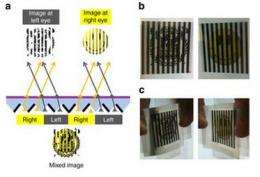
Autostereoscopic 3D display. Image: NPG, doi:10.1038/ncomms1456

(PhysOrg.com) -- With the recent rise in popularity of 3D movies at the theater, consumers quite naturally have begun to wonder about what’s being done to bring such technology to their smartphones and better yet, the big flat screen TVs in their living rooms. As it stands now, most viewers that wish to watch 3D movies, whether at home or the theater, must wear some type of 3D eyeglasses. This is unfortunate, because most would prefer to watch without having to don the goofy looking accessories.

Such viewers are likely then to get excited about the new technology that is currently being developed in South Korea. There a team of scientists have figured out a way to use tiny prisms to bend light in optical devices so that different images are shown to each eye, thus producing a 3D effect. The team, a consortium of scientists from Seoul National University, Act Company and Minuta Technology, have published the results of their research in .

Their idea involves the use of a microscopic sized array of prisms stuck on to a sheet of plastic to facilitate a filtering effect that reflects the light being emitted by the diode below it. The concept works because it doesn’t need to be backlit as is done with LCDs. Organic Light Emitting Diodes (OLEDs) instead use organic compounds that light up when a small amount of electricity is applied to them. The prism array, called by the researchers a Lucius prism (Latin for bright) allowed the research team to create a display that showed an image that could only be seen when looked at from a certain angle, meaning that all of the emitted was directed together in a new direction, a key component in creating a 3D screen. The team also created a screen that displayed two different versions of the same, but slightly altered, image at the same time; one image for the left eye, the other for the right, creating for the viewer the sensation of depth, without the need for special eyeglasses.

The array created by the team is just 4 centimeters square, which is obviously too small for practical use, but the team believes they can scale it up to television size given more research time. And because the team used what amounts to a simple plastic to make the screen, it’s possible the final result will be flexible as well, opening the door to the creation of all sorts of new display devices.

More information: Arrays of Lucius microprisms for directional allocation of light and autostereoscopic three-dimensional displays, Nature Communications 2, Article number: 455 doi:10.1038/ncomms1456

Abstract
Directional and asymmetric properties are attractive features in nature that have proven useful for directional wetting, directional flow of liquids and artificial dry adhesion. Here we demonstrate that an optically asymmetric structure can be exploited to guide light with directionality. The Lucius prism array presented here has two distinct properties: the directional transmission of light and the disproportionation of light intensity. These allow the illumination of objects only in desired directions. Set up as an array, the Lucius prism can function as an autostereoscopic three-dimensional display.

via Scientific American

© 2011 PhysOrg.com

4.3 /5 (8 votes)  

Filter


Move the slider to adjust rank threshold, so that you can hide some of the comments.


Display comments: newest first

antialias_physorg
Sep 01, 2011

Rank: 3 / 5 (2)
There a team of scientists have figured out a way to use tiny prisms to bend light in optical devices so that different images are shown to each eye, thus producing a 3D effect.

This is new? I saw something like this at a medical imaging trade show 10 years ago. The drawback of the prism architecture is that you have to be at a certain distance from the screen. Move slightly closer or further away and the 3D effect is lost (something that isn't a problem with 3D glasses).

Choose your posion: Either be condemned to not move during the movie or wear goofy glasses. Neither solution seems optimal.
Pete1983
Sep 02, 2011

Rank: not rated yet
This is new? I saw something like this at a medical imaging trade show 10 years ago. The drawback of the prism architecture is that you have to be at a certain distance from the screen. Move slightly closer or further away and the 3D effect is lost (something that isn't a problem with 3D glasses).


I agree completely. These attempts at 3d that don't require the use of glasses are ridiculous. At least with the glasses it will work from various angles, as opposed to these systems that require your head to be in the right place.

This reminds me of when Kryten got turned into a human on red dwarf and asked how does one enable the zoom function in our eyes, and Lister's response was "we move our head closer to the object". This isn't the same as that... but it was funny, and kind of related I guess!
Rank 4.3 /5 (8 votes)
Relevant PhysicsForums posts
  • Why does light move?
    created26 minutes ago
  • How to calculate the repulsion force between a permanent and an electromagnet?
    created1 hour ago
  • Why does light allow us to see things?
    created1 hour ago
  • Room temperature superconductivity
    created1 hour ago
  • Water flow question
    created5 hours ago
  • 16 year old solves 300 year old problem set by Isaac Newton
    created6 hours ago
  • More from Physics Forums - General Physics

More news stories

Is a classical electrodynamics law incompatible with special relativity?

(Phys.org) -- The laws of classical electromagnetism that were developed in the 19th century are the same laws that scientists use today. They include Maxwell’s four equations along with the Lorentz la ...

Physics / General Physics

created May 24, 2012 | popularity 4.7 / 5 (17) | comments 43 | with audio podcast feature

Landmark calculation clears the way to answering how matter is formed

(Phys.org) -- An international collaboration of scientists, including Thomas Blum, associate professor of physics, is reporting in landmark detail the decay process of a subatomic particle called a kaon – ...

Physics / General Physics

created May 25, 2012 | popularity 4.3 / 5 (22) | comments 51 | with audio podcast

Lying in wait for WIMPs: Researchers seek to dramatically increase sensitivity of Large Underground Xenon detector

Although it's invisible, dark matter accounts for at least 80 percent of the matter in the universe. No one knows what it is, but most scientists would bet on weakly interacting massive particles, or WIMPs.

Physics / General Physics

created May 23, 2012 | popularity 4 / 5 (7) | comments 16 | with audio podcast

Hawaii lab turns laser-powered bubbles into microrobots

(Phys.org) -- A team of scientists from the University of Hawaii are working on microrobots created from bubbles of air in a saline solution. The bubbles take on their title of “robots” as a laser ...

Physics / General Physics

created May 23, 2012 | popularity 5 / 5 (4) | comments 2 | with audio podcast weblog

Sound increases the efficiency of boiling

Scientists at the Georgia Institute of Technology achieved a 17-percent increase in boiling efficiency by using an acoustic field to enhance heat transfer. The acoustic field does this by efficiently removing vapor bubbles ...

Physics / Soft Matter

created May 24, 2012 | popularity 5 / 5 (2) | comments 2


Land and sea species differ in climate change response: study

(Phys.org) -- Marine and terrestrial species will likely differ in their responses to climate warming, new research by Simon Fraser University and Australia’s University of Tasmania has found.

'Unzipped' carbon nanotubes could help energize fuel cells, batteries

Multi-walled carbon nanotubes riddled with defects and impurities on the outside could replace some of the expensive platinum catalysts used in fuel cells and metal-air batteries, according to scientists at ...

T cells 'hunt' parasites like animal predators seek prey, study shows

By pairing an intimate knowledge of immune-system function with a deep understanding of statistical physics, a cross-disciplinary team at the University of Pennsylvania has arrived at a surprising finding: T cells use a movement ...

Computer model used to pinpoint prime materials for efficient carbon capture

When power plants begin capturing their carbon emissions to reduce greenhouse gases – and to most in the electric power industry, it's a question of when, not if – it will be an expensive undertaking.

Change in developmental timing was crucial in the evolutionary shift from dinosaurs to birds: study

At first glance, it's hard to see how a common house sparrow and a Tyrannosaurus Rex might have anything in common. After all, one is a bird that weighs less than an ounce, and the other is a dinosaur that ...

Almost half of new vets seek disability

(AP) -- America's newest veterans are filing for disability benefits at a historic rate, claiming to be the most medically and mentally troubled generation of former troops the nation has ever seen.