Iowa State chemists help astronauts make sure their drinking water is clean
September 14, 2011

Iowa State chemists help astronauts make sure their drinking water is clean

Enlarge

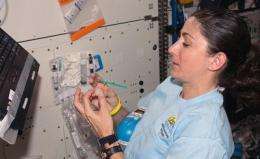
Nicole Stott, a flight engineer on Expedition 21 of the International Space Station, tests the quality of drinking water using chemistry and procedures developed by Iowa State University and Ames Laboratory researchers Credit: NASA photo.

Bob Lipert held up a syringe, attached a plastic cartridge and demonstrated how chemistry developed at Iowa State University is helping astronauts and cosmonauts make sure they have safe drinking water at the International Space Station.

Each cartridge contains a thin, one-centimeter disk that's loaded with , said Lipert, an associate scientist with Iowa State's Institute for Physical Research and Technology and an associate of the U.S. Department of Energy's Ames Laboratory. Run a 10-milliliter water sample through a disk and it will change color in the presence of , which uses to inhibit the growth of microorganisms in the stored at the space station. The disk will turn from white to yellow and, as it's exposed to higher concentrations of iodine, it will turn to orange and finally to a rust color.

A – a diffuse reflectance spectrometer – can read the disk's color changes and precisely measure the concentration of molecular iodine, or I2. The whole process is called colorimetric solid phase extraction.

Starting in late September, Lipert said astronauts at the space station will use new developments and procedures that convert all forms of iodine in the water samples to molecular iodine. That will give astronauts a more precise reading of total iodine in their drinking water. Lipert said they'll know in real time whether there's too much, too little or just enough iodine in the water.

Disks loaded with different chemistry can also measure and record concentrations of silver, which the Russian Federal Space Agency uses as a biocide in its water supply at the space station. As silver concentrations increase, disks turn from yellow to purple.

Before Iowa State chemists helped develop the new tests, the only way to test the space station's drinking water was to send samples back to earth.

"We figured out the chemistry and put it into a form that can be used in space," Lipert said. "We also took lab techniques and simplified them as much as possible. And we developed procedures that can be used in the absence of gravity."

The result is a quick, accurate test that doesn't use up much drinking water or much astronaut time.

"What's neat about what we came up with is that all the chemistry we need to do can be accomplished in about one minute per sample using a little, 1-centimeter cartridge," Lipert said.

It took some work to develop the test's chemistry and procedures. The NASA-sponsored project began more than a decade ago under the direction of Marc Porter, a former Iowa State professor of chemistry and chemical and biological engineering who is now a USTAR Professor at the University of Utah in Salt Lake City. Lipert has worked on the project since 2000.

Other Iowa State researchers who have worked on the project include Jim Fritz, Distinguished Professor Emeritus of Liberal Arts and Sciences; former post-doctoral researchers Matteo Arena and Neil Dias; and former graduate students April Hill, Daniel Gazda, John Nordling, Lisa Ponton and Cherry Shih. Lorraine Siperko, a research scientist at the University of Utah, has also worked on the project.

The university researchers have also collaborated with the Wyle Integrated Science and Engineering Group, a NASA subcontractor that helped develop and certify the water-testing hardware that has been deployed on the space station.

After a series of successful space tests in 2009 and '10, the researchers' water-testing equipment is now certified operational hardware and is part of the space station's environmental monitoring toolbox.

Lipert said the testing technology can also be a useful tool in many earthbound applications, including forensics tests for drugs, environmental tests for heavy metals and water quality tests for pesticides or herbicides.

"This is a very flexible platform," he said. "You just have to work out the chemistry for each substance you're analyzing."

Provided by Iowa State University search and more info website


Rank 5 /5 (1 vote)
Relevant PhysicsForums posts
  • Calculating partial pressures Pa and Pw
    created19 minutes ago
  • Gibbs Free Energy Change/Entropy
    created10 hours ago
  • What's the rule to covalent character
    created11 hours ago
  • Schwartz reagent-- NMR/MS/IR
    createdMay 26, 2012
  • High school chemistry EEI
    createdMay 25, 2012
  • oxidation of I- by KMnO4
    createdMay 25, 2012
  • More from Physics Forums - Chemistry

More news stories

Computer model used to pinpoint prime materials for efficient carbon capture

When power plants begin capturing their carbon emissions to reduce greenhouse gases – and to most in the electric power industry, it's a question of when, not if – it will be an expensive undertaking.

Chemistry / Materials Science

created 3 hours ago | popularity not rated yet | comments 0 | with audio podcast

Scientists develop ultra-sensitive test that detects diseases in their earliest stages

Scientists have developed an ultra-sensitive test that should enable them to detect signs of a disease in its earliest stages, in research published today in the journal Nature Materials.

Chemistry / Analytical Chemistry

created 3 hours ago | popularity not rated yet | comments 0 | with audio podcast

New CO2-removing catalyst can take the heat

(Phys.org) -- The current method of removing the greenhouse gas carbon dioxide (CO2) from the flues of coal-fired power plants uses so much energy that no one bothers to use it. So says Roger Aines, principal ...

Chemistry / Materials Science

created May 24, 2012 | popularity 5 / 5 (9) | comments 10 | with audio podcast

High-speed method to aid search for solar energy storage catalysts

Eons ago, nature solved the problem of converting solar energy to fuels by inventing the process of photosynthesis.

Chemistry / Materials Science

created May 25, 2012 | popularity 5 / 5 (3) | comments 4 | with audio podcast

Researchers demonstrate possible primitive mechanism of chemical info self-replication

(Phys.org) -- When scientists think about the replication of information in chemistry, they usually have in mind something akin to what happens in living organisms when DNA gets copied: a double-stranded molecule ...

Chemistry / Materials Science

created May 25, 2012 | popularity 5 / 5 (4) | comments 2 | with audio podcast


Land and sea species differ in climate change response: study

(Phys.org) -- Marine and terrestrial species will likely differ in their responses to climate warming, new research by Simon Fraser University and Australia’s University of Tasmania has found.

'Unzipped' carbon nanotubes could help energize fuel cells, batteries

Multi-walled carbon nanotubes riddled with defects and impurities on the outside could replace some of the expensive platinum catalysts used in fuel cells and metal-air batteries, according to scientists at ...

T cells 'hunt' parasites like animal predators seek prey, study shows

By pairing an intimate knowledge of immune-system function with a deep understanding of statistical physics, a cross-disciplinary team at the University of Pennsylvania has arrived at a surprising finding: T cells use a movement ...

Change in developmental timing was crucial in the evolutionary shift from dinosaurs to birds: study

At first glance, it's hard to see how a common house sparrow and a Tyrannosaurus Rex might have anything in common. After all, one is a bird that weighs less than an ounce, and the other is a dinosaur that ...

Almost half of new vets seek disability

(AP) -- America's newest veterans are filing for disability benefits at a historic rate, claiming to be the most medically and mentally troubled generation of former troops the nation has ever seen.

Nvidia trumpets Tegra 3 phone design wins for 2012

(Phys.org) -- Nvidia’s competitive war paint has a name, Tegra 3. On the heels of Nvidia announcements about lowering costs of its Tegra 3 processors and Nvidia-enabled tablets running Android Ice Cream ...