What investors have learned from the major earthquake
The Great East Japan Earthquake has dramatically altered the way the Japanese economy is seen. For example, the way that housing and real estate values are seen in Japan has changed since 3.11. Location value is what determines the values of homes and real estate. Before the major earthquake, for example, locations for residential areas in the Tokyo metropolitan area with beautiful townscapes were highly appraised, even if they were landfill sites. The preferences of people toward residential areas have greatly changed since 3.11, however. Safety is now more of a concern than factors such as convenience and comfort. Factors such as whether or not there are active faults or the durability of the ground, which had been viewed as relatively unimportant, have all suddenly become important issues. Let us take a look at the psychological changes that have occurred in people’s minds after the major earthquake through stock and housing prices.
May 11, 2011 is the day that a 9-magnitude earthquake struck East Japan. On the following Monday, March 14, the Nikkei average stock price had dropped 6.2%. There was not much else in the news that was significant, and this dropping in stock prices was due to the huge earthquake.
On January 17 sixteen years ago, a 7.2-magnitude earthquake struck the Hanshin-Awaji area. The day that the stock market was affected the most by this earthquake was also the following Monday. On January 23rd, the Nikkei average stock price had dropped 5.6%. There was not much else in the news that was significant, and this dropping in stock prices was also due to the huge earthquake.
The Japanese stock market reacted to these two major earthquakes with up to about 6% drops in stock prices on a daily basis. This can be seen as a universal scale for measuring the level of response that the market has shown to the major earthquakes as unexpected factors.
In the East Japan case, however, there were chain-reaction explosions at the nuclear power plant in Fukushima on March 15. The market immediately reacted to this second unexpected factor, and the Nikkei average dropped 10.6% on that same day. In the Hanshin-Awaji case, there was no such second tragedy, and that is why the point drop range of stock prices one week after the major earthquakes was very different in each of these cases. The Nikkei average dropped only 8.3% at most in the Hanshin-Awaji case, but it dropped as far as 16.8% in the East Japan case.
Interestingly, although the market reacted differently to these two major earthquakes as shown above, the Nikkei average point drop range as of sixteen business days (about three weeks) from the earthquake disasters in both cases showed convergences at about the same levels (about 5% drops).
Markets such as the housing and real estate markets react differently to major earthquakes than the stock market does. Let us examine this while referring to the TSE Home Price Index, which provides monthly changes in the trading prices of used condominiums in the metropolitan area.
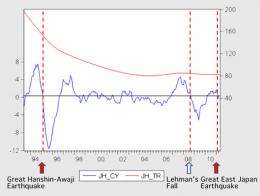
In order to understand the effects of major earthquakes, the long-term fluctuations (trends) must be eliminated from housing price fluctuations, and the fluctuations (cycles) that are disassociated from this are to be derived (Figure 1). After the Great Hanshin-Awaji Earthquake, the cycle components of the housing price index of the metropolitan area dramatically dropped for a long period of time (eighteen months). On the other hand, the dropping in prices after the Great East Japan Earthquake was no more than one-tenth of that in the Hanshin-Awaji case.
In the Hanshin-Awaji case, housing price cycles decreased the most eight months after the earthquake disaster so there is a chance that they will decrease the most around November 2011 in the case of the Great East Japan Earthquake. However, the point drop range should be very low when judging from the current situation.
Housing prices in the metropolitan area reacted differently with the two major earthquakes. The following two factors may be the reasons why. The first is the difference in the types of earthquakes that struck. The earthquake in the Hanshin-Awaji type was an inland-type and the earthquake in the East Japan case was a trench-type, and the damages such as destroyed houses are far greater when there are inland-type earthquakes. Furthermore, trends of housing prices already significantly dropped at the time around the Great Hanshin-Awaji Earthquake. In contrast, housing price trends had remained stable at low levels for a long time when the Great East Japan Earthquake occurred.
New levels of stock prices and housing prices suggest the possibility that the Japanese economy is seen in a new and completely different way after the major earthquake. It can be said, however, that the effects on stock prices, housing prices, and so on that the Great East Japan Earthquake had are not so huge when compared with the effects brought upon by the bursting of Japan’s real estate bubble in 1990 or the fall of Lehman Brothers in the autumn of 2008. Figure 2 shows the transitions in stock prices and housing prices in Japan and the US from the bursting of Japan’s real estate bubble to now. The world has seen six rare phenomena including currency crises, fiscal crises, economic bubble collapses, and financial crises during the roughly sixteen years between the Great Hanshin-Awaji and East Japan earthquakes.
The Great East Japan Earthquake once again showed investors that rare circumstances occur frequently. The importance of risk management has been further elevated.
Provided by Waseda University


