Over the hump: Ecologists use power of network science to challenge long-held theory
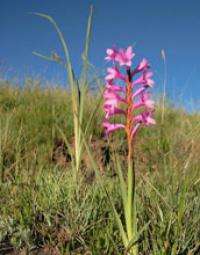
Bugle lily at the Mt. Gilboa study site in South Africa. Credit: Image courtesy of Peter Wragg
For decades, ecologists have toiled to nail down principles explaining why some habitats have many more plant and animal species than others.
Much of this debate is focused on the idea that the number of species is determined by the productivity of the habitat.Shouldn't a patch of prairie contain a different number of species than an arid steppe or an alpine tundra?
Maybe not, says an international team of scientists that pooled its resources to re-evaluate the relationship between species numbers and habitat productivity.
The innovative, standardized global sampling of 48 sites on five continents yielded an unprecedented data set.
"Our study shows no clear relationship between productivity and the number of plant species in small study plots," says Utah State University plant ecologist Peter Adler.
Scientists say Adler's and his colleagues' findings represent a significant advance in ecological thought. The findings appear in this week's issue of the journal Science.
"We challenged a prevailing model developed in the early 1970s by British ecologist J. Philip Grime," says Adler, lead author of the paper. "He proposed that the number of species rises then declines with increasing productivity."Though hotly debated, this "hump-shaped" model has remained a textbook standard for nearly four decades.
"In the search for underlying principles of ecology in a very complex natural world, it's inevitable that even long-standing and accepted theories will be debunked as more data are accumulated and synthesized," says Henry Gholz, program director in the National Science Foundation's (NSF) Division of Environmental Biology, which funded the research.
In an "Emperor's New Clothes" moment, Adler remembers skeptical observations about the hump-shaped model made by graduate students in his classroom.
"'Why do ecologists spend so much time on this model when the evidence to support it is so weak?' they asked me," he says. "That was the kick I needed to pursue this question."
The challenge was daunting.
Existing, disparate case studies couldn't conclusively support Grime's unimodal pattern. Inconsistencies in data collection methods further hampered efforts to distill evidence to support the hump-shaped model. So Adler and fellow ecologists formed the Nutrient Network, or "NutNet," an NSF Research Coordination Network dedicated to investigating biodiversity and ecosystem processes in grasslands around the world.>Based at the University of Minnesota (UMN), the network is funded by an NSF grant to network organizers and UMN scientists Elizabeth Borer and Eric Seabloom.
"Our work not only sheds light on this classic question, it also demonstrates the power of a network approach," Borer says. "NutNet data are poised to inform many pressing ecological questions. Similar global, grassroots collaborations could help settle other longstanding scientific debates."
Says Gholz, "Research Coordination Networks are designed to facilitate these types of insights into the functioning of nature, insights that aren't possible in a focus on individual ecosystems."
Adler says that NutNet's data "emphasize the need to consider many factors to explain patterns of diversity--not just productivity alone."
NutNet's findings should spur ecologists to focus on other important factors regulating biodiversity, he says, such as evolutionary history, disturbance and resource supply.
"It's time to remove outdated models from our textbooks and concentrate on more sophisticated approaches," Adler says,"That will improve our ability to predict the effects of environmental change on biodiversity."
Provided by
National Science Foundation
-
From lemons to lemonade: Reaction uses carbon dioxide to make carbon-based semiconductor,
32 comments
-
Thioridazine kills cancer stem cells in human while avoiding toxic side-effects of conventional cancer treatments,
3 comments
-
SpaceX private rocket blasts off for space station (Update),
42 comments
-
Climate scientists say they have solved riddle of rising sea,
31 comments
-
SpaceX capsule has 'new car' smell, astronauts say (Update),
4 comments
-
What would stain as translucent on light-coloured fabric?
22 hours ago
-
How do I identify different bacteria on culture plates?
May 26, 2012
-
Why Do Dogs do Strange things...
May 25, 2012
-
What does exophillic and endophillic mean in terms of mosquito and their control?
May 24, 2012
-
Semen stains glows under black lights (uv light)?
May 23, 2012
-
Question on Human Chromosome 2
May 23, 2012
- More from Physics Forums - Biology
More news stories
Manufacturing genes to attack flu virus
An international research team has manufactured a new protein that can combat deadly flu epidemics.
3 hours ago |
not rated yet |
0
|
Scientist: Evolution debate will soon be history
(AP) -- Richard Leakey predicts skepticism over evolution will soon be history. Not that the avowed atheist has any doubts himself.
21 hours ago |
3.5 / 5 (20) |
83
More plant species responding to global warming than previously thought
(Phys.org) -- Far more wild plant species may be responding to global warming than previous large-scale estimates have suggested.
May 22, 2012 |
4.6 / 5 (14) |
18
|
Thousands of shellfish found dead in Peru
Thousands of crustaceans were found dead off the coast of Lima following the mystery mass death of dolphins and pelicans, the Peruvian Navy said Friday.
May 26, 2012 |
4.8 / 5 (5) |
7
For monogamous sparrows, it doesn't pay to stray (but they do it anyway)
It's quite common for a female song sparrow to stray from her breeding partner and mate with the male next door, but a new study shows that sleeping around can be costly.
May 22, 2012 |
5 / 5 (2) |
8
|
Land and sea species differ in climate change response: study
(Phys.org) -- Marine and terrestrial species will likely differ in their responses to climate warming, new research by Simon Fraser University and Australia’s University of Tasmania has found.
'Unzipped' carbon nanotubes could help energize fuel cells, batteries
Multi-walled carbon nanotubes riddled with defects and impurities on the outside could replace some of the expensive platinum catalysts used in fuel cells and metal-air batteries, according to scientists at ...
T cells 'hunt' parasites like animal predators seek prey, study shows
By pairing an intimate knowledge of immune-system function with a deep understanding of statistical physics, a cross-disciplinary team at the University of Pennsylvania has arrived at a surprising finding: T cells use a movement ...
Computer model used to pinpoint prime materials for efficient carbon capture
When power plants begin capturing their carbon emissions to reduce greenhouse gases and to most in the electric power industry, it's a question of when, not if it will be an expensive undertaking.
Change in developmental timing was crucial in the evolutionary shift from dinosaurs to birds: study
At first glance, it's hard to see how a common house sparrow and a Tyrannosaurus Rex might have anything in common. After all, one is a bird that weighs less than an ounce, and the other is a dinosaur that ...
Almost half of new vets seek disability
(AP) -- America's newest veterans are filing for disability benefits at a historic rate, claiming to be the most medically and mentally troubled generation of former troops the nation has ever seen.
Sep 22, 2011
Rank: 3 / 5 (2)