Hot nickel nudges graphene: Study simplifies manufacture of semiconducting bilayer graphene
September 16, 2011

Hot nickel nudges graphene: Study simplifies manufacture of semiconducting bilayer graphene

Enlarge

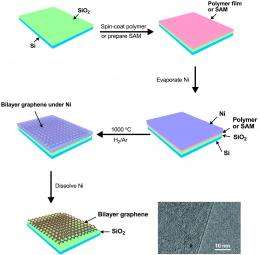
This graphic shows the process of creating bilayer graphene on an insulating substrate, skipping the need to transfer graphene from a metal catalyst. The final image, captured with an electron microscope, clearly shows two layers of graphene produced via the process. (Credit Tour Lab/Rice University)

(PhysOrg.com) -- By heating metal to make graphene, Rice University researchers may warm the hearts of high-tech electronics manufacturers.

The lab of Rice chemist James Tour published two papers this month that advance the science of making high-quality, bilayer graphene. They show how to grow it on a functional substrate by first having it diffuse into a layer of

Graphene is commonly grown on a metal catalyst, usually copper, and must be transferred to an electrically insulating substrate like silicon dioxide before it can be used in a circuit. The transfer process is cumbersome and time-consuming and can be as frustrating as manipulating household plastic wrap, Tour said.

The new processes outlined in two related ACS Nano papers show large-scale bilayer graphene can be grown directly onto a variety of insulating substrates. They eliminate the transfer process and facilitate the growth of large sheets of semiconducting graphene ready for incorporation into patterned transistors, Tour said.

“The ability to grow bilayer graphene directly onto an insulator can permit electronic device manufacturers to build transistors without the industrially burdensome step of placing one sheet of graphene upon another," said Tour, Rice's T.T. and W.F. Chao Chair in Chemistry as well as a professor of mechanical engineering and materials science and of computer science.

Graphene, the single-atom-thick form of carbon, has been the subject of much study since its discovery in 2004. Tour's lab has become a major player in graphene research by publishing in recent years papers on unzipping nanotubes into graphene nanoribbons, characterizing its electrical properties through lithography, creating transparent electrodes for touch screens and making graphene from a variety of cheap sources, even Girl Scout cookies. All aim to cut the cost and complexity of making graphene and bring it into widespread use.

A single layer of graphene, which at the atomic scale looks like chicken wire, is a semimetal and has no bandgap; this makes it unsuitable for many electronic applications. But bilayer graphene is a semiconductor. Its properties depend upon the offset or rotation of the layers in relation to each other and it is tunable using an electric field applied across the layers.

The new processes depend on the solubility of carbon atoms in hot nickel. In one study, a group led by graduate student Zhiwei Peng evaporated a coat of nickel onto silicon dioxide and placed a polymer film -- the carbon source -- on top. 

Heating the sandwich to 1,000 degrees Celsius in the presence of flowing argon and hydrogen gas allowed the polymer to diffuse into the metal; upon cooling, graphene formed on the nickel and on the silicon dioxide surfaces. When the nickel and incidental graphene that formed on top were etched away, bilayer graphene was left attached to the silicon dioxide substrate. 

In the other study, graduate student Zheng Yan shuffled the sandwich. He topped a layer of silicon dioxide with a sliver of one of a variety of polymers and then put the nickel on top. Again, under high temperature and low pressure, bilayer graphene formed between the and nickel. Experimentation with other substances revealed that bilayer graphene would also form on hexagonal boron nitride, silicon nitride and sapphire.  

“This type of process eliminates the need for roll-to-roll transfer of the graphene to an electronic substrate, because bilayer graphene can now be grown directly upon the of interest,” Tour said.

Authors of the first paper, "Growth of Bilayer Graphene on Insulating Substrates," are Yan, Peng, graduate student Zhengzong Sun, former graduate student Jun Yao, postdoctoral research associates Yu Zhu and Zheng Liu, Tour and Pulickel Ajayan, the Benjamin M. and Mary Greenwood Anderson Professor in Mechanical Engineering and Materials Science and of chemistry.

Authors of the second paper, "Direct Growth of Bilayer on SiO2 Substrates by Carbon Diffusion Through Nickel," are Peng, Yan, Sun and Tour. 

More information:

Growth of Bilayer Graphene on Insulating Substrates: http://pubs.acs.or … 21/nn202829y

Direct Growth of Bilayer Graphene on SiO2 Substrates by Carbon Diffusion Through Nickel: http://pubs.acs.or … 21/nn202923y

Provided by Rice University search and more info website


Rank 5 /5 (6 votes)
Relevant PhysicsForums posts
  • microstructure of titanium
    createdMay 26, 2012
  • Steam in My Espresso Machine
    createdMay 26, 2012
  • Density question
    createdMay 24, 2012
  • Mass transport originating from a point source at a solid gas interface
    createdMay 22, 2012
  • Ammonia dispersion in Air
    createdMay 22, 2012
  • Multi Choice Help
    createdMay 21, 2012
  • More from Physics Forums - Materials & Chemical Engineering

More news stories

'Unzipped' carbon nanotubes could help energize fuel cells, batteries

Multi-walled carbon nanotubes riddled with defects and impurities on the outside could replace some of the expensive platinum catalysts used in fuel cells and metal-air batteries, according to scientists at ...

Nanotechnology / Nanomaterials

created 3 hours ago | popularity not rated yet | comments 0 | with audio podcast

In nanorod crystal growth, nanoparticles seen as artificial atoms

In the growth of crystals, do nanoparticles act as "artificial atoms" forming molecular-type building blocks that can assemble into complex structures? This is the contention of a major but controversial theory ...

Nanotechnology / Nanophysics

created May 24, 2012 | popularity 4.8 / 5 (6) | comments 0 | with audio podcast

Dopant gives graphene solar cells highest efficiency yet

(Phys.org) -- By taking advantage of graphene’s favorable electrical and optical properties, and then adding an organic dopant, researchers have achieved the highest power conversion efficiency yet for ...

Nanotechnology / Nanophysics

created May 21, 2012 | popularity 5 / 5 (10) | comments 14 | with audio podcast feature

First direct observation of oriented attachment in nanocrystal growth

Berkeley Lab researchers have reported the first direct observation of nanoparticles undergoing oriented attachment, the critical step in biomineralization and the growth of nanocrystals. A better understanding ...

Nanotechnology / Nanophysics

created May 24, 2012 | popularity 4.7 / 5 (3) | comments 0 | with audio podcast

Synthetic nano-waste does not disappear

(Phys.org) -- Tiny particles of cerium oxide do not burn or change in the heat of a waste incineration plant. They remain intact on combustion residues or in the incineration system, as a new study by Swiss ...

Nanotechnology / Bio & Medicine

created May 25, 2012 | popularity 5 / 5 (2) | comments 1 | with audio podcast


Land and sea species differ in climate change response: study

(Phys.org) -- Marine and terrestrial species will likely differ in their responses to climate warming, new research by Simon Fraser University and Australia’s University of Tasmania has found.

T cells 'hunt' parasites like animal predators seek prey, study shows

By pairing an intimate knowledge of immune-system function with a deep understanding of statistical physics, a cross-disciplinary team at the University of Pennsylvania has arrived at a surprising finding: T cells use a movement ...

Computer model used to pinpoint prime materials for efficient carbon capture

When power plants begin capturing their carbon emissions to reduce greenhouse gases – and to most in the electric power industry, it's a question of when, not if – it will be an expensive undertaking.

Change in developmental timing was crucial in the evolutionary shift from dinosaurs to birds: study

At first glance, it's hard to see how a common house sparrow and a Tyrannosaurus Rex might have anything in common. After all, one is a bird that weighs less than an ounce, and the other is a dinosaur that ...

Almost half of new vets seek disability

(AP) -- America's newest veterans are filing for disability benefits at a historic rate, claiming to be the most medically and mentally troubled generation of former troops the nation has ever seen.

Nvidia trumpets Tegra 3 phone design wins for 2012

(Phys.org) -- Nvidia’s competitive war paint has a name, Tegra 3. On the heels of Nvidia announcements about lowering costs of its Tegra 3 processors and Nvidia-enabled tablets running Android Ice Cream ...