The hidden power of moss
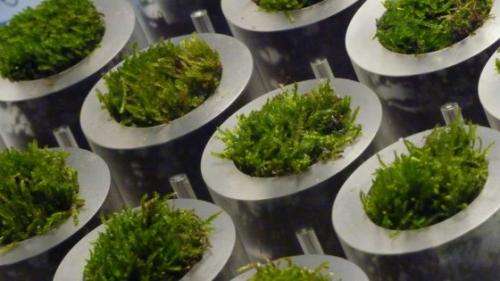
Close-up of the moss pots incorporated into a novel table developed at Cambridge University. Credit: Institute for Manufacturing, University of Cambridge
(PhysOrg.com) -- Scientists at Cambridge University are exhibiting a prototype table that demonstrates how biological fuel cells can harness energy from plants.
Moss is regarded as a menace by gardeners who seek to eradicate it from their lawns. Now researchers all over the world are exploring how moss, algae and plants could be used as a source of renewable energy in the future.
A team of designers and scientists at Cambridge University are exhibiting a novel moss table at the London Design Festival which takes place today and tomorrow. The table will showcase an emerging technology called biophotovoltaics (BPV) which uses the natural process of photosynthesis to generate electrical energy.
Featuring biological fuel cells made from moss, the table has been created to provide a possible vision of the future by Alex Driver and Carlos Peralta from Cambridges Institute for Manufacturing and Paolo Bombelli from the Universitys Chemical Engineering and Biotechnology Department.
Still at early stages, BPV has the potential to power small devices such as digital clocks. Low cost BPV devices may become competitive alternatives to conventional renewable technologies such as bio-fuels in the next ten years.
The appeal of BPV lies in its ability to harness a natural process that takes place all around us. Photosynthesis occurs when plants convert carbon dioxide from the atmosphere into organic compounds using energy from sunlight. Plants use these organic compounds carbohydrates, proteins and lipids to grow.
When the moss photosynthesises it releases some of these organic compounds into the soil which contains symbiotic bacteria. The bacteria break down the compounds, which they need to survive, liberating by-products that include electrons. The table designed by the Cambridge University team captures these electrons to produce an electrical current.
The table is based on research into biophotovoltaics funded by the Engineering and Physical Sciences Research Council (EPSRC). This pioneering work involves collaboration between the Departments of Chemical Engineering and Biotechnology, Biochemistry and Plant Sciences at Cambridge University, and the Chemistry Department at Bath University. The research is led jointly by Dr Adrain Fisher, Professor Christopher Howe and Professor Alison Smith at Cambridge, and Dr Petra Cameron at Bath.
Alex Driver said: The moss table provides us with a vision of the future. It suggests a world in which self-sustaining organic-synthetic hybrid objects surround us, and supply us with our daily needs in a clean and environmentally friendly manner.
Looking into the future, possible applications for BPV include solar panels, power stations and generators. Currently at concept stage, these are envisaged as sustainable solutions to pressing problems across the world including the growing need for energy and fresh water from vulnerable communities.
A modular system of biological solar panels would be mounted on to the roof of a building to supply it with a portion of its energy requirements. A biophotovoltaic power station would comprise giant algae-coated lily-pads floating on the surface of the ocean near the coastline, generating energy for local communities. A biophotovoltaic generator would feature algae solar collectors mounted on floating buoys and anchored just offshore to generate energy and harvest desalinated water, which is a waste product of one of the chemical reactions occurring in the device.
The Cambridge team emphasised that the technology was at very early stages. It will be a long time before a product powered by this technology will be commercially available, said Dr James Moultrie, Head of the Design Management Group at the Institute for Manufacturing. The table we are exhibiting this week demonstrates the ways in which designers can play a valuable role in early stage scientific research by identifying commercial potential and is one of the outcomes from our Design in Science research project.
Provided by
University of Cambridge
-
From lemons to lemonade: Reaction uses carbon dioxide to make carbon-based semiconductor,
32 comments
-
Thioridazine kills cancer stem cells in human while avoiding toxic side-effects of conventional cancer treatments,
3 comments
-
SpaceX private rocket blasts off for space station (Update),
42 comments
-
Climate scientists say they have solved riddle of rising sea,
31 comments
-
SpaceX capsule has 'new car' smell, astronauts say (Update),
4 comments
-
Need a rigid insulation material???
18 hours ago
-
magnets or EMF in car bumpers to protect from fender bender
May 26, 2012
-
length of wire in a coil of known dimensions?
May 25, 2012
-
India Engineering Powerhouse
May 25, 2012
-
electromagnet core dereference between hard and soft iron
May 25, 2012
-
Measuring water pressure in an open tank
May 24, 2012
- More from Physics Forums - General Engineering
More news stories
Browser wars flare in mobile space
The browser wars are heating up again, but this time the fight is for dominance of the mobile Internet.
10 hours ago |
5 / 5 (1) |
3
Probability of contamination from severe nuclear reactor accidents is higher than expected: study
Catastrophic nuclear accidents such as the core meltdowns in Chernobyl and Fukushima are more likely to happen than previously assumed. Based on the operating hours of all civil nuclear reactors and the number ...
Technology / Energy & Green Tech
May 22, 2012 |
3.6 / 5 (22) |
56
|
HyperSolar shows dirty water no barrier to power world
(Phys.org) -- The Santa Barbara, California, company, HyperSolar, is set to transparently share the ups and downs of its research experiences toward the companys ultimate vision, successfully producing ...
SpotterRF debuts Radar Backpack Kit (w/ Video)
(Phys.org) -- SpotterRF has announced a special radar backpack kit designed to enhance situational awareness for soldiers on the ground. The company says its special radar is designed for warfighters as part ...
Tesla to launch electric sedan in US on June 22
Tesla Motors said Tuesday it would begin deliveries of "the world's first premium electric sedan" on June 22, slightly ahead of schedule.
Technology / Energy & Green Tech
May 22, 2012 |
4.5 / 5 (12) |
18
Land and sea species differ in climate change response: study
(Phys.org) -- Marine and terrestrial species will likely differ in their responses to climate warming, new research by Simon Fraser University and Australia’s University of Tasmania has found.
'Unzipped' carbon nanotubes could help energize fuel cells, batteries
Multi-walled carbon nanotubes riddled with defects and impurities on the outside could replace some of the expensive platinum catalysts used in fuel cells and metal-air batteries, according to scientists at ...
T cells 'hunt' parasites like animal predators seek prey, study shows
By pairing an intimate knowledge of immune-system function with a deep understanding of statistical physics, a cross-disciplinary team at the University of Pennsylvania has arrived at a surprising finding: T cells use a movement ...
Computer model used to pinpoint prime materials for efficient carbon capture
When power plants begin capturing their carbon emissions to reduce greenhouse gases and to most in the electric power industry, it's a question of when, not if it will be an expensive undertaking.
Change in developmental timing was crucial in the evolutionary shift from dinosaurs to birds: study
At first glance, it's hard to see how a common house sparrow and a Tyrannosaurus Rex might have anything in common. After all, one is a bird that weighs less than an ounce, and the other is a dinosaur that ...
Almost half of new vets seek disability
(AP) -- America's newest veterans are filing for disability benefits at a historic rate, claiming to be the most medically and mentally troubled generation of former troops the nation has ever seen.
Sep 22, 2011
Rank: 5 / 5 (1)
I've seen people pull small currents from tree trunks, I know for a fact that the US Forest service has smoke and fire detectors that run off tree juice.
Axel Erlandson explored some very interesting concepts that I always thought would prove valuable in the integration of nature and technology.
http://en.wikiped...rlandson
Think, when a tree's leaves are fluttering in the breeze, it creates piezoelectric power, why should we not seek to use it ?
http://onlinelibr...abstract
This kind of work has great potential for the future of astrobiology and space colonization, imnsho. I could blah blah about it all day.
Sep 22, 2011
Rank: not rated yet
http://en.wikiped...iki/Gall
http://www.ecofri...e-blood/
Hell, for that matter, any future agricultural biorobots, controlled insects, biological crop monitors and pollinators, etc could use power generated directly from the crop being monitored, especially with any tree-cropping operation.
They could just come in to dock at a gall and away they go.
The whole " giant algae-coated lily-pads floating on the surface of the ocean near the coastline " thing sounds like a nightmare of an idea to maintain.
Sep 22, 2011
Rank: not rated yet
Sep 22, 2011
Rank: not rated yet
Most of my ideas about things over the years I've seen come to fruition by other people, but this is a wide-open field and there are some pretty interesting prospects out there yet to even be approached, at least as far as I can tell with my limited ability to follow research in associated areas.