Herschel paints new story of galaxy evolution
September 13, 2011

Herschel paints new story of galaxy evolution

Enlarge

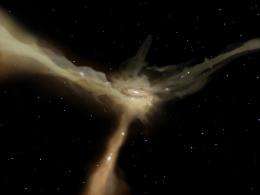
A galaxy accretes mass from rapid, narrow streams of cold gas. These filaments provide the galaxy with continuous flows of raw material to feed its star-forming at a rather leisurely pace. This theoretical scenario for galaxy formation is based on the numerical simulations presented by Dekel et al., 2009 (Nature, 457, 451D). However, the actual process of stream accretion onto a galaxy has never been directly observed and it remains speculative. Credits: ESA-AOES Medialab

(PhysOrg.com) -- ESA's Herschel infrared space observatory has discovered that galaxies do not need to collide with each other to drive vigorous star birth. The finding overturns this long-held assumption and paints a more stately picture of how galaxies evolve.

The conclusion is based on Herschel's observations of two patches of sky, each about a third of the size of the .

It's like looking through a keyhole across the Universe – Herschel has seen more than a thousand at a variety of distances from the Earth, spanning 80% of the age of the cosmos.
Herschel paints new story of galaxy evolution
Enlarge

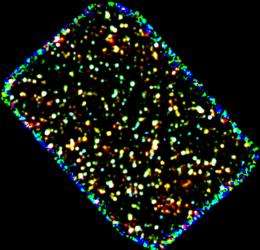
GOODS-North is a patch of sky in the northern hemisphere that covers an area of about a third the size of the Full Moon. This images was taken by Herschel at the following infrared wavelengths: 100μm (blue), 160μm (green) and 250μm (red). North is up and East is left. Credits: ESA/GOODS-Herschel consortium/David Elbaz

These observations are unique because Herschel can study a wide range of infrared light and reveal a more complete picture of star birth than ever seen before.

It has been known for some years that the rate of star formation peaked in the early Universe, about 10 billion years ago. Back then, some galaxies were forming stars ten or even a hundred times more vigorously than is happening in our Galaxy today.

In the nearby, present-day Universe, such high birth rates are very rare and always seem to be triggered by galaxies colliding with each other. So, astronomers had assumed that this was true throughout history.

Herschel now shows that this is not the case by looking at galaxies that are very far away and thus seen as they were billions of years ago.

David Elbaz, CEA Saclay, France, and collaborators have analysed the Herschel data and find that galaxy collisions played only a minor role in triggering star births in the past, even though some young galaxies were creating stars at furious rates.

By comparing the amount of infrared light released at different wavelengths by these galaxies, the team has shown that the rate depends on the quantity of gas they contain, not whether they are colliding.

Gas is the raw building material for stars and this work reveals a simple link: the more gas a galaxy contains, the more stars are born.

"It's only in those galaxies that do not already have a lot of gas that collisions are needed to provide the gas and trigger high rates of star formation", says Dr. Elbaz.
Herschel paints new story of galaxy evolution
Enlarge

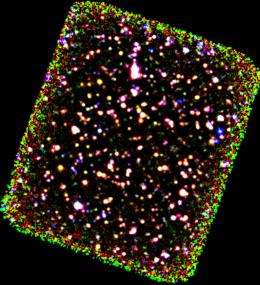
GOODS-South is a patch of sky in the southern hemisphere that covers an area of about a third the size of the Full Moon. This images was taken by Herschel and NASA's Spitzer space telescope at the following infrared wavelengths:24 μm (blue), 100 μm (green) and 160 μm (red). North is up and East is left. Credits: ESA/GOODS-Herschel consortium/NASA/JPL-Caltech/David Elbaz

This applies to today's galaxies because, after forming stars for more than 10 billion years, they have used up most of their gaseous raw material.

The research paints a much more stately picture of star births than before, with most galaxies sitting in space, growing slowly and naturally from the gas they attract from their surroundings.

"Herschel was conceived to study the history of across cosmic time", says Göran Pilbratt, ESA Project Scientist.

"These new observations now change our perception of the history of the Universe."

Provided by European Space Agency search and more info website

Filter


Move the slider to adjust rank threshold, so that you can hide some of the comments.


Display comments: newest first

that_guy
Sep 13, 2011

Rank: 2 / 5 (1)
Just a thought regarding observational bias. At the specific resolution that herschel provides at those distances, what exactly would it look like if a small galaxy, such as the small magenellic cloud merged with a larger galaxy in the wavelength that herschel sees?

It isn't like these pictures provide a lot of detail at those distances.

I would like them to set up a second experiment to independently verify that these findings are accurate before I give this weight.
omatumr
Sep 13, 2011

Rank: 1 / 5 (13)
Thanks for the story.

Are streams of gas simply waste products from the galaxy of smaller neutron stars produced when a large parent compact object fragments from neutron repulsion [1[?

1. The APEIRON report, in press (2011):
http://arxiv.org/...2.1499v1

With kind regards,
Oliver K. Manuel
Former NASA Principal
Investigator for Apollo
Ethelred
Sep 13, 2011

Rank: 4.5 / 5 (15)
No.

Ethelred
yyz
Sep 13, 2011

Rank: 5 / 5 (5)
"At the specific resolution that herschel provides at those distances, what exactly would it look like if a small galaxy, such as the small magenellic cloud merged with a larger galaxy in the wavelength that herschel sees?

It isn't like these pictures provide a lot of detail at those distances."

While Herschel has too poor a resolution to easily discriminate distant galaxy mergers from solitary starburst galaxies, the fields looked at are the well studied and surveyed GOODS fields centered on the Hubble Deep Field-N and the Chandra Deep Field-S: http://en.wikiped...ki/GOODS

The solitary starburst galaxies seen by Hershel had already been ID as such in previous studies by HST, VLA, Spitzer and other large ground based observatories. I do think the PR overhypes astronomers' "assumptions" of mergers as the dominant driver of star formation in the early universe, as studies of distant Lyman-alpha systems and gas-accreting isolated galaxies indicate other SF mechanisms at work.
yyz
Sep 13, 2011

Rank: 5 / 5 (5)
I guess as to underscore some of the work on the GOODS fields I alluded to above, a paper posted tonight on arXiv presents a HST study of the occurrence of galaxy mergers among a sample of AGNs in the CDF-S: http://arxiv.org/...88v1.pdf

All these multiwavelength observations, combined with models, will be used in the future to tease out what mechanisms contributed to star formation in the early universe and what the dominant mechanism(s) were at different epochs.
Rank 5 /5 (8 votes)
Relevant PhysicsForums posts
  • Distance of planets from stars and revolution
    created3 hours ago
  • revamping general concept and cosmological principle
    createdMay 25, 2012
  • Transiting Exoplanet Light Curve
    createdMay 25, 2012
  • Math behind Theoretical Physics
    createdMay 24, 2012
  • Do we know whats at the center of galaxies yet?
    createdMay 23, 2012
  • Structure of the Milky Way?
    createdMay 20, 2012
  • More from Physics Forums - General Astronomy

More news stories

Land and sea species differ in climate change response: study

(Phys.org) -- Marine and terrestrial species will likely differ in their responses to climate warming, new research by Simon Fraser University and Australia’s University of Tasmania has found.

Space & Earth / Environment

created 1 hour ago | popularity not rated yet | comments 1 | with audio podcast

Yale study concludes public apathy over climate change unrelated to science literacy

Are members of the public divided about climate change because they don't understand the science behind it? If Americans knew more basic science and were more proficient in technical reasoning, would public consensus match ...

Space & Earth / Environment

created 3 hours ago | popularity 4 / 5 (1) | comments 10 | with audio podcast

10 million years needed to recover from mass extinction

It took some 10 million years for Earth to recover from the greatest mass extinction of all time, latest research has revealed.

Space & Earth / Earth Sciences

created 3 hours ago | popularity not rated yet | comments 1 | with audio podcast

Sophisticated simulations predict future warming

The chances of our planet being hit by a global warming of 3 degrees Celsius by 2050 is as likely as it being hit by an increase of 1.4 degrees, new research shows. Presented in the journal Nature Geoscience, the British study ...

Space & Earth / Earth Sciences

created May 22, 2012 | popularity 4.4 / 5 (9) | comments 51

Aliens don't want to eat us, says former SETI director

Alien life probably isn’t interested in having us for dinner, enslaving us or laying eggs in our bellies, according to a recent statement by former SETI director Jill Tarter.

Space & Earth / Space Exploration

created May 25, 2012 | popularity 4.4 / 5 (14) | comments 39


'Unzipped' carbon nanotubes could help energize fuel cells, batteries

Multi-walled carbon nanotubes riddled with defects and impurities on the outside could replace some of the expensive platinum catalysts used in fuel cells and metal-air batteries, according to scientists at ...

T cells 'hunt' parasites like animal predators seek prey, study shows

By pairing an intimate knowledge of immune-system function with a deep understanding of statistical physics, a cross-disciplinary team at the University of Pennsylvania has arrived at a surprising finding: T cells use a movement ...

Computer model used to pinpoint prime materials for efficient carbon capture

When power plants begin capturing their carbon emissions to reduce greenhouse gases – and to most in the electric power industry, it's a question of when, not if – it will be an expensive undertaking.

Change in developmental timing was crucial in the evolutionary shift from dinosaurs to birds: study

At first glance, it's hard to see how a common house sparrow and a Tyrannosaurus Rex might have anything in common. After all, one is a bird that weighs less than an ounce, and the other is a dinosaur that ...

Almost half of new vets seek disability

(AP) -- America's newest veterans are filing for disability benefits at a historic rate, claiming to be the most medically and mentally troubled generation of former troops the nation has ever seen.

Nvidia trumpets Tegra 3 phone design wins for 2012

(Phys.org) -- Nvidia’s competitive war paint has a name, Tegra 3. On the heels of Nvidia announcements about lowering costs of its Tegra 3 processors and Nvidia-enabled tablets running Android Ice Cream ...