Harmless soil-dwelling bacteria successfully kill cancer
Sep 05, 2011
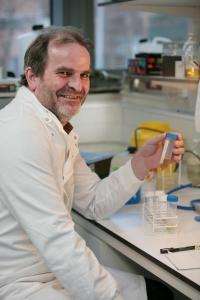
Professor Nigel Minton works at the University of Nottingham. Credit: University of Nottingham

A bacterial strain that specifically targets tumours could soon be used as a vehicle to deliver drugs in frontline cancer therapy. The strain is expected to be tested in cancer patients in 2013 says a scientist at the Society for General Microbiology's Autumn Conference at the University of York.

The therapy uses Clostridium sporogenes – a bacterium that is widespread in the soil. Spores of the bacterium are injected into patients and only grow in solid tumours, where a specific bacterial enzyme is produced. An anti-cancer drug is injected separately into the patient in an inactive 'pro-drug' form. When the pro-drug reaches the site of the tumour, the bacterial enzyme activates the , allowing it to destroy only the cells in its vicinity – the tumour cells.

Researchers at the University of Nottingham and the University of Maastricht have now overcome the hurdles that have so far prevented this therapy from entering clinical trials. They have introduced a gene for a much-improved version of the enzyme into the C. sporogenes DNA. The improved enzyme can now be produced in far greater quantities in the tumour than previous versions, and is more efficient at converting the pro-drug into its active form.

A fundamental requirement for any new is the ability to target cells while excluding healthy cells. Professor Nigel Minton, who is leading the research, explains how this therapy naturally fulfils this need. "Clostridia are an ancient group of bacteria that evolved on the planet before it had an oxygen-rich atmosphere and so they thrive in low oxygen conditions. When Clostridia spores are injected into a cancer patient, they will only grow in oxygen-depleted environments, i.e. the centre of solid tumours. This is a totally natural phenomenon, which requires no fundamental alterations and is exquisitely specific. We can exploit this specificity to kill tumour cells but leave healthy tissue unscathed," he said.

The research may ultimately lead to a simple and safe procedure for curing a wide range of solid tumours. "This therapy will kill all types of tumour cell. The treatment is superior to a surgical procedure, especially for patients at high risk or with difficult locations," explained Professor Minton. "We anticipate that the strain we have developed will be used in a clinical trial in 2013 led by Jan Theys and Philippe Lambin at the University of Maastricht in The Netherlands. A successful outcome could lead to its adoption as a frontline therapy for treating solid tumours. If the approach is successfully combined with more traditional approaches this could increase our chance of winning the battle against cancerous tumours."

Explore further: Researchers find little correlation between microbial gene expression and environmental conditions in the laboratory

Provided by Society for General Microbiology

5 /5 (23 votes)

Related Stories

Open cancer surgery set to become a thing of the past

Sep 24, 2008

The surgeon's knife is playing an ever smaller role in the treatment of cancer, as it is replaced by increasingly efficient and safe radiation therapy techniques. Progress in radiation technology will also lead to better ...

Genes associated with aggressive breast cancer

Aug 16, 2010

Researchers at the University of Gothenburg, Sweden, have for the first time identified 12 genes that could be associated with aggressive breast tumours. The discovery could result in more reliable prognoses and better treatment ...

Recommended for you

User comments : 7

Adjust slider to filter visible comments by rank

Display comments: newest first

BradynStanaway
5 / 5 (3) Sep 05, 2011
Impressive!!!!!!
antialias_physorg
5 / 5 (4) Sep 05, 2011
When Clostridia spores are injected into a cancer patient, they will only grow in oxygen-depleted environments,

That is very clever. Other research had always focussed on oxygenating the hypoxic regions. Using the 'weakness' as a strength is very good out-of-the-box thinking.

Especialy useful once the tumor has spread and surgical procedures are no longer an option.

With the ability to tailor various pro-drugs to repond to this enzyme this could be made into a very potent weapon.
YawningDog
2.5 / 5 (10) Sep 05, 2011
The CANCER INDUSTRY does not want to find a cure for cancer. That would be a game ender.

Some years back a researcher noted that the surest way of getting a cancer research project funded was to make certain the only findings were that more study was needed.
Myno
not rated yet Sep 05, 2011
So this would hollow out the insides of solid tumors, but do nothing about metastases and the outer shells of solid tumors, both of which would continue to grow? Or would the activated pro-drug kill the outer shells too?
blazingspark
5 / 5 (1) Sep 05, 2011
I hope this works. A revolution in medicine has been waiting for a long long time!
antialias_physorg
5 / 5 (1) Sep 06, 2011
So this would hollow out the insides of solid tumors, but do nothing about metastases and the outer shells of solid tumors, both of which would continue to grow?

Just hypothesizing here: Since we're dealing with an enzyme there will be some diffusion into the surrounding tissue. So this should work a little bit beyond the immediate position of the bacteria.

The outer parts of a tumor are less hypoxic so they're more susceptible to other types of treatment (standard chemo/radiation therapy)

This work is a great step forward in one area of cancer research that has been confounding many. It's probably not a silver bullet, though.
Ricochet
not rated yet Sep 06, 2011
That's what I was thinking... it would make sense that a tumor would be a little spongy on the outside, given that it wants to grow. That would be hard if it had a hard shell around it. That gives the bacteria a foothold to start "infecting" the tumor.

More news stories

Have you had your cereal today?

Cereals are grasses that produce grains, the bulk of our food supply. Carnegie's Plant Biology Department is releasing genome-wide metabolic complements of several cereals including rice, barley, sorghum, and millet. Along ...

How do bees make honey? It's not just bee barf

(Phys.org) —Last weekend, my daughter asked me how bees made honey, and I realized that I didn't know the answer. How do bees make honey? I did some homework, and can now explain it to her – and to you.

Has motorization in the US reached its peak?

(Phys.org) —Fewer light vehicles are on America's roads today than five years ago, thanks possibly to increases in telecommuting and public transportation, says a University of Michigan researcher.