Happy Feet the penguin begins long swim home
September 4, 2011

Happy Feet's home in Antarctica is about 2,000 kilometres further south

Enlarge

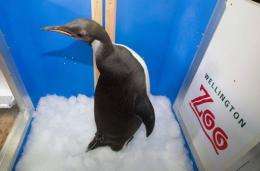
The emperor penguin nicknamed "Happy Feet" sits in a special crate used to transport him to the Southern Ocean east of Campbell Island. The penguin who became a worldwide celebrity after he washed up on a New Zealand beach was released back into the Southern Ocean on Sunday to begin a long swim home to Antarctica

Happy Feet, the lost penguin who became a worldwide celebrity after he washed up on a New Zealand beach was released back into the Southern Ocean on Sunday to begin a long swim home to Antarctica.

"It's an indescribable feeling to see a patient finally set free. It’s definitely the best part of the job," said veterinary surgeon Lisa Argilla who treated the penguin after he was found emaciated and near death in late June.

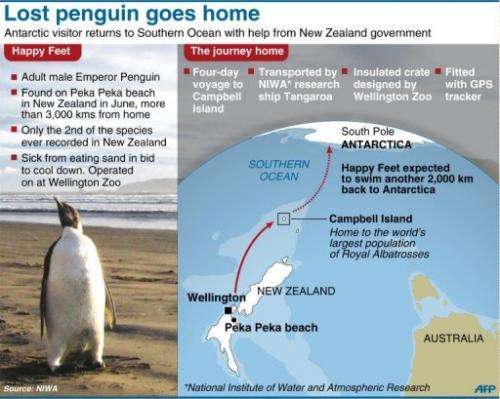
The emperor penguin, dubbed Happy Feet, was released into the water from the fisheries vessel Tangaroa near Campbell Island, about 700 kilometres (435 miles) south of New Zealand's South Island.

His home in is about 2,000 kilometres further south and it is expected he will join up with other emperor on the long voyage.

Argilla, the manager of veterinary science at Wellington Zoo, said in a statement from the Tangaroa that the penguin was released down a purpose-built hydro-slide after other options were abandoned because of rough seas.
Lost penguin goes home
Enlarge

Graphic detailing the return of a lost Emperor Penguin to Antarctica. Happy Feet, found on a beach near Wellington in mid-June, was only the second emperor penguin ever recorded in New Zealand.

He needed "some gentle encouragement" to leave the safety of his crate that has been his home for six days since leaving New Zealand after spending two months at Wellington Zoo, she said.

"He slid down his specially designed penguin slide backwards but once he hit the water he spared no time in diving off away from the boat."

The penguin had travelled south in a custom-made crate designed to keep him cold and comfortable during the voyage.

Happy Feet, found on a beach near Wellington in mid-June, was only the second emperor penguin ever recorded in New Zealand.

He was close to death and needed surgery to remove sand and sticks from his stomach before he could be fattened up on a diet of fish milkshakes.

The three-and-a-half-year-old bird, which now weighs about 27.5 kilograms (60.5 pounds), attracted international attention during his New Zealand sojourn and there are plans for a book and documentary recounting his story.

Attendance at Wellington Zoo almost doubled during Happy Feet's stay, even though he was rarely on display. His fans include New Zealand Prime Minister John Key and actor Stephen Fry, who is in Wellington to film "The Hobbit".

He has been fitted with a satellite tracker and microchip and his progress can be followed on http://www.nzemperor.com.

(c) 2011 AFP

4.5 /5 (2 votes)  

Rank 4.5 /5 (2 votes)
Relevant PhysicsForums posts

More news stories

Manufacturing genes to attack flu virus

An international research team has manufactured a new protein that can combat deadly flu epidemics.

Biology / Biotechnology

created 3 hours ago | popularity not rated yet | comments 0 | with audio podcast

Scientist: Evolution debate will soon be history

(AP) -- Richard Leakey predicts skepticism over evolution will soon be history. Not that the avowed atheist has any doubts himself.

Biology / Evolution

created 21 hours ago | popularity 3.5 / 5 (20) | comments 83

More plant species responding to global warming than previously thought

(Phys.org) -- Far more wild plant species may be responding to global warming than previous large-scale estimates have suggested.

Biology / Ecology

created May 22, 2012 | popularity 4.6 / 5 (14) | comments 18 | with audio podcast

Thousands of shellfish found dead in Peru

Thousands of crustaceans were found dead off the coast of Lima following the mystery mass death of dolphins and pelicans, the Peruvian Navy said Friday.

Biology / Ecology

created May 26, 2012 | popularity 4.8 / 5 (5) | comments 7

For monogamous sparrows, it doesn't pay to stray (but they do it anyway)

It's quite common for a female song sparrow to stray from her breeding partner and mate with the male next door, but a new study shows that sleeping around can be costly.

Biology / Plants & Animals

created May 22, 2012 | popularity 5 / 5 (2) | comments 8 | with audio podcast


Land and sea species differ in climate change response: study

(Phys.org) -- Marine and terrestrial species will likely differ in their responses to climate warming, new research by Simon Fraser University and Australia’s University of Tasmania has found.

'Unzipped' carbon nanotubes could help energize fuel cells, batteries

Multi-walled carbon nanotubes riddled with defects and impurities on the outside could replace some of the expensive platinum catalysts used in fuel cells and metal-air batteries, according to scientists at ...

T cells 'hunt' parasites like animal predators seek prey, study shows

By pairing an intimate knowledge of immune-system function with a deep understanding of statistical physics, a cross-disciplinary team at the University of Pennsylvania has arrived at a surprising finding: T cells use a movement ...

Computer model used to pinpoint prime materials for efficient carbon capture

When power plants begin capturing their carbon emissions to reduce greenhouse gases – and to most in the electric power industry, it's a question of when, not if – it will be an expensive undertaking.

Change in developmental timing was crucial in the evolutionary shift from dinosaurs to birds: study

At first glance, it's hard to see how a common house sparrow and a Tyrannosaurus Rex might have anything in common. After all, one is a bird that weighs less than an ounce, and the other is a dinosaur that ...

Almost half of new vets seek disability

(AP) -- America's newest veterans are filing for disability benefits at a historic rate, claiming to be the most medically and mentally troubled generation of former troops the nation has ever seen.