Gene regulatory networks in the bee brain linked to behavior
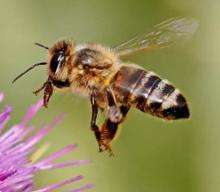
A new study reveals that distinct networks of genes in the honey bee brain contribute to specific behaviors, such as foraging or aggression, researchers report.
The study, in the Proceedings of the National Academy of Sciences, is the first to show that common, naturally occurring behaviors are under the influence of discrete regulatory networks in the brain. It confirms, scientists say, what years of research into the brain and behavior seemed to indicate: There is a close relationship between changes in gene expression which genes are actively transcribed into other molecules to perform specific tasks in the cell and behavior.
"We found that there is a high degree of modularity in the regulation of genes and behavior, with distinct behavioral states represented by distinct gene network configurations," said University of Illinois entomology and neuroscience professor Gene Robinson, who led the study. Robinson is the director of the Institute for Genomic Biology at Illinois.
The study made use of data from the BeeSpace Project. Curated by Illinois medical information science professor Bruce Schatz, BeeSpace is a catalog of genes that turn on or off in the bee brain in response to social cues, environmental changes or as a result of hereditary factors. By analyzing gene expression and behavioral data from dozens of studies (which were performed under the auspices of the BeeSpace Project), the researchers were able to get a broad view of the molecular changes in the bee brain that contribute to behavior.
The team focused their analysis on lists of genes implicated in at least one of three categories of behavior: foraging, such as scouting for flowers or navigating to and from the hive; maturation, the process by which an adult honey bee graduates from being a nanny to working as a forager as it grows older; and aggression, or hive defense.
The researchers then used a systems approach, led by Illinois chemical and biomolecular engineering professor Nathan Price (now at the Institute for Systems Biology in Seattle), to create a computer model of a gene regulatory network that could predict the differences in gene expression seen in the experimental studies.
The model found a "mosaic" pattern of behavior-related gene expression in the brain. It also predicted that a few transcription factors genes that regulate other genes play a role in all three behavioral categories. Only four of these "global regulators" were identified, while sets of about 15-25 transcription factors were behavior-specific.
Researchers have long worried that the regulation of brain gene expression is too complex to fathom, because so many factors can act together to regulate behavior.
"But now we see that direct, linear relationships between transcription factors and downstream genes can predict a surprisingly large amount of gene expression," Price said. "This gives scientists hope that it will be possible to completely understand the regulation of brain gene expression in the future."
More information: "Behavior-Specific Changes in Transcriptional Modules Lead to Distinct and Predictable Neurogenomic States," Proceedings of the National Academy of Sciences (2011).
Provided by
University of Illinois at Urbana-Champaign
-
From lemons to lemonade: Reaction uses carbon dioxide to make carbon-based semiconductor,
32 comments
-
Thioridazine kills cancer stem cells in human while avoiding toxic side-effects of conventional cancer treatments,
3 comments
-
SpaceX private rocket blasts off for space station (Update),
42 comments
-
Climate scientists say they have solved riddle of rising sea,
31 comments
-
SpaceX capsule has 'new car' smell, astronauts say (Update),
4 comments
-
What would stain as translucent on light-coloured fabric?
22 hours ago
-
How do I identify different bacteria on culture plates?
May 26, 2012
-
Why Do Dogs do Strange things...
May 25, 2012
-
What does exophillic and endophillic mean in terms of mosquito and their control?
May 24, 2012
-
Semen stains glows under black lights (uv light)?
May 23, 2012
-
Question on Human Chromosome 2
May 23, 2012
- More from Physics Forums - Biology
More news stories
Manufacturing genes to attack flu virus
An international research team has manufactured a new protein that can combat deadly flu epidemics.
3 hours ago |
not rated yet |
0
|
Scientist: Evolution debate will soon be history
(AP) -- Richard Leakey predicts skepticism over evolution will soon be history. Not that the avowed atheist has any doubts himself.
21 hours ago |
3.5 / 5 (20) |
83
More plant species responding to global warming than previously thought
(Phys.org) -- Far more wild plant species may be responding to global warming than previous large-scale estimates have suggested.
May 22, 2012 |
4.6 / 5 (14) |
18
|
Thousands of shellfish found dead in Peru
Thousands of crustaceans were found dead off the coast of Lima following the mystery mass death of dolphins and pelicans, the Peruvian Navy said Friday.
May 26, 2012 |
4.8 / 5 (5) |
7
For monogamous sparrows, it doesn't pay to stray (but they do it anyway)
It's quite common for a female song sparrow to stray from her breeding partner and mate with the male next door, but a new study shows that sleeping around can be costly.
May 22, 2012 |
5 / 5 (2) |
8
|
Land and sea species differ in climate change response: study
(Phys.org) -- Marine and terrestrial species will likely differ in their responses to climate warming, new research by Simon Fraser University and Australia’s University of Tasmania has found.
'Unzipped' carbon nanotubes could help energize fuel cells, batteries
Multi-walled carbon nanotubes riddled with defects and impurities on the outside could replace some of the expensive platinum catalysts used in fuel cells and metal-air batteries, according to scientists at ...
T cells 'hunt' parasites like animal predators seek prey, study shows
By pairing an intimate knowledge of immune-system function with a deep understanding of statistical physics, a cross-disciplinary team at the University of Pennsylvania has arrived at a surprising finding: T cells use a movement ...
Computer model used to pinpoint prime materials for efficient carbon capture
When power plants begin capturing their carbon emissions to reduce greenhouse gases and to most in the electric power industry, it's a question of when, not if it will be an expensive undertaking.
Change in developmental timing was crucial in the evolutionary shift from dinosaurs to birds: study
At first glance, it's hard to see how a common house sparrow and a Tyrannosaurus Rex might have anything in common. After all, one is a bird that weighs less than an ounce, and the other is a dinosaur that ...
Almost half of new vets seek disability
(AP) -- America's newest veterans are filing for disability benefits at a historic rate, claiming to be the most medically and mentally troubled generation of former troops the nation has ever seen.