FC-R&D releases natural-energy power system
Sep 09, 2011 by Nancy Owano weblog

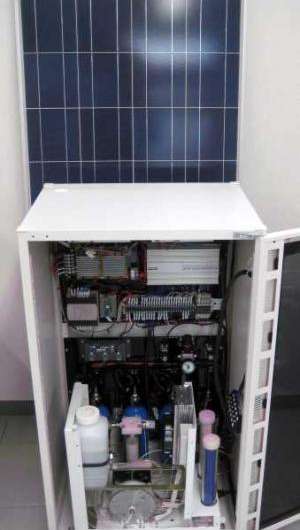
(PhysOrg.com) -- A home energy system that uses water, sunlight, and hydrogen has been released by Japan's FC-R&D. The system is called ZEEP24, where electricity is generated during the day using solar panels. Hiroshi Nakijima, FC-R&D president, in a video on DigInfo, talked about the significance of the system in making use of any excess capacity of electricity.

"In Japanese homes during the day, usually, not much electricity is used, as both parents are working and the children are at school. So with solar , there's often excess capacity during the day. With this system, the excess capacity isn't sold; instead, it's used to produce stored , another energy source, through electrolysis. Hydrogen is used because it has high energy density."

ZEEP24 was conceived for use for communities that experience power outages during disasters where the supply has been knocked out or for homes as a general emergency power supply.

The ZEEP24 as an alternative power source reflects the FC-R&D mission, defined as wanting to provide as many people as possible in with applications of clean and sustainable energy. In talking about the new release of ZEEP24, he pointed out that it uses a hydrogen storage alloy, developed to absorb the hydrogen. Even when the system isn't being used, it does not consume unnecessary power. Also, he said, the system is carbon-free. In contrast with an ordinary battery, there is no carbon-induced deterioration.

Devices that are powered by hydrogen have been of interest to Japanese researchers for years. Hydro-electricity is a clean source of energy, and many companies have explored ways to harness it within varied applications.

Around five years ago, Tokyo Seiden worked on a hydro-powered coffee stand bearing two small tanks of hydrogen, enabling the brewing of coffee and cooked food. Michio Tatsuno of Tokyo Seiden was quoted as saying that the stand, in the event of heavy snow or earthquakes, could provide electricity for medical teams and households.

The report in ITN Source also said that FC-R&D was focusing on hydrogen power to light up a miniature house. At the time, the devised was a combination of magnesium taken from sea water and vitamin C to generate hydrogen. Nakajima said the goal was to develop a larger version to light up a real house.

As for future directions, FC-R&D is working on attaching hydrogen storage containers directly to hydrogen-powered cars.

Explore further: Report heralds new $50 billion energy industry for Australia

More information: Japanese product page

via Diginfo

Related Stories

NREL, Xcel energy sign wind to hydrogen research agreement

May 08, 2006

The U.S. Department of Energy's, National Renewable Energy Laboratory and Xcel Energy recently signed a cooperative agreement for an innovative "wind to hydrogen" research, development and demonstration project. Researchers ...

U.S. funds hydrogen experiment

Feb 26, 2007

The U.S. Energy Department has awarded a U.S. researcher a $3 million grant for a project that focuses on harnessing photoactive material from the sun.

Experimental 'wind to hydrogen' system up and running

Jan 08, 2007

Xcel Energy and the U.S. Department of Energy’s National Renewable Energy Laboratory today unveiled a unique facility that uses electricity from wind turbines to produce and store pure hydrogen, offering what may become ...

Storing green electricity as natural gas

May 05, 2010

Renewable electricity can be transformed into a substitute for natural gas. Until now, electricity was generated from gas. Now, a German-Austrian cooperation wants to go in the opposite direction. In the future, these researchers ...

Recommended for you

Green conversion of heat to electricity

12 hours ago

Soon, it will be possible to produce electricity from heat over 30 degrees emitted from a waste incinerator, refinery, or data processor. The start-up Osmoblue has just confirmed the feasibility of this new ...

Space drives e-mobility

13 hours ago

An ESA business incubation start-up company is helping major car manufacturers to develop electric vehicle concepts and improve safety systems by turning ideas quickly into virtual prototypes.

User comments : 1

Adjust slider to filter visible comments by rank

Display comments: newest first

DGBEACH
5 / 5 (2) Sep 09, 2011
Since when is power from hydrogen referred to as hydroelectric power?

More news stories

Game system castAR debuts at Maker Faire

(Phys.org) —Two tech talents, formerly employees at video game publisher Valve, have been working on their own vision in the form of game-ready glasses. Their company, Technical Illusions, will seek to ...

If you can remember it, you can remember it wrong

(Medical Xpress)—Native peoples in regions where cameras are uncommon sometimes react with caution when their picture is taken. The fear that something must have been stolen from them to create the photo ...

B vitamins could delay dementia

(Medical Xpress)—Despite spending billions of dollars on research and development, drug companies have been unable to come up with effective treatments for dementia and Alzheimer's Disease (AD). Now, A. ...

Reducing caloric intake delays nerve cell loss

Activating an enzyme known to play a role in the anti-aging benefits of calorie restriction delays the loss of brain cells and preserves cognitive function in mice, according to a study published in the May ...