3 Questions: Faster than light?
September 26, 2011 by David L. Chandler
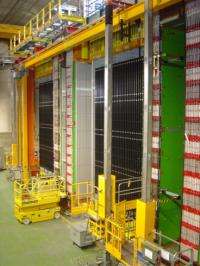
View of the OPERA detector (on the CNGS facility) with its two identical Super Modules, each one containing one target section and one spectrometer. Image: CERN
The news media were abuzz this week with reports of experiments conducted at the Gran Sasso particle detector complex in Italy, apparently showing subatomic particles called neutrinos had traveled from the giant particle accelerator at CERN, outside Geneva, to the Italian detector at a speed just slightly faster than the speed of light -- a result that, if correct, would overturn more than a century of accepted physics theory. Professor of Physics Peter Fisher, head of MIT's Particle and Nuclear Experimental Physics division, answered some questions about these new findings.
Q. If this result is confirmed, does it really undermine Einsteins theory of relativity, as some news reports claim? And if so, is there a theory thats been proposed that might account for it?
A. Einsteins theory rests on two postulates, one of which is that electromagnetic radiation travels at the same speed (the speed of light, 300,000 kilometers per second) no matter how the observer moves. Light particles photons have no mass, so a consequence is that no particle with mass can move at a velocity greater than light. These neutrinos have a tiny, but non-zero, mass and hence should not be able to travel faster than the speed of light.
There are theories that predict particles moving faster than the speed of light, but, to my knowledge, none of them account for all the other phenomena we have measured experimentally since the time of Einstein.
Q. What kind of other tests or independent experiments would it take to confirm this result so that it would be widely accepted?
A. There are two other experiments that shoot neutrinos over long distances that may have something to say about this result. One experiment is in the U.S., and the beam goes from Fermilab, near Chicago, to a detector called MINOS in northern Minnesota. The other shoots a neutrino beam across Japan to an experiment in a mine called Super-Kamiokande. The energies of the neutrinos in these experiments are much lower than the CERN beam, but they may have something to say very soon.
Q. If this turns out to be some kind of unrecognized systematic error in the measurements, would that reflect badly on the scientists who reported it, or would it just be a reflection of science working as its supposed to?
A. I would say more the latter. I know a number of the people on the OPERA experiment [at Gran Sasso] and they are very thoughtful, careful people who would never publish a result like this unless they were certain there was no better explanation. I would bet that whatever the explanation is, it will be very interesting.
Provided by
Massachusetts Institute of Technology
-
From lemons to lemonade: Reaction uses carbon dioxide to make carbon-based semiconductor,
32 comments
-
Thioridazine kills cancer stem cells in human while avoiding toxic side-effects of conventional cancer treatments,
3 comments
-
SpaceX private rocket blasts off for space station (Update),
42 comments
-
Climate scientists say they have solved riddle of rising sea,
31 comments
-
SpaceX capsule has 'new car' smell, astronauts say (Update),
4 comments
-
Why does light move?
26 minutes ago
-
How to calculate the repulsion force between a permanent and an electromagnet?
1 hour ago
-
Why does light allow us to see things?
1 hour ago
-
Room temperature superconductivity
1 hour ago
-
Water flow question
5 hours ago
-
16 year old solves 300 year old problem set by Isaac Newton
6 hours ago
- More from Physics Forums - General Physics
More news stories
Is a classical electrodynamics law incompatible with special relativity?
(Phys.org) -- The laws of classical electromagnetism that were developed in the 19th century are the same laws that scientists use today. They include Maxwell’s four equations along with the Lorentz la ...
Landmark calculation clears the way to answering how matter is formed
(Phys.org) -- An international collaboration of scientists, including Thomas Blum, associate professor of physics, is reporting in landmark detail the decay process of a subatomic particle called a kaon ...
May 25, 2012 |
4.3 / 5 (22) |
51
|
Lying in wait for WIMPs: Researchers seek to dramatically increase sensitivity of Large Underground Xenon detector
Although it's invisible, dark matter accounts for at least 80 percent of the matter in the universe. No one knows what it is, but most scientists would bet on weakly interacting massive particles, or WIMPs.
May 23, 2012 |
4 / 5 (7) |
16
|
Hawaii lab turns laser-powered bubbles into microrobots
(Phys.org) -- A team of scientists from the University of Hawaii are working on microrobots created from bubbles of air in a saline solution. The bubbles take on their title of robots as a laser ...
Sound increases the efficiency of boiling
Scientists at the Georgia Institute of Technology achieved a 17-percent increase in boiling efficiency by using an acoustic field to enhance heat transfer. The acoustic field does this by efficiently removing vapor bubbles ...
May 24, 2012 |
5 / 5 (2) |
2
Land and sea species differ in climate change response: study
(Phys.org) -- Marine and terrestrial species will likely differ in their responses to climate warming, new research by Simon Fraser University and Australia’s University of Tasmania has found.
'Unzipped' carbon nanotubes could help energize fuel cells, batteries
Multi-walled carbon nanotubes riddled with defects and impurities on the outside could replace some of the expensive platinum catalysts used in fuel cells and metal-air batteries, according to scientists at ...
T cells 'hunt' parasites like animal predators seek prey, study shows
By pairing an intimate knowledge of immune-system function with a deep understanding of statistical physics, a cross-disciplinary team at the University of Pennsylvania has arrived at a surprising finding: T cells use a movement ...
Computer model used to pinpoint prime materials for efficient carbon capture
When power plants begin capturing their carbon emissions to reduce greenhouse gases and to most in the electric power industry, it's a question of when, not if it will be an expensive undertaking.
Change in developmental timing was crucial in the evolutionary shift from dinosaurs to birds: study
At first glance, it's hard to see how a common house sparrow and a Tyrannosaurus Rex might have anything in common. After all, one is a bird that weighs less than an ounce, and the other is a dinosaur that ...
Almost half of new vets seek disability
(AP) -- America's newest veterans are filing for disability benefits at a historic rate, claiming to be the most medically and mentally troubled generation of former troops the nation has ever seen.
Sep 26, 2011
Rank: 1.8 / 5 (11)
This is exactly, what the Lorentz invariance really means in its very consequences: the completely flat and transparent Universe. Because the truly constant speed of light in vacuum admits no lensing, diffraction and dispersive phenomena in vacuum. If we want to find a real tachyons, we should focus to gravitational waves and/or long wavelength photons.
Indeed, this interpretation still doesn't explain, why neutrinos are ignoring CMBR background, while the other particles do.
Sep 26, 2011
Rank: 1.6 / 5 (7)
As an aether proponent, I'd like to have the later option confirmed, but it violates another theories of mine, especially the slow neutrino origin of warm dark matter. This model is quite predicative, but it requires, the neutrinos could move in arbitrary subluminal speeds, too. One solution of this paradox could be, the superluminal neutrinos moving along zig-zag paths due their interactions with CMBR photons at low energy sector, so that their global speed still remains subluminal at the case of primordial neutrinos.
Sep 26, 2011
Rank: 1.5 / 5 (8)
The superluminal neutrinos could explain, why many black holes are intensive sources of neutrinos - they're simply emanate them through their even horizon. It allows the black hole to radiate their matter a much faster, than the classical Hawking mechanism would allow.
Bursts of energetic neutrinos would explain the X-ray flares emitted the Milky Way core in accordance to LaViolette theory, which I believe are responsible for some global warming and geovolcanic effects across solar system.
http://www.techno...v/25780/
I'm sure, you could extrapolate many other testable consequences of this finding. It's entertaining conceptual physics, violating many established paradigms.
Sep 26, 2011
Rank: 2.3 / 5 (3)
Are you saying, that when space is curved their remains an uncurved component that the Neutrinos use? or are you saying that either photon or neutrinos are moving through the Aether and the other is not?
"Because the truly constant speed of light in vacuum admits no lensing" can you try to explain please or I might have to ask omataranter?
remember the curvature is proposed to increase the amount of space the photon has to traverse at c
Sep 26, 2011
Rank: 4.6 / 5 (14)
what a stupid question what matters is knowing facts of universe not whether Einstein is right or wrong. Stick to physic not people
Sep 26, 2011
Rank: 2.3 / 5 (7)
Sep 26, 2011
Rank: 1.6 / 5 (7)
IMO this result supports the idea of double time arrow, as proposed with some theorists. Our Universe consist of pair dual time arrows, which differ only infinitesimally each other for lightest particles.
http://www.physor...776.html
In aether theory the space-time is composed of membranes of foam bubble with pair of surface gradients, which implies the double time arrow too.
Sep 26, 2011
Rank: 1.5 / 5 (8)
http://twitter.co...87526400
IMO the worm holes are rather exotic stuff (..we actually don't know any..) - but the penetration of neutrinos through event horizon of "normal" black hole is the way, in which the superluminal speed of neutrinos could be independently tested a way easier. The energetic neutrinos could interact with interstellar dust at close neighbourhood of black hole in rather specific way under formation of X-ray or even ultraviolet radiation.
Sep 26, 2011
Rank: 1.5 / 5 (8)
General relativity evades this restriction with assumption of space-time curvature, which works only from intrinsic perspective of gravitational lens. Outside of such lens is no gravity field and space-time is flat - so that the general relativity cannot be applied anyway there. Nevertheless the path of light still appears curved there - which means, the general relativity is violated outside of gravity lens.
I know, it sounds strange, but it's quite consequential thinking - the gravitational lensing is actually quantum mechanics phenomena.
Sep 26, 2011
Rank: 1.5 / 5 (8)
And vice-verse: inside of gravitational lens (when the space-time is really curved and time is dilated in accordance to special relativity) we wouldn't experience no relativist aberration at all. Such lensing can be observed only when we are residing OUTSIDE of gravity lens and its curvature of space-time.
I know quite well, only the GR enables to predict exact value of this lensing - but it cannot explain it logically and phenomenologically this effect doesn't belong into relativistic phenomena at all. In aether theory it's quite common, the theorems of one theory are used as a postulates of another theory and vice-versa. The logical predictions of one model differs from formal predictions of this model, because nonformal logic is in duality with formal applications of it.
Sep 26, 2011
Rank: 2 / 5 (3)
Sep 26, 2011
Rank: 1 / 5 (4)
http://www.newsci...tly.html
BTW the 7 km/sec difference in neutrino speed is in range with Doppler anisotropy shift of CMBR (627 km/s toward Virgo cluster) - we should check its directional dependence too.
Sep 26, 2011
Rank: 1 / 5 (1)
Sep 26, 2011
Rank: 2 / 5 (4)
Sep 26, 2011
Rank: 4 / 5 (3)
Sep 26, 2011
Rank: 4.4 / 5 (5)
They're not comparing the speed of these neutrinos to 'the speed of light' as measured. Instead they're comparing the speed of these neutrinos to "c", which is often confused with 'the speed that light travels'. The constant c is calculated out of some fairly fundamental electromagnetic equations (Maxwell's equations), and it can be thought of as "the speed of light in a vacuum". Light is very often slowed from c, and sometimes things travel faster than that slowed light, but we've yet to confirm anything traveling faster than c.
I wrote more about that here:
Point Five Past Lightspeed:
http://www.isthis...htspeed/
Sep 26, 2011
Rank: 1.7 / 5 (6)
My bad. - OmaTard
Sep 26, 2011
Rank: 3 / 5 (2)
Oops, you dropped your facade there.
Sep 26, 2011
Rank: 2.3 / 5 (3)
This is one crucial weak point of modern physics. The problem is because photon was not accepted as the vibration of some physical thing, instead it was thought as a magical thing!
Sep 26, 2011
Rank: 1 / 5 (1)
...Neutrinos CAN Go Faster Than Light Without Violating Relativity
Sep 26, 2011
Rank: 1 / 5 (3)
stop molesting your little boys and leave science to the rest of us.
Sep 26, 2011
Rank: 1 / 5 (1)
A simple calculation: the index of refraction of air is about 1.0003, so photons are slowed by .03% traveling through air. 450 miles is about 2.38 million feet, which is about 2.38 million ns at the speed of light in vacuum. Photons would normally take .0003x2.38 million ns (about 713 ns) more to travel 450 miles than they would in free space, so the relative index of refraction of neutrinos compared to photons in air would only have to be about 8% less than that of photons in order to account for 60 ns. I'm pretty sure nobody has yet measured the index of refraction for neutrinos in air, for whatever that is worth. The theory of relativity says that nothing can travel faster than the speed of light in free space, and as of right now it appears to me the CERN people have not exceeded THAT limit yet.
But maybe I did the math wrong?
Sep 26, 2011
Rank: 5 / 5 (1)
The author starts by belittling proponents of currently known physics because they pooh-pooh the results for violating relativity and because we're now in the 21 century, apparently.
He then proceeds to forward an idea based on string/brane theory and unseen dimensions to 'prove' that relativity isn't violated?
Well, excuse me for being doubly skeptical. He's asking us to both accept an extraordinary and (yet) unverified result and to plug that into a theory that so far has produced no predictions or means of falsifiability.
Could it be? Sure, why not? But any wild guess is as good as any other at this stage.
Sep 27, 2011
Rank: 3 / 5 (2)
Sep 27, 2011
Rank: not rated yet
Sep 27, 2011
Rank: 1 / 5 (1)
Fact: Nobody ever measured the mass of a neutrino.
You can find on physics books the mass of electrons, protons, muon, and a lot of particles. Not a single book says what mass have any of neutrino types/flavors.
The mass of neutrino is just a theory. In fact experiments trying to measure neutrino mass can only conclude that his mass squared is negative, so their mass should be imaginary, and that is exactly what relativity predicts for faster than light particles:
http://arxiv.org/.../0012060
http://arxiv.org/.../0009291
So, if experiments show that neutrinos are faster than light, and have imaginary mass, then they confirm again Relativity.
All the babble about this experiment being anything against relativity is garbage. Pseudo science.
Sep 27, 2011
Rank: 5 / 5 (1)
I'd like to see a recent reference from a peer-reviewed journal for that assertion, not a arxiv reference from 2000.
The (small) masses are predicted from theory on neutrino oscillation and from BB cosmology.
Also in July 2010 the 3D MegaZ experiment reported a measurement for the upper limit of the combined mass of all three neutrino varieties to be less than 0.28 eV.
http://prl.aps.or.../e031301
Sep 27, 2011
Rank: not rated yet
He does suggest a good test:
...building an OPERA detector not at 730 km distance but say only 200 km or say as far as 2000 km away
Then he makes some prediction but honestly I don't understand how he interprets the possible results.
Sep 27, 2011
Rank: not rated yet
Just search low energy beta decay of tritium
http://pdg.lbl.go...s802.pdf
Sep 27, 2011
Rank: not rated yet
I am all for the new speed of night - ([n]eutrino l[ight])
Already mentioned before : this speed is easier to remember.
300,006 km/s
Next please.
Imaginary mass? Check.
Negative mass? Check.
Constant. No? Check.
Never let go of your old love until you and your new love are locked in embrace. Monkeys do this to swing from one branch to the other.
Sep 28, 2011
Rank: 1 / 5 (2)
If we take this statement at face value, it is entirely indicative of a supra-light speed frameworks or integrational condition ---of some sort.
Sep 29, 2011
Rank: 5 / 5 (1)
Just an idea. Or..
Neutrino Reduction
Neutrinos reduce time and space....
http://WWW.blahblahblah.com
now where has that little boy gone?
Oliver
Former NASAcist
Sep 29, 2011
Rank: not rated yet
Sep 29, 2011
Rank: not rated yet
Mass-energy equivalency as per e=mc^2
Sep 30, 2011
Rank: 1 / 5 (1)
http://arxiv.org/abs/1109.6562
http://arxiv.org/...9.6160v1
We shouldn't forget, to impeach these experiments is much easier, than to replicate them.
Oct 01, 2011
Rank: not rated yet
Was thinking along those lines myself. Perhaps we should drop the term "speed of light" and replace with "fundamental speed limit". Meaning that, for example, the "c" in E=mc^2 and 1/(1-v^2/c^2) may have a very slightly higher value than the measured speed of light in a vacuum.
Oct 01, 2011
Rank: 1 / 5 (1)
Oct 01, 2011
Rank: not rated yet
Good question - yes they did compensate for this effect.
Oct 01, 2011
Rank: not rated yet
Better to talk of mass/energy than mass. Their equivalence is the most famous equation in physics history.
Oct 01, 2011
Rank: 1 / 5 (1)
When massive body radiates the energy in photons, it's actually losing mass, not just some "momentum" or "energy". If it absorbs a photon, it really gains a mass. For example the atom nuclei excited with X-rays are heavier in atom mass spectrometer in measurable way.
Oct 01, 2011
Rank: 4 / 5 (1)
1) Why is the speed of light in a vacuum the speed that it is?
2) I've always thought that at the speed of light, time slows to a stop,
in relative terms. Is this correct?
3) If the electrowave and the magnetic wave cause self propagation even
when the source no longer exists, is this not a form of perpetual
energy?
4) If gravity causes a distortion of Spacetime, doesn't that mean that
very "shape of the universe is distorted meaning all things must
follow this shape to following a "straight line" as in adhering to
the shape of real space?
Oct 01, 2011
Rank: not rated yet
Oct 01, 2011
Rank: 5 / 5 (1)
Since velocity = distance /time (in it's basic form), then anything travelling at "light speed" stands still in time, therefore giving an infinite/undefind velocity as we are dividing by zero!!!
Also the interpretation of relativity 4D spacetime, is that the maximum velocity through the SUM OF ALL 4 Dimensions cannot excede C. So if you're travelling at velocity C in space, then you must be at rest in TIME!!! If it's at rest in time, how does the feedback propagation take effect for the electric and magnetic fields which light is supposedly comprised of???
How does something "move" when time stops???? Seems like light is frozen, and everything else in the universe whips past at light speed. But this is a circular argument!!!
I don't think we know enough about light yet. Still one of the most mysterious entities around!!!!!!!
My head hurts!!!!! Maybe a super luminal Neutrino collided with a Neuron!!!!
Oct 02, 2011
Rank: 1 / 5 (1)
How young ambitious capos and soldiers from Italian Institute of Technology (IIT) under supervision of a decrepit american don-godfather from Northwestern University are successfully completed their sequential plagiaristic enterprise: http://issuu.com/...saivaldi
Oct 02, 2011
Rank: not rated yet
jsberry Has anyone taken into account time dilation as the particles travel through the Earth? If a particle gets closer to the center of the Earth, the effective gravitational field strength is decreased. Clocks at the surface would be slower than the particle's clock by a small amount.
Time dilation depends on gravitational potential, not field strength.
Oct 02, 2011
Rank: not rated yet
If energy is conserved, never being created nor destroyed, then the conservation of energy is continuously perpetual.
Apologetics for curiosity doesn't exist. An assumption that is as close to human nature as imagination allows.
Oct 03, 2011
Rank: not rated yet
Equivalent wording is:
What is the (physical) nature of symmetry, besides it's mathematical nature.
What physics underlie symmetry and/or asymmetry?
When is any state no longer transitional?
Oct 03, 2011
Rank: not rated yet
What?
c = 299792458 m/s
v = distance (m) / time (s)
You're not dividing by zero, you're dividing by 1 second to get ~300 million meters of distance... that is the speed of light in terms of distance/time, in terms of velocity.
You're confusing the principles of special relativity here...
Oct 03, 2011
Rank: 5 / 5 (1)
Mathematics may be used to model reality, they do not dictate reality. An asymptote on a graph of related rates does not mean one rate goes to infinity IN REALITY... it means the mathematical model breaks down at that point and is inaccurate.
Oct 03, 2011
Rank: 1 / 5 (1)
Why photon never stay at rest?
Oct 03, 2011
Rank: not rated yet
why light never stays at rest :) - the same reason
Oct 04, 2011
Rank: 5 / 5 (1)
Oct 05, 2011
Rank: 1 / 5 (1)
What the reason?
Oct 05, 2011
Rank: 1 / 5 (1)
Before some time I made an illustrative HTML applet (it runs in MSIE browser only, though), which represents an array of clocks, which are using surface ripples for their pace in similar way, like the laser clock resonators. The faster these "clocks" will move, the slower time they will measure.
http://www.aether...wins.htm
Oct 05, 2011
Rank: 1 / 5 (1)
http://en.wikiped...nta_rhei
Oct 05, 2011
Rank: not rated yet
Oct 05, 2011
Rank: not rated yet
They would travel at about h=10km below the surface, so the effect would be of order gh/c^2, i.e., one part in 10^12 instead of a few parts per 10^5, and in the opposite direction.
Oct 25, 2011
Rank: not rated yet
...Panta Rhei - our Universe is in eternal microscopic motion and we are floating in it.
Worth repeating. Macroscopic motion? Relative to what? Acceleration? We don't think so, else it would not be isotropic and homogeneous.
Oct 25, 2011
Rank: not rated yet
...Why photon never stay at rest?
Maybe you could have a standing wave?
Oct 25, 2011
Rank: 5 / 5 (1)
...Mathematics may be used to model reality, they do not dictate reality
Yes but note mathematics may dictate unreality.
Oct 25, 2011
Rank: not rated yet
...Apologetics for curiosity doesn't exist.
Pardon?
Oct 25, 2011
Rank: not rated yet
... why it is thought that time "stops" from the "point of view" of a photon
The fields don't move relative to an observer moving with the light wave, so there is no propagation relative to this observer.
Oct 25, 2011
Rank: not rated yet
... if you're travelling at velocity C in space, then you must be at rest in TIME!!! If it's at rest in time, how does the feedback propagation take effect for the electric and magnetic fields which light is supposedly comprised of???
Same answer as above.
Oct 25, 2011
Rank: not rated yet
...If gravity causes a distortion of Spacetime, doesn't that mean that
very "shape of the universe is distorted meaning all things must
follow this shape to following a "straight line" as in adhering to the shape of real space?
IMO gravity is distortion of spacetime so yes all things follow this shape like it was a straight line.
I also think matter and anti-matter are distortions in spacetime, matter being a compressed form of spacetime and anti-matter an expanded form. As a result spacetime around matter is stretched inwards (gravity) and around anti-matter stretched outwards (anti-gravity). So objects follow these shapes as they travel through spacetime.
...if the universe and ererything in it was at a dead stop, what would the speed of light be then?
Assuming light is a thing then it would also be at a dead stop.
Oct 25, 2011
Rank: not rated yet
Oct 25, 2011
Rank: not rated yet
Oct 25, 2011
Rank: not rated yet
Oct 25, 2011
Rank: not rated yet