Exploring an asteroid with the Desert RATS
September 23, 2011

Exploring an asteroid with the Desert RATS

Enlarge

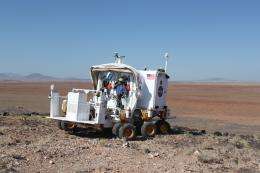
One of two vehicles used in Desert RATS. In addition to the 'science backroom' at ESTEC, ESA had a robotic expert Frédéric Didot in Arizona and a mission control expert Paul Steele at NASA's Johnson Space Centre. Steele also acted as CapComm during the operations. Credits: ESA - F. Didot

Earlier this month, European scientists linked up with astronauts roaming over the surface of an asteroid. Desert RATS, NASA’s realistic simulation of a future mission, this year included a European dimension for the first time.

It was not really an asteroid, but a desert near Flagstaff in Arizona, USA. Since 1999, scientists, astronauts and engineers from various NASA establishments and universities have gathered once a year to simulate human missions to the Moon and Mars.

– Desert Research and Technology Studies – have tested rovers, habitats, spacesuits, instruments, robots, communication systems, research methods and other technical, scientific and operational aspects of future missions.

These realistic ‘missions’ in extreme environments help to guide planning for future space exploration and build valuable experience in complex operations.  

Fly me to an asteroid
 
This time, the crew of astronauts and geologists ‘landed’ on a nearby asteroid and ventured out on field trips – by foot and on two Space Exploration Vehicles.

For two weeks, the crew lived in a Deep Space Habitat with realistic radio links to their mother craft and mission control on Earth.
Exploring an asteroid with the Desert RATS
Enlarge

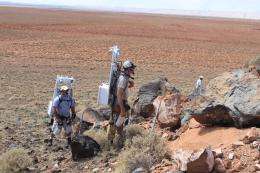
Desert RATS field trip by an astronaut and geologist. The space suits were not used on these "spacewalks" this year. Credits: ESA - F. Didot

They had to cope with a two-way communications delay of 100 seconds with Earth, and limited bandwidth.

Reproducing the low gravity on an asteroid was impossible, but the ‘spacewalkers’ acted as though they were on a small body.

For instance, they had to attach themselves to the ground when they used their hammers to take geological samples – otherwise, the recoil would have sent them spinning into space.

Europe comes aboard
 
In last year’s DRATS, William Carey, an ESA specialist in future exploration operations strategies, was the only European in Arizona but this year a full science team was active in Europe.

“The simulation is similar to a cricket game: long periods of inactivity punctuated by periods of intense concentration,” explained William, referring to the long preparations.

“When the extravehicular activities began, everyone’s hearts started to beat faster.”

This was especially so in the two ‘science backrooms’, each with a team of scientists and engineers supporting one vehicle and its crew. The European scientists worked in the Erasmus backroom at ESA’s ESTEC technical centre in Noordwijk, the Netherlands which normally support science operations for the ISS.

The team of 11 from Italy, France, the Netherlands, ESA and communicated with the crews out in Arizona, just like a backroom would on a real asteroid mission.
“These scientists were the backup eyes and the extra brain power of the crew,” said Sylvie Espinasse, coordinator for the undertaking in ESA.

“Operating with access to real-time audio and video feeds, we could monitor astronauts and geologists in the field and communicate with them taking into account the delay.”

During the two intense days when ESTEC was online, the team tracked everything on the asteroid surface, observing what the crew was doing, trying to make geological sense of it and helping the explorers to squeeze all they could from the limited spacewalking time.

“I enjoyed this different type of exploration tremendously,” said Goro Komatsu, a field geologist from the International Research School of Planetary Science, Italy.

He was excited when the action was interrupted during the second day by a thunderstorm: “It was very useful to learn how to face the unexpected!”

After all, on a real mission to an , there might be solar storms, hampering communications and forcing the to protect themselves.

Provided by European Space Agency search and more info website

Filter


Move the slider to adjust rank threshold, so that you can hide some of the comments.


Display comments: newest first

omatumr
Sep 25, 2011

Rank: 1 / 5 (3)
It was not really an asteroid, but a desert near Flagstaff in Arizona . . .


Another reminder of the demise of our space science program since Big Brother started manipulating government science in ~1971 to unite nations against an imaginary threat of global climate change. See:

1. Video summary as "Big Brother" took control of science (1961-2011)
http://dl.dropbox...reer.pdf

2. Professor Ian Pilmer's new book, "How to get expelled from school"

http://joannenova...ew-book/

One of few politicians who understands the serious danger facing our formerly free society today, Václav Klaus, President of the Czech Republic wrote the Foreword.

With kind regards,
Oliver K. Manuel
Former NASA Principal
Investigator for Apollo
http://myprofile....anuelo09
jsdarkdestruction
Sep 27, 2011

Rank: 5 / 5 (1)
since your just posting the same garbage once again oliver I'll say it again-
so since ethelred called you out its now "big brother" and not kissinger and mao? were you hoping no one would notice you were wrong again? I've seen you do this multiple times now. Why not just admit you were wrong oliver?
rsklyar
Oct 02, 2011

Rank: not rated yet
Plagiarism in a "family" style
How young ambitious capos and soldiers from Italian Institute of Technology (IIT) under supervision of a decrepit american don-godfather from Northwestern University are successfully completed their sequential plagiaristic enterprise: http://issuu.com/...saivaldi
Rank 5 /5 (1 vote)
Relevant PhysicsForums posts
  • Distance of planets from stars and revolution
    created3 hours ago
  • revamping general concept and cosmological principle
    createdMay 25, 2012
  • Transiting Exoplanet Light Curve
    createdMay 25, 2012
  • Math behind Theoretical Physics
    createdMay 24, 2012
  • Do we know whats at the center of galaxies yet?
    createdMay 23, 2012
  • Structure of the Milky Way?
    createdMay 20, 2012
  • More from Physics Forums - General Astronomy

More news stories

Land and sea species differ in climate change response: study

(Phys.org) -- Marine and terrestrial species will likely differ in their responses to climate warming, new research by Simon Fraser University and Australia’s University of Tasmania has found.

Space & Earth / Environment

created 1 hour ago | popularity not rated yet | comments 1 | with audio podcast

Yale study concludes public apathy over climate change unrelated to science literacy

Are members of the public divided about climate change because they don't understand the science behind it? If Americans knew more basic science and were more proficient in technical reasoning, would public consensus match ...

Space & Earth / Environment

created 3 hours ago | popularity 4 / 5 (1) | comments 10 | with audio podcast

10 million years needed to recover from mass extinction

It took some 10 million years for Earth to recover from the greatest mass extinction of all time, latest research has revealed.

Space & Earth / Earth Sciences

created 3 hours ago | popularity not rated yet | comments 1 | with audio podcast

Sophisticated simulations predict future warming

The chances of our planet being hit by a global warming of 3 degrees Celsius by 2050 is as likely as it being hit by an increase of 1.4 degrees, new research shows. Presented in the journal Nature Geoscience, the British study ...

Space & Earth / Earth Sciences

created May 22, 2012 | popularity 4.4 / 5 (9) | comments 51

Aliens don't want to eat us, says former SETI director

Alien life probably isn’t interested in having us for dinner, enslaving us or laying eggs in our bellies, according to a recent statement by former SETI director Jill Tarter.

Space & Earth / Space Exploration

created May 25, 2012 | popularity 4.4 / 5 (14) | comments 39


'Unzipped' carbon nanotubes could help energize fuel cells, batteries

Multi-walled carbon nanotubes riddled with defects and impurities on the outside could replace some of the expensive platinum catalysts used in fuel cells and metal-air batteries, according to scientists at ...

T cells 'hunt' parasites like animal predators seek prey, study shows

By pairing an intimate knowledge of immune-system function with a deep understanding of statistical physics, a cross-disciplinary team at the University of Pennsylvania has arrived at a surprising finding: T cells use a movement ...

Computer model used to pinpoint prime materials for efficient carbon capture

When power plants begin capturing their carbon emissions to reduce greenhouse gases – and to most in the electric power industry, it's a question of when, not if – it will be an expensive undertaking.

Change in developmental timing was crucial in the evolutionary shift from dinosaurs to birds: study

At first glance, it's hard to see how a common house sparrow and a Tyrannosaurus Rex might have anything in common. After all, one is a bird that weighs less than an ounce, and the other is a dinosaur that ...

Almost half of new vets seek disability

(AP) -- America's newest veterans are filing for disability benefits at a historic rate, claiming to be the most medically and mentally troubled generation of former troops the nation has ever seen.

Nvidia trumpets Tegra 3 phone design wins for 2012

(Phys.org) -- Nvidia’s competitive war paint has a name, Tegra 3. On the heels of Nvidia announcements about lowering costs of its Tegra 3 processors and Nvidia-enabled tablets running Android Ice Cream ...