50 new exoplanets discovered by HARPS
September 12, 2011

50 new exoplanets discovered by HARPS

Enlarge

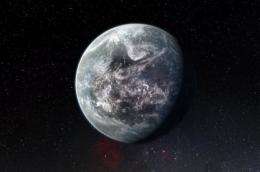
This artist's impression shows the planet orbiting the Sun-like star HD 85512 in the southern constellation of Vela (The Sail). This planet is one of sixteen super-Earths discovered by the HARPS instrument on the 3.6-metre telescope at ESO’s La Silla Observatory. This planet is about 3.6 times as massive as the Earth and lies at the edge of the habitable zone around the star, where liquid water, and perhaps even life, could potentially exist. Credit: ESO/M. Kornmesser

Astronomers using ESO's world-leading exoplanet hunter HARPS have today announced a rich haul of more than 50 new exoplanets, including 16 super-Earths, one of which orbits at the edge of the habitable zone of its star. By studying the properties of all the HARPS planets found so far, the team has found that about 40% of stars similar to the Sun have at least one planet lighter than Saturn.

The on the 3.6-metre telescope at ESO's in Chile is the world's most successful planet finder. The HARPS team, led by Michel Mayor (University of Geneva, Switzerland), today announced the discovery of more than 50 new exoplanets orbiting , including sixteen super-Earths. This is the largest number of such ever announced at one time. The new findings are being presented at a conference on Extreme Solar Systems where 350 exoplanet experts are meeting in Wyoming, USA.

"The harvest of discoveries from HARPS has exceeded all expectations and includes an exceptionally rich population of super-Earths and Neptune-type planets hosted by stars very similar to our Sun. And even better — the new results show that the pace of discovery is accelerating," says Mayor.

In the eight years since it started surveying stars like the Sun using the radial velocity technique HARPS has been used to discover more than 150 new planets. About two thirds of all the known exoplanets with masses less than that of Neptune were discovered by HARPS. These exceptional results are the fruit of several hundred nights of HARPS observations.

Working with HARPS observations of 376 Sun-like stars, astronomers have now also much improved the estimate of how likely it is that a star like the Sun is host to low-mass planets (as opposed to gaseous giants). They find that about 40% of such stars have at least one planet less massive than . The majority of exoplanets of mass or less appear to be in systems with multiple planets.

With upgrades to both hardware and software systems in progress, HARPS is being pushed to the next level of stability and sensitivity to search for rocky planets that could support life. Ten nearby stars similar to the Sun were selected for a new survey. These stars had already been observed by HARPS and are known to be suitable for extremely precise radial velocity measurements. After two years of work, the team of astronomers has discovered five new planets with masses less than five times that of Earth.

"These planets will be among the best targets for future space telescopes to look for signs of life in the planet's atmosphere by looking for chemical signatures such as evidence of oxygen," explains Francesco Pepe (Geneva Observatory, Switzerland), the lead author of one of the recent papers.

One of the recently announced newly discovered planets, HD 85512 b, is estimated to be only 3.6 times the mass of the Earth and is located at the edge of the habitable zone — a narrow zone around a star in which water may be present in liquid form if conditions are right.

"This is the lowest-mass confirmed planet discovered by the radial velocity method that potentially lies in the habitable zone of its star, and the second low-mass planet discovered by HARPS inside the ," adds Lisa Kaltenegger (Max Planck Institute for Astronomy, Heidelberg, Germany and Harvard Smithsonian Center for Astrophysics, Boston, USA), who is an expert on the habitability of exoplanets.

The increasing precision of the new HARPS survey now allows the detection of planets under two Earth masses. HARPS is now so sensitive that it can detect radial velocity amplitudes of significantly less than 4 km/hour — less than walking speed.

"The detection of HD 85512 b is far from the limit of HARPS and demonstrates the possibility of discovering other super-Earths in the habitable zones around stars similar to the Sun," adds Mayor.

These results make astronomers confident that they are close to discovering other small rocky habitable planets around stars similar to our Sun. New instruments are planned to further this search. These include a copy of HARPS to be installed on the Telescopio Nazionale Galileo in the Canary Islands, to survey stars in the northern sky, as well as a new and more powerful planet-finder, called ESPRESSO, to be installed on ESO's Very Large Telescope in 2016. Looking further into the future also the CODEX instrument on the European Extremely Large Telescope (E-ELT) will push this technique to a higher level.

"In the coming ten to twenty years we should have the first list of potentially habitable planets in the Sun's neighbourhood. Making such a list is essential before future experiments can search for possible spectroscopic signatures of life in the exoplanet atmospheres," concludes Michel Mayor, who discovered the first-ever exoplanet around a normal star in 1995.

More information: "The HARPS search for Earth-like planets in the habitable zone, I — Very low-mass planets around HD20794, HD85512, HD192310" (Pepe et al., 2011)

Provided by ESO search and more info website

4.8 /5 (17 votes)  

Filter


Move the slider to adjust rank threshold, so that you can hide some of the comments.


Display comments: newest first

Nanobanano
Sep 12, 2011

Rank: 4.1 / 5 (7)
This planet is about 3.6 times as massive as the Earth and lies at the edge of the habitable zone around the star, where liquid water, and perhaps even life, could potentially exist.


Sigh...

Why do they never mention the real facts that the "habitable zone" varies not just for every star, but for every planet? I mean, the mass of the planet and the mass and composition of the planet's atmosphere change whether or not it would be habitable for any given distance to the parent star.

On a super earth, liquid water is actually easier to maintain because gravity is greater, therefore atmospheric pressures are greater. Thus liquid water would exist at the surface unless the planet was absurdly cold.

A 3.6 earth masses terrestrial planet, assuming similar composition, would have 9763km radius, and therefore 1.533g surface gravity. So if you had the same amount of atmospheric MASS per unit surface area then the pressure would be 1.533 times greater.
Nanobanano
Sep 12, 2011

Rank: 2.8 / 5 (8)
Assuming it isn't a molten ball of lava, it probably has liquid water, even if it is somewhat outside the habitable zone (at least on the cold side) for a 1 earth mass planet.

Although, somewhat paradoxically, I find that Venus would be colder than Mars if it was in the same location as Mars. This probably has something to do with the fact Venus actually has a high albedo.

The point is, every planet is different based on mass, age, and composition. You can't just define the habitable zone by distance from the star.
Nanobanano
Sep 12, 2011

Rank: 2.3 / 5 (3)
It so happens Chad Meyers on the news just said that this planet's average temperature is estimated as 77f...vs Earth's 57.2f...

Not sure how they came up with that number, unless its just a hypothesis based on some assumptions about the atmosphere, maybe they just assumed 1 atmosphere pressure and similar composition to Earth and did a calculation...

Wow, oh my God...

That is a LOT closer to Earth's temperature than I first realized. In fact, that would EASILY make this the most Earth-like planet ever discovered, if the assumption is correct, or even close to correct for that matter.

Probably would be hotter than blazes in the tropical regions and at like 30 degrees north and south though. Daytime surface highs of like 160f seems reasonable in summer? God...Death valley would be a paradise compared to that...

Still, at like 60 north and south it's probably comparable to our 30 north and south on earth, depending on the tilt of the axis of rotation...
HarmVanDorp
Sep 12, 2011

Rank: 4.2 / 5 (5)
The whole habitable zone is based on what our scientist have experienced on earth without even considering what possibilities we have here or elsewhere. On earth all life forms from 4500 to 3500Ma were anaerobic and from 3500 to 2500 Ma photosynthetic life forms appeared and extinct almost all anaerobic life forms via oxigene intoxication. There are life forms completely cosy reproducing in 112c or -70c, there is life form thriving on nuclearing toxic wasted and surviving solely on consuming sulfuric acid and at the ocean floor where pressure is 600 times greater than at the surface and high up in the admosphere exposed to radiation. Unfortunately we know almost nothing about other solar systems let alone about other environmental conditions and its possiblities to adapt, although I wish we would.
yyz
Sep 12, 2011

Rank: 4.8 / 5 (6)
"It so happens Chad Meyers on the news just said that this planet's average temperature is estimated as 77f...vs Earth's 57.2f..."

LOL. Chad Meyers knows a good deal about weather (and a few other topics) but I prefer to get my astronomy news elsewhere......when possible. ;-)

"Not sure how they came up with that number..."

The paper doesn't go into much detail there, but the "computed equilibrium temperature" is given as 298K (=77F), assuming an albedo of 0.3[Sec 5.2 pg. 18]: http://www.eso.or...134a.pdf

Telekinetic
Sep 12, 2011

Rank: not rated yet
And the elephant in the room is- "we're not alone".
Nanobanano
Sep 12, 2011

Rank: not rated yet
Would the James Webb telescope be able to resolve the infrared signature of a planet at this distance as an object distinct from the host star? That would allow a more direct temperature measurement and perhaps give additional clues to the mass, composition, and proper classification of the planet.
TehDog
Sep 12, 2011

Rank: 4.5 / 5 (2)
The whole habitable zone is based on what our scientist have experienced on earth without even considering what possibilities we have here or elsewhere.

English is not your first language I'd guess, but good effort at making some interesting points :)
The question I would ask is, did life originate in these extreme (to us) environments, or adapt to it?
Deesky
Sep 12, 2011

Rank: 5 / 5 (4)
And the elephant in the room is- "we're not alone".

That would be because there is an elephant in the room!
HarmVanDorp
Sep 13, 2011

Rank: 5 / 5 (1)

The question I would ask is, did life originate in these extreme (to us) environments, or adapt to it?

Correct, English is not my first language.
Your question is quite interesting and in my opinion it could be both but it is usually the latter one since environmental conditions in any solar system always changes, the life cycle of the star(s), bombardment, vulcanic activity. I tried to say: A habitable zone depends on what life forms consider habitable. Our planet leaves us astonished sometimes under what conditions organismes thrive, let alone on others.
Telekinetic
Sep 13, 2011

Rank: 5 / 5 (1)
Those who deny the existence of or even the possibility of extraterrestrial life share with the creationist the notion that with the perfection of man, God's work was finished.
Nanobanano
Sep 13, 2011

Rank: not rated yet
Those who deny the existence of or even the possibility of extraterrestrial life share with the creationist the notion that with the perfection of man, God's work was finished.


I think this planet has the POTENTIAL to be habitable to humans (with a bit of technology,) and depending on the atmospheric pressure and composition. The gravity is low enough that FIT humans could still reasonably live there, at least if they don't need space suits.

Because of the calculated temperature ranges, and depending on the tilt of the axis, the tropics are likely uninhabitable regardless of the atmosphere, and the poles would be uninhabitable during summer, so that excluded maybe at least 3/4's of the planets surface from human habitation. BUT the higher lattitudes of the temperate zones, like between 45 and 60 lattitude, maybe, would probably have a climate similar to Earth's tropics.

This planet's tropics would be more extreme than Death Valley, depending on oceans and continents.
Nanobanano
Sep 13, 2011

Rank: 5 / 5 (1)
On the other hand, if the axis is tilted by MORE than 45 degrees it would be the opposite; you'd want to live in the tropics, and the poles would be so extreme from winter to summer that it would be uninhabitable in the temperate and polar regions during Winter and Summer, though you could probably visit in Spring and Autumn with some precautions.

Axis makes a big difference in what part of the planet would be habitable, as does the shape and depths of oceans and topography of continents, because that also influences climate and weather.

Habitability also depends on the rotation speed of the planet. A slower rotation (like Venus or the Moon) introduces another source of temperature extremes as days and nights would be longer.

So that's another "IF".

IF it's rotating at a decent speed, it might be habitable. If not, then day-time highs might be above boiling, and night time lows might be colder than Mars.
antialias_physorg
Sep 13, 2011

Rank: 5 / 5 (5)
A habitable zone depends on what life forms consider habitable.

Yes. We don't even know if life originated above ground or below. It could be that life originated with the extremophiles that feed on radiation and then moved upwards...or it could be that life originated at oceanic vents and then moved upwards (and downwards).

The only real prerequisite for life seems to be:
a) an energy source
b) (maybe) water
c) an environment that is relatively stable and which can support structures (i.e. not something molten or rapidly changing)

There are other energy sources than the sun (the molten part of a planets interior is a vast energy source, as are tidal forces of nearby celestial bodies or deposits of radioactive material).

Under these circumstances water in any phase and within a stable environment can occur anywhere - even on planets that don't even circle a sun!
Rank 4.8 /5 (17 votes)
Relevant PhysicsForums posts
  • Distance of planets from stars and revolution
    created3 hours ago
  • revamping general concept and cosmological principle
    createdMay 25, 2012
  • Transiting Exoplanet Light Curve
    createdMay 25, 2012
  • Math behind Theoretical Physics
    createdMay 24, 2012
  • Do we know whats at the center of galaxies yet?
    createdMay 23, 2012
  • Structure of the Milky Way?
    createdMay 20, 2012
  • More from Physics Forums - General Astronomy

More news stories

Land and sea species differ in climate change response: study

(Phys.org) -- Marine and terrestrial species will likely differ in their responses to climate warming, new research by Simon Fraser University and Australia’s University of Tasmania has found.

Space & Earth / Environment

created 1 hour ago | popularity not rated yet | comments 1 | with audio podcast

Yale study concludes public apathy over climate change unrelated to science literacy

Are members of the public divided about climate change because they don't understand the science behind it? If Americans knew more basic science and were more proficient in technical reasoning, would public consensus match ...

Space & Earth / Environment

created 3 hours ago | popularity 4 / 5 (1) | comments 10 | with audio podcast

10 million years needed to recover from mass extinction

It took some 10 million years for Earth to recover from the greatest mass extinction of all time, latest research has revealed.

Space & Earth / Earth Sciences

created 3 hours ago | popularity not rated yet | comments 1 | with audio podcast

Sophisticated simulations predict future warming

The chances of our planet being hit by a global warming of 3 degrees Celsius by 2050 is as likely as it being hit by an increase of 1.4 degrees, new research shows. Presented in the journal Nature Geoscience, the British study ...

Space & Earth / Earth Sciences

created May 22, 2012 | popularity 4.4 / 5 (9) | comments 51

Aliens don't want to eat us, says former SETI director

Alien life probably isn’t interested in having us for dinner, enslaving us or laying eggs in our bellies, according to a recent statement by former SETI director Jill Tarter.

Space & Earth / Space Exploration

created May 25, 2012 | popularity 4.4 / 5 (14) | comments 39


'Unzipped' carbon nanotubes could help energize fuel cells, batteries

Multi-walled carbon nanotubes riddled with defects and impurities on the outside could replace some of the expensive platinum catalysts used in fuel cells and metal-air batteries, according to scientists at ...

T cells 'hunt' parasites like animal predators seek prey, study shows

By pairing an intimate knowledge of immune-system function with a deep understanding of statistical physics, a cross-disciplinary team at the University of Pennsylvania has arrived at a surprising finding: T cells use a movement ...

Computer model used to pinpoint prime materials for efficient carbon capture

When power plants begin capturing their carbon emissions to reduce greenhouse gases – and to most in the electric power industry, it's a question of when, not if – it will be an expensive undertaking.

Change in developmental timing was crucial in the evolutionary shift from dinosaurs to birds: study

At first glance, it's hard to see how a common house sparrow and a Tyrannosaurus Rex might have anything in common. After all, one is a bird that weighs less than an ounce, and the other is a dinosaur that ...

Almost half of new vets seek disability

(AP) -- America's newest veterans are filing for disability benefits at a historic rate, claiming to be the most medically and mentally troubled generation of former troops the nation has ever seen.

Nvidia trumpets Tegra 3 phone design wins for 2012

(Phys.org) -- Nvidia’s competitive war paint has a name, Tegra 3. On the heels of Nvidia announcements about lowering costs of its Tegra 3 processors and Nvidia-enabled tablets running Android Ice Cream ...